IT Services
Why Bengaluru's Potholes Keep Coming Back: A Camera-on-Every-Garbage-Truck Plan for Finding and Checking Road Repairs
October 12, 2026


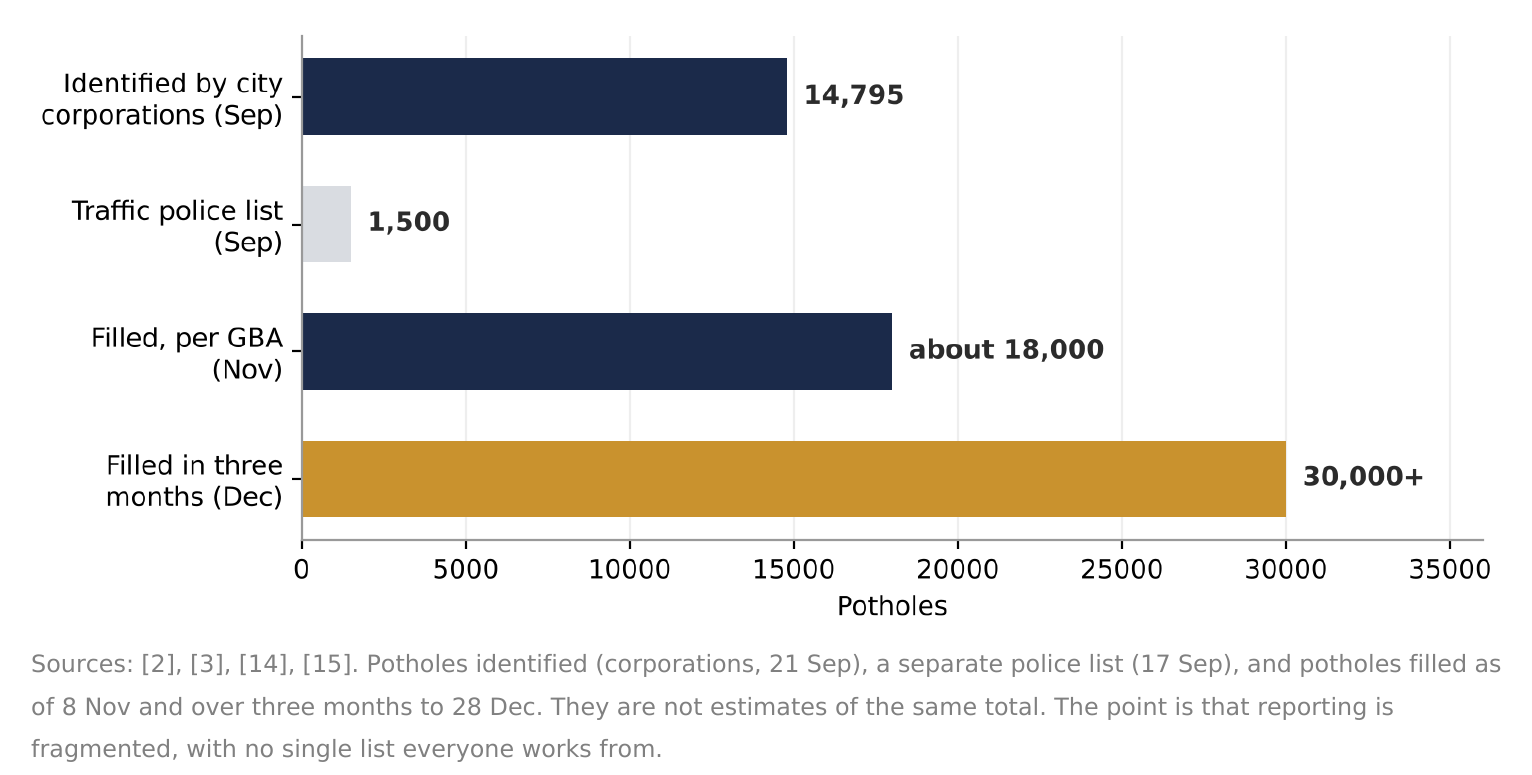
Four pothole figures from one season, each counting something different
Executive Summary
Anyone who rides a two-wheeler in Bengaluru knows how October goes. The rains ease off, the roads are full of holes, and somebody announces a date by which every pothole will be filled. In 2025 that date was October 31. The Chief Minister set it in September and warned that engineers would face action if it was missed [2]. It was missed, and the GBA pushed it to November 10 [15]. Rs 65 crore was set aside only for pothole repairs, and by December the authority said it had filled more than 30,000 potholes in three months [3]. The published figures say how many potholes were filled, but nothing we found says how many of those repairs were still intact a few months later.
The city has records of repair work, but not a reliable picture of how long those repairs last. It mostly manages roads through repair drives and does not keep a running record of their condition. Repairs are set off by complaints, news stories, a list from the traffic police or a deadline. When volunteers went through data from the city’s own FixMyStreet app, they found that most complaints were about narrow neighbourhood roads, while most of the repair money had gone to main roads, often in different parts of the city [5]. Residents were telling the city where the problem was, and the money was going somewhere else.
GBA has started to fix part of this. In July 2026 it announced a GIS-based Road History Platform where every agency has to upload its road works six months in advance [21], and it was reported to be developing a single complaint system, Sahaaya Plus, across agencies [22]. We couldn’t confirm how far either had got by October, so the pilot should start by checking. These record what work is planned and what people complain about. What they don’t record is the actual condition of the road surface, or whether a repair held. That is the gap this case study looks at.
We recommend adding a Road Health Monitoring layer to GBA’s platform. Cameras are fitted to vehicles that already go down almost every street, mainly garbage trucks. Software picks out potholes and cracks from the footage and puts each one on GBA’s road map. Every defect gets a priority score based on how bad it is, how busy the road is and whether a school, hospital or bus stop is nearby. When a contractor fixes it, the next camera pass checks the spot, engineers inspect the larger and disputed repairs, and the bill is cleared once the repair is confirmed. Dangerous potholes keep getting fixed as now while this is tested. The complaint apps would still be used, and their reports would sit on the same map as the camera detections. Jammu has been running camera vehicles for pothole detection since June 2026 [10], Bengaluru itself tried 15 camera vehicles on main roads in 2024 [9], and NHAI surveys more than 20,000 km of highway this way [11].
Our illustrative model puts set-up at about Rs 4.4 crore and running costs at about Rs 3 crore a year for the whole city, both to be firmed up with vendor quotes. Under base-case assumptions the system avoids around Rs 12.6 crore a year of repair spending once fully running. In the downside case it saves only about Rs 1.7 crore a year. Which way it goes depends on two numbers nobody in Bengaluru has measured yet: how much of the pothole budget goes on redoing failed patches, and how much early sealing actually saves on local roads. So we recommend a 14-month pilot in one corporation: about five months to set up and test, then a full monsoon of operation, so that repairs can be checked six months after they are made. Citywide money should only follow if the pilot passes clear tests on coverage, accuracy, contracts and savings.
1. The Challenge
Bengaluru spends a lot on roads. The trouble is that nobody can say with much confidence where that money should go, or whether the work it paid for lasted.
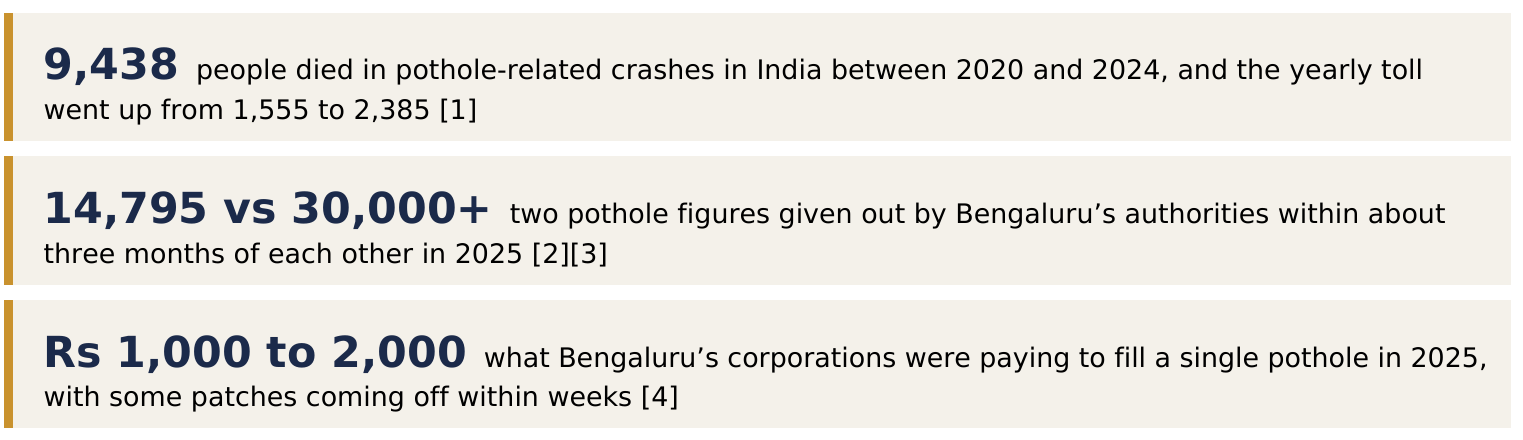
Potholes kill people. Ministry of Road Transport and Highways figures given to Parliament show 9,438 deaths in pothole-related crashes across India from 2020 to 2024, or roughly five a day [1]. In a city where so many people get to work on two-wheelers, a pothole hidden under rainwater at night is a real danger, not an annoyance. Courts have noticed. In October 2025 the Bombay High Court ordered Maharashtra’s civic bodies to pay Rs 6 lakh to the family of anyone killed by a pothole or open manhole, and to recover the money from the officer or contractor responsible [12]. Karnataka has no equivalent order yet, so we haven’t counted it as a financial risk. There is no published breakdown of these deaths for Bengaluru alone, so we haven’t used a Bengaluru-specific figure.
The city has several pothole counts instead of one. In September 2025 the Chief Minister said 14,795 potholes had been found and 6,749 fixed [2]. In November the GBA said close to 18,000 had been filled [15]. By December the number being quoted was over 30,000 in three months [3]. Around the same time the traffic police gave the government its own list of 1,500 [14]. Each of these probably came from a genuine survey. They just came from different people at different times, and there is no sign that anyone was working from a shared list.
Work is planned around deadlines. Last year followed a pattern Bengaluru knows well: complaints pile up, a deadline is announced, it slips, and a new one is set [2][15]. When the target is a number by a date, crews fill as many holes as they can, as fast as they can. Residents saw the results. One pointed out that earlier patchwork on the Outer Ring Road had come off within two or three weeks [4]. Corporations were reported to be paying Rs 1,000 to Rs 2,000 a pothole [4], and a patch that fails that quickly usually has to be paid for again.
The money and the complaints point in different directions. Volunteers from Open City, Janaagraha and Ward Samithi Balaga went through the FixMyStreet data and found that 61% of complaints were about roads narrower than 12 metres. That is a figure about complaints, not about where all the potholes are, but it is a useful signal. Repair spending, meanwhile, went mostly to arterial and sub-arterial roads, and the work orders were bunched up in a different part of the city from the complaints [5]. Main roads get fixed because more people see them. The smaller roads where people actually live tend to wait.
Many agencies dig up the same road. The GBA’s chief commissioner has said water leaks are part of the reason potholes keep coming back [15], and the Chief Minister asked the Metro, the Water Board, BESCOM and the BDA to coordinate better [2]. A trench dug for a pipe or cable and filled in badly is often next year’s pothole. Without a record of who dug a road and when, it is hard to say who should pay to put it right. GBA’s new rule that agencies upload road works six months ahead should help with this [21].
Contractors aren’t on the hook for long. NHAI hands out maintenance contracts that run for several years. 2025 reporting described Bengaluru’s civic road contracts as generally carrying a defect liability period of one year [14], which limits how long a contractor is answerable for a repair. Terms vary by contract, so the pilot’s legal review should confirm them.
Bengaluru already spends heavily on road maintenance. What we couldn’t find in any of the sources reviewed is a consistent record of road condition, or of how long completed repairs last.
What better data can and can’t fix. A camera won’t repair a leaking pipe or a weak road base. What it can do is show where the same spot keeps failing, so that those locations get sent to the Water Board, the drainage team or for full resurfacing instead of being patched again. Nobody knows today what share of Bengaluru’s potholes are repeat failures at the same spot. Finding that out is one of the first things the pilot should do, because it tells the city how much of its pothole budget this approach can actually touch.
2. The Core Problem and Strategic Questions
Speeding up pothole filling doesn’t help with finding damage, choosing what to fix first or checking repairs. The practical questions are:
How can all five corporations work from one up-to-date list of road defects?
How should repairs be ranked, and how much weight should go to how bad the damage is, how busy the road is and what is nearby?
Can small cracks be sealed before the monsoon so that they never become potholes?
Who checks a repair, if not the contractor who did it?
How can this be tried in one part of the city before it is rolled out everywhere?
3. Diagnosing the Opportunity: Why the Apps Haven’t Fixed It
Bengaluru has already tried apps, more than once. FixMyStreet was opened to the public and got close to 2,500 complaints in its first 15 days, of which officials said 1,500 had been resolved [6]. Even early on, users were asking simply to be told what had happened to their complaint [6]. In July 2024 the city launched Raste Gundi Gamana, which added GPS tagging and photos and let officials and the traffic police update progress [7]. Within a few months residents were saying complaints were being closed by passing them on to another department, and a volunteer with a citizens’ group said some engineers closed cases by uploading a photo of a different pothole that had been filled [8]. People using the older Sahaaya app said there was no way to reopen or escalate a complaint once it had been closed [8].
The problem is how the apps collect and close complaints. Three things stand out.
They rely on a citizen to spot the pothole. Someone has to stop, take a photo and file it. Busy roads and well-connected neighbourhoods get reported. Quiet lanes, poorer areas and people who have given up complaining mostly don’t. So the data is lopsided before an engineer ever looks at it.
The person who closes the job is usually the person paid for it. That only works if you can trust everyone in the chain, and a reused photo is easy to slip through.
They handle complaints one at a time. They don’t keep a history of how a road is wearing out, which stretches break every year, or which agency last dug it up. Without that history, the city can only react.
Using city vehicles for the surveys removes the dependence on people complaining. A later camera pass gives a check on repairs that doesn’t rely on the contractor’s photo. And storing detections by location slowly gives the city a history of how each road changes, which it can use to plan work before the rains. Citizen complaints would still be useful, alongside regular camera surveys.
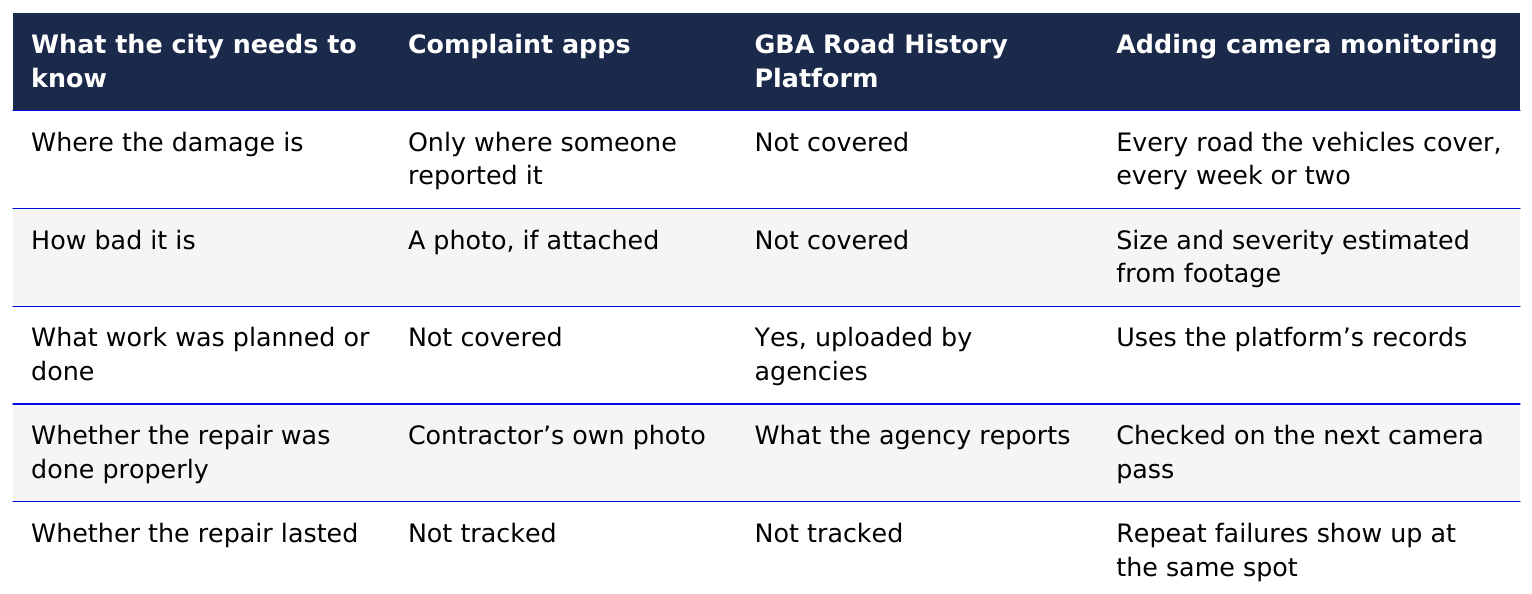
What GBA is already building. Two things changed in 2026. In July the Karnataka government set up a GBA executive committee to cut down repeat road digging, with a GIS-based Road History Platform where the Water Board, BESCOM, the Metro and other agencies must upload work plans six months in advance [21]. GBA was also reported in July 2026 to be developing Sahaaya Plus, a single complaint system covering several agencies [22]. We couldn’t confirm the status of either by October 2026. Both are useful and the proposal is designed to plug into them. But a road history platform records the work that agencies plan and finish. It doesn’t tell you whether the surface is cracking, whether last month’s patch has already come off, or which spots keep failing. A complaint system still depends on someone reporting the problem.
4. The Solution: A Road Health Monitoring System
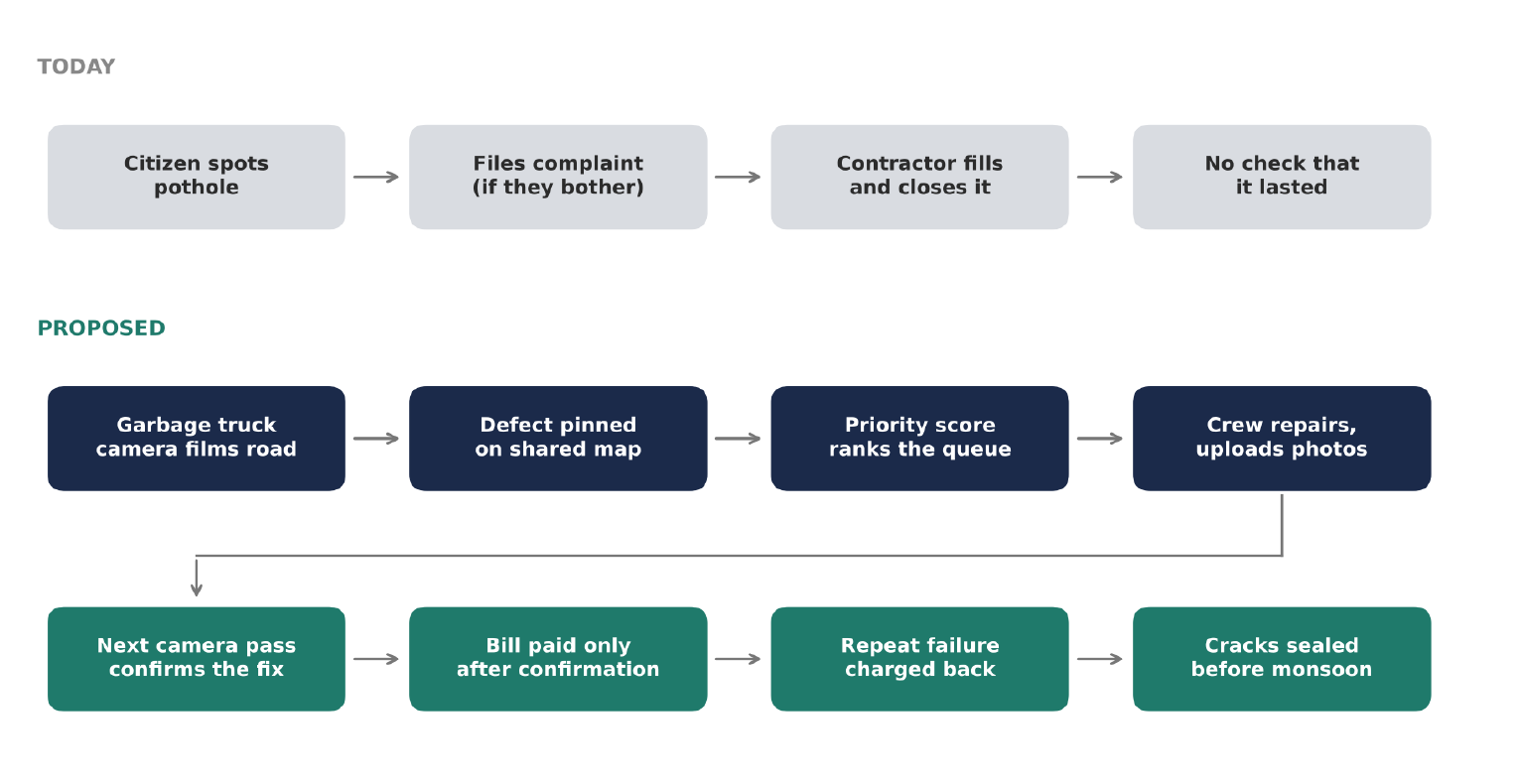
The system would do four things: find damage, decide what to fix first, catch cracks early and check finished work. It runs on top of GBA’s Road History Platform rather than as a separate system.
Road Health Monitoring: who finds the damage, and who checks the fix
4.1 Spotting damage with vehicles the city already runs
Cameras running image-recognition software are fitted to municipal vehicles that cover the city every day anyway. Garbage auto tippers are the main candidate because their job is door-to-door collection, so they go into residential lanes that buses and engineering vehicles never touch. In 2019 the city estimated it needed about 4,200 of them, though officials suspected far fewer were actually on the road [18], and in 2026 a Lokayukta inquiry found 200 to 300 skipping duty on any given day [19]. Nobody has measured how many kilometres of ward road these vehicles actually cover in a week. That is the first thing the pilot should find out, using the GPS logs from the cameras themselves. Engineering department vehicles, and BMTC buses if the transport corporation agrees, can fill the gaps, and a small number of dedicated survey runs can cover whatever is left. The software goes through the footage, marks potholes, cracks and broken patches, estimates how big each one is, and records where and when it was seen.
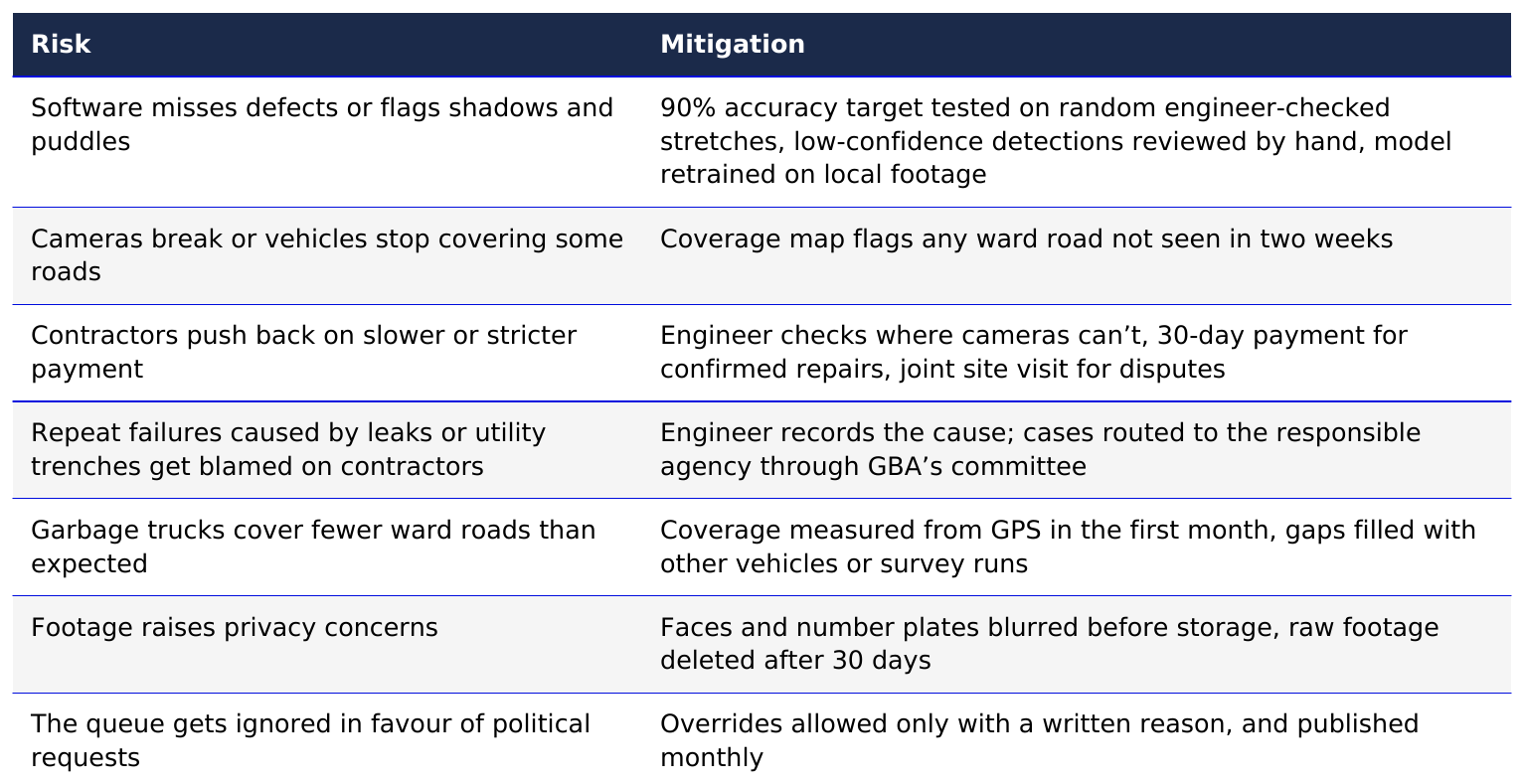
Jammu already does a version of this. Since June 2026 its municipal corporation has had camera-fitted vehicles surveying roads and flagging potholes automatically, along with a Rs 1.3 crore cold emulsion patching machine to fix what they find [10]. Crews there repair around 150 to 200 metres a night once traffic thins out, and the same cameras pick up overflowing bins, waterlogging, open manholes and broken footpaths [10]. Bengaluru put 15 camera vehicles on its arterial and sub-arterial roads in 2024, an idea taken from the Electronics City Township Authority [9]. Accuracy is a fair worry. Water-filled potholes, shadows and night footage can fool the software. RoadMetrics, a Bengaluru-based firm that maps road damage from windshield cameras, reports about 95% detection accuracy across more than 50,000 km of roads, and its system is already used on 419 km of bus routes in Chennai [20]. For the pilot, we would test whether the system can reach 90% on both counts: at least 90% of flagged defects should be real, and it should catch at least 90% of the defects engineers find on a weekly sample of roads. The 90% is our target, not something already proven in Bengaluru. Only detections the software is confident about go straight into the queue. The rest go to an engineer to check. The pilot should test the system on ward roads, where most complaints come from [5], and use camera detections as the main trigger for repairs. Our figure of about 1,200 vehicles for the whole city, roughly a quarter to a third of the auto tipper fleet, is a guess at what it takes to see every ward road every week or two if routes don’t overlap much. The pilot’s GPS data will show whether that is too many or too few.
4.2 One map and one repair queue, inside GBA’s platform
GBA doesn’t need a second map. Everything the cameras find goes onto the GIS platform GBA is already building, as a new layer next to the road works the agencies upload [21]. Complaints from Sahaaya Plus and the older apps go onto the same map [22]. If a complaint and a camera detection are at the same spot they are merged, and any complaint the cameras haven’t confirmed gets checked on the next pass. Each defect then gets a priority score:
Priority = 0.40 (Severity) + 0.30 (Traffic Exposure) + 0.20 (Sensitive Locations) + 0.10 (Recurrence)
Severity is how large and deep the damage is, measured from the images. Traffic Exposure is how many vehicles use that stretch, with extra weight for two-wheelers, based on traffic police and transport data. Sensitive Locations raises the score for anything near a school, hospital, bus stop or ambulance route. Recurrence raises it for spots that have been patched before and broken again, which usually means a leak or a badly filled trench underneath [15].
These weights are our starting guess. They haven’t been tested on real Bengaluru data, so the pilot should try a few versions and settle them with the city’s engineers and the traffic police.
4.3 Catching cracks before they become potholes
Because the same roads are filmed again and again, the city ends up with a running record of each one. A crack that is getting wider every month can be sealed in April or May, before the rain gets into it. Studies from the United States report savings of six to ten dollars in later repairs for every dollar spent sealing a road at the right time, and World Bank modelling puts the cost of bringing a failed road back at roughly four times the cost of keeping it in shape [13]. Those figures come from very different roads, traffic and weather, so we don’t assume they apply in Bengaluru. Our own model uses much lower returns, and the pilot should measure the real one by comparing sealed and unsealed stretches through a monsoon. The aim is to find cracks that are suitable for sealing in April and May, before the monsoon speeds up the damage.
4.4 Checking the work
For every repair, the contractor uploads a before and after photo with its location. The next time a camera vehicle passes that spot, the system checks that the visible damage has gone. A camera can show that a pothole is no longer there. It can’t show whether the right material was used or whether the patch was compacted properly. So the camera handles routine checks, and the ward engineer still inspects in person: larger repairs, a random one in ten of the rest, and any repair no camera has passed within seven days. Once a repair is confirmed, the contractor is paid within 30 days. If the camera and the contractor disagree, a joint site visit settles it within a week. The contractor still submits the usual bills. What changes is the evidence used to decide the work was done. Bengaluru has already talked about an app where contractors upload proof of work [16]. Here the check doesn’t rely only on the contractor’s photo, so a recycled photo won’t get anyone paid [8]. All of these rules need a legal review to see whether they fit current contracts or need new tender terms.
When the same spot keeps failing. A camera can’t fix a leaking pipe or a weak road base, so a repeat failure isn’t automatically the contractor’s fault. If a spot fails again within 12 months of a repair, it is marked on the map and the ward engineer inspects it within seven days, recording the likely cause: a poor patch, a recent utility trench, a water leak, drainage, or a failed road base. The Road History Platform shows which agency last dug that stretch [21], so the case goes to the contractor, to that agency, or onto the resurfacing list. The agency responsible has 30 days to act or explain why not, and open cases go to GBA’s monthly executive committee meeting [21]. Without this step the system would only record the same failures more accurately.
4.5 Designing it with the people who do the work
Contractors. Many road repair contractors are small firms that wait months for bills to clear. Closer checks on payment only work if the checks are quick. We suggest a rule that confirmed repairs are paid within 30 days, so contractors get something in return for being checked more closely.
Garbage truck crews. The cameras should need nothing from the driver. They switch on with the ignition and upload over the mobile network. The crew’s route should not change to suit the survey.
Ward engineers. The queue gives engineers a written basis for which roads they pick, which helps when a local representative pushes for a particular road. They should be able to override the score with a written reason, since they will know things the data doesn’t.
Residents. People should be able to see the map, check when their road was last surveyed and look up a repair. Complaints still go in through the existing apps and land on the same map.
Who owns the data. Street-level footage captures faces, number plates and homes. The GBA should own the data, blur faces and plates before anything is stored, keep raw footage only for a short period, for example 30 days, and keep only the defect records beyond that.
4.6 What is actually new here
Camera-based road surveys, automated pothole detection and repair monitoring already exist in India. NHAI requires survey vehicles to check highway condition when a project is finished and every six months after, and it is sending 3D laser survey vehicles over 20,933 km in 23 states, with the data analysed on its own portal to plan maintenance [11]. Jammu combines camera detection with machine patching at city level [10]. Bengaluru already has camera vehicles and complaint apps [7][9]. What this proposal adds is combining them with the city’s road-work records and a repair check linked to payment. Our review didn’t find a documented example combining these with repair checks tied to contractor payment on municipal ward roads. GBA should check this with the Urban Development Department before finalising the pilot.
5. Strategic Options
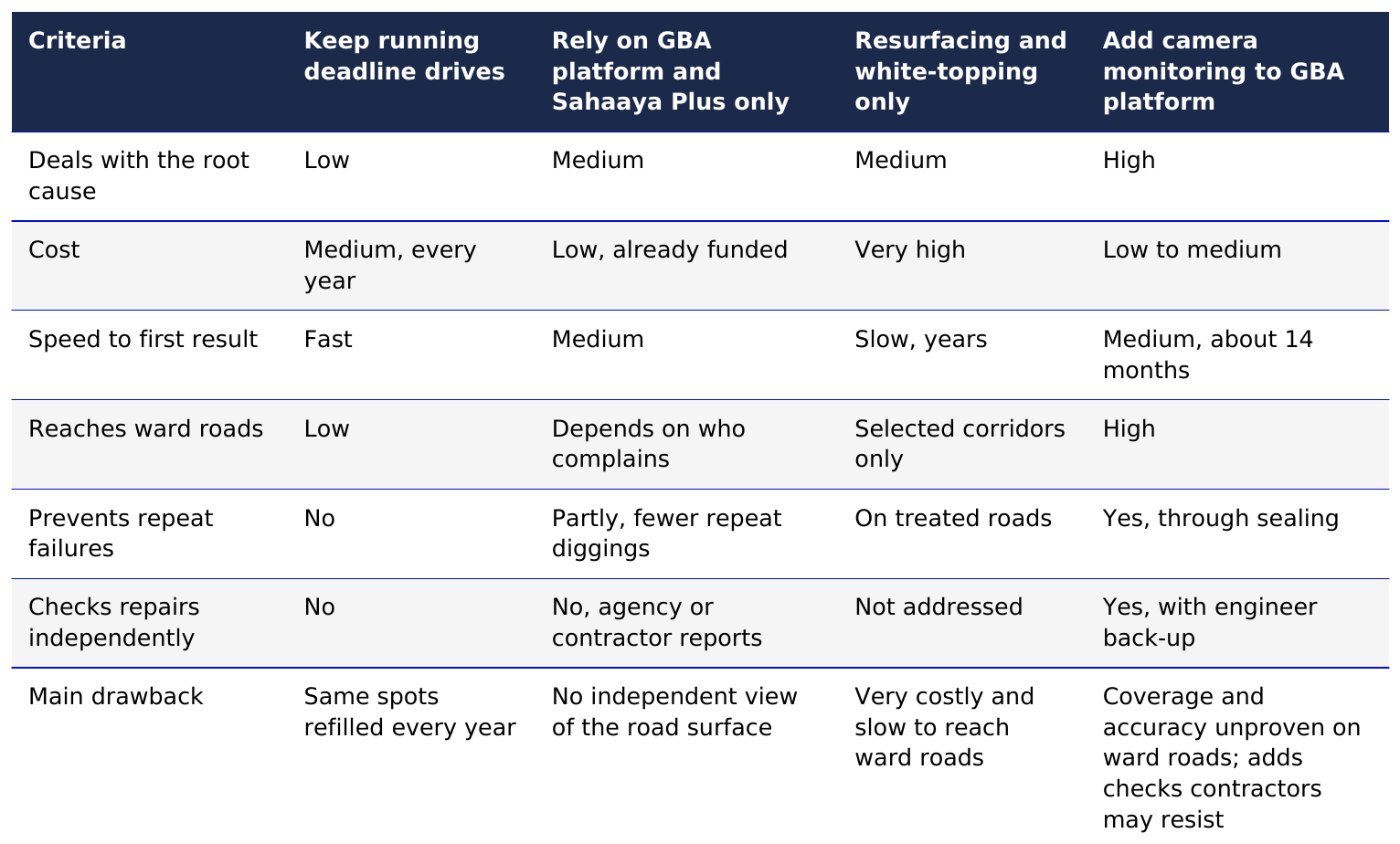
The ratings are a qualitative judgement, not a scored exercise. High means the option clearly addresses that criterion on its own, Medium means it helps partly or only on some roads, and Low means it does little or nothing. Deadline drives get quick, visible results, but last year showed the downside: missed dates, complaints about quality and patches coming off within weeks [4][15]. GBA’s own platform and Sahaaya Plus should cut down repeat digging and lost complaints [21][22], but they still depend on agencies reporting their work and citizens reporting damage, so nobody is independently looking at the road itself. Resurfacing and white-topping, like the 141 km white-topping programme estimated at Rs 1,700 crore [3], make sense for big corridors, but they will never reach every ward road and don’t help decide or check day-to-day repairs. Of the four options assessed, camera monitoring offers the most complete combination of ward-road coverage, prevention and repair checks, though it carries its own risks on coverage and accuracy. It also costs least when added to what GBA is already building, and it would help decide where the resurfacing money goes.
6. The Investment Case
Bengaluru doesn’t need a new road budget for this. In 2025 the city set aside Rs 65 crore for pothole repairs alone, Rs 694 crore for asphalting and about Rs 1,700 crore for white-topping [3], and the state announced another Rs 1,100 crore for city roads after a school bus accident linked to potholes [17]. In June 2026 the state also approved Rs 2,000 crore for 654 road works across the city’s 28 constituencies, mostly asphalting neighbourhood roads [23]. The question is whether a few crore spent on knowing where to work saves more than it costs. The answer depends on whether the system can stop enough repeat repairs and make early sealing worthwhile, and neither has been measured in Bengaluru yet.
What it costs. We estimate the citywide cost using about 1,200 vehicles. The unit costs are ICG estimates, and every line should be replaced with vendor quotes during procurement.
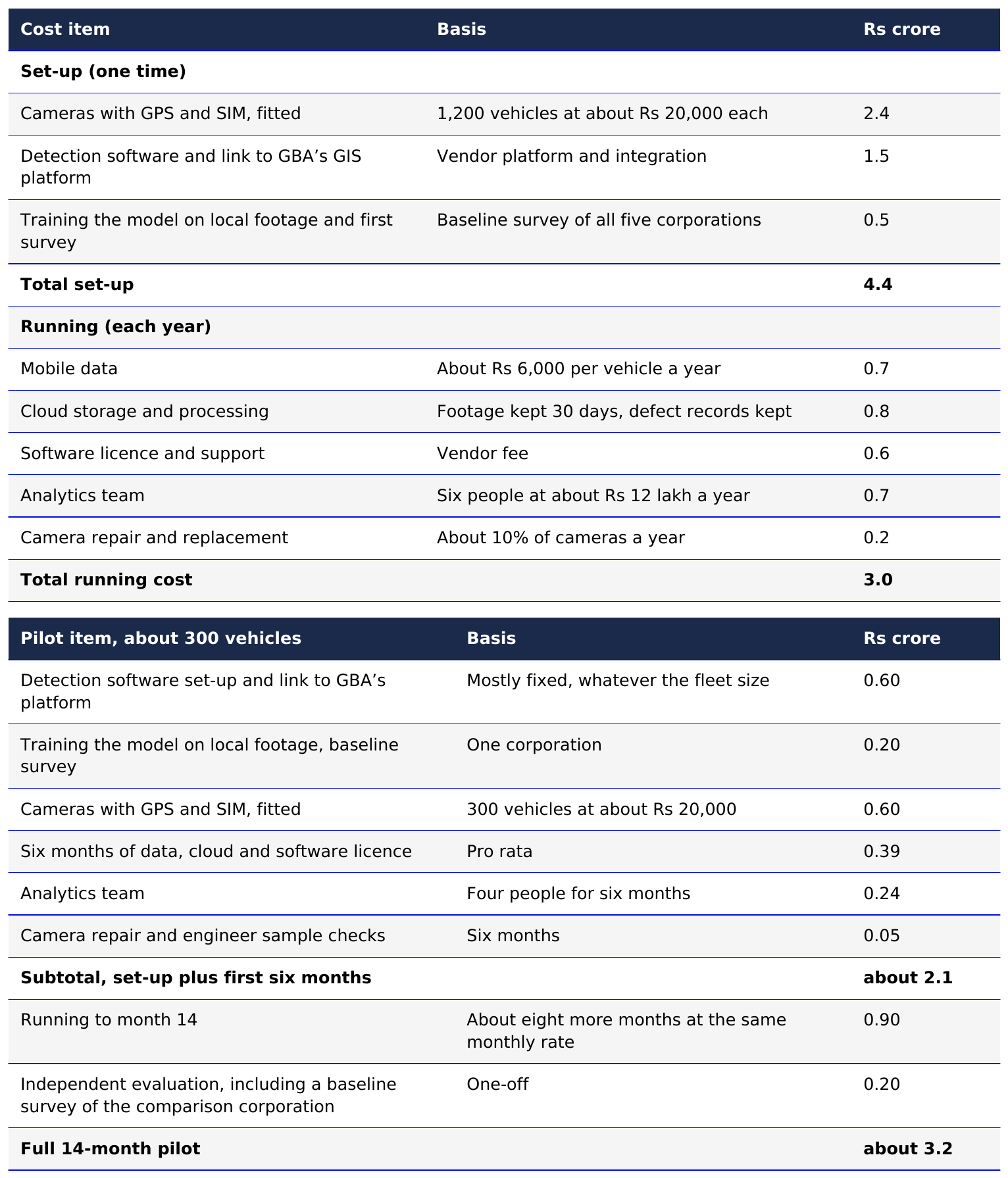
The full 14-month pilot comes to about Rs 3.2 crore. Fixed costs like software integration make it dearer per vehicle than the citywide rollout. All lines are ICG estimates to be replaced with vendor quotes.
Where the savings come from. We model two savings separately. The first is money moved from emergency pothole filling into sealing cracks before the monsoon, which avoids bigger repairs later. The second is fewer patches paid for twice, because every repair is checked. We apply the second saving only to the part of the budget still spent on pothole filling after the move to sealing.
We take Rs 65 crore as the reactive pothole budget because that is what Bengaluru allocated in 2025 [3]. That is only the 2025 figure. In later years the savings would scale with whatever the city actually spends on pothole repairs. We have deliberately left the much larger asphalting budgets, like the Rs 2,000 crore approved in 2026 [23], out of the model, even though better data on road condition should help decide where that money goes too. We have also cut the return on sealing well below the international figures, to between 1.5 and 4 rupees for every rupee spent.
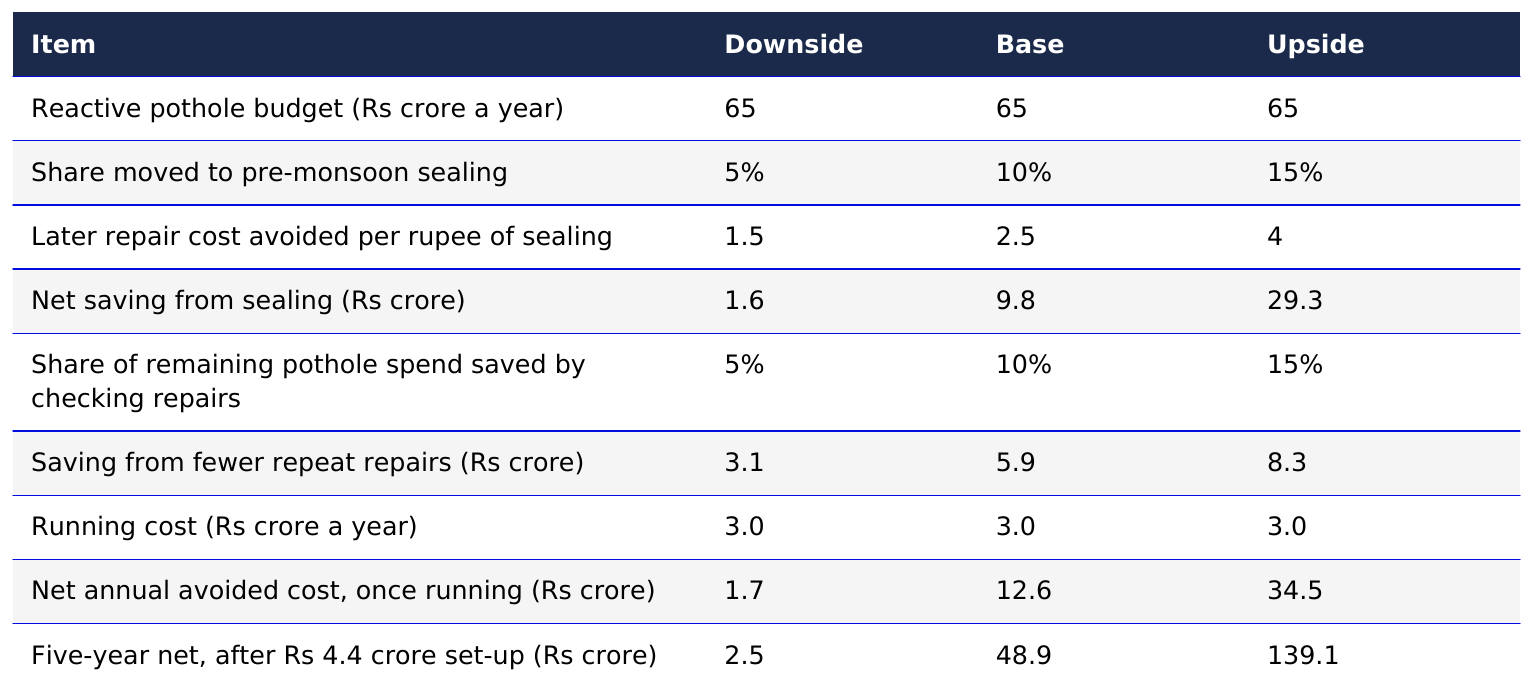
Running cost is kept at Rs 3 crore in all three cases so that only the savings change. If it comes in at Rs 4 crore, every yearly figure falls by Rs 1 crore and the downside case no longer repays its set-up cost within five years.
Net avoided cost per year once running (not the five-year figure)
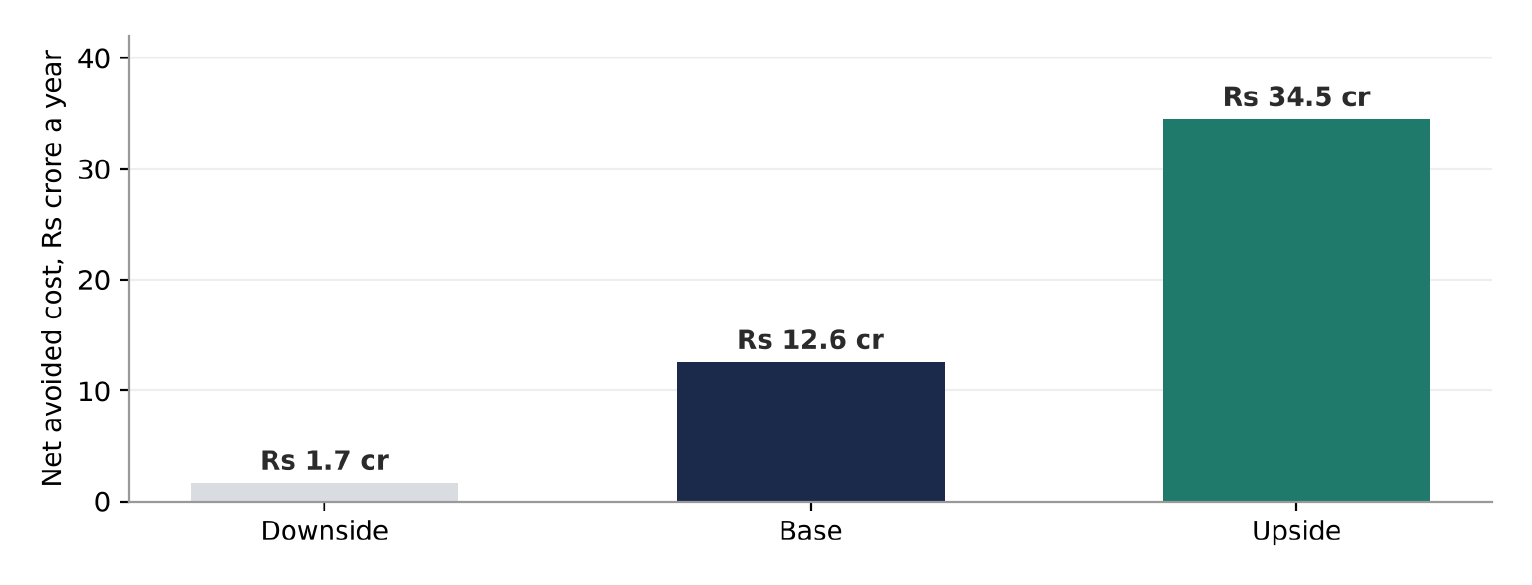
The five-year figures assume sealing savings only start in the second year, since the first year is spent building up road history. In the base case the system avoids about Rs 12.6 crore a year and repays its set-up cost early in the second year. In the downside case it takes until the fourth year.
A simpler test is how much repeat-repair spending the system needs to stop to cover its running cost. Leave sealing out completely. If checking repairs stops just over 5% of the remaining pothole budget, about Rs 3 crore, from being spent on redoing failed patches, the system covers its running cost from that alone. Residents have reported patches failing within weeks [4], but nobody knows the actual repeat-repair rate. This is a benefit the pilot has to measure, not one we can assume.
A note on what these numbers mean. They are estimates of repair spending avoided, not cash that disappears from the GBA’s budget. In practice the money would more likely go on fixing more roads than be handed back. The repeat-repair share, the sealing share and return, and every cost line are ICG planning assumptions, and the whole table should be rerun after six months of pilot data. We haven’t put a figure on fewer injuries and deaths, less damage to people’s vehicles, or the risk of a compensation order like Maharashtra’s [12], though all three matter.
7. Implementation Operating Model
How success will be measured. The number of potholes filled tells you very little, because a city can fill the same pothole three times a year. The pilot should report five measures every month:
Repair survival rate: the share of repairs still intact six months later, tracked by camera and checked by engineers on a random sample. It is measured on repairs made in months 6 to 8, so their six-month mark falls inside the pilot
New defects per kilometre of road surveyed
Median days from first detection to confirmed repair
Share of the zone’s ward-road length seen at least once every two weeks, rising to weekly
Cost per repair that lasts, not per repair done
Testing accuracy properly. To know how many potholes the software misses, engineers have to check road it didn’t flag as well. Each week they would inspect about 50 randomly chosen 200-metre stretches in the pilot zone and compare what they find with what the system found. Two numbers are reported separately: the share of flagged defects that are real, and the share of real defects the system caught. Both are also broken down by severity, because missing a deep pothole matters far more than missing a hairline crack. We suggest a stricter target for severe potholes, catching at least 95% of them.
A fair comparison. The pilot zone is compared both with its own baseline before the pilot and with a second corporation of similar road length, traffic, drainage problems and pothole budget, which keeps working the usual way. Rainfall differences between the two should be noted when reading the results.
Risks and mitigations
8. What Government Needs to Do, and Who Needs to Do It
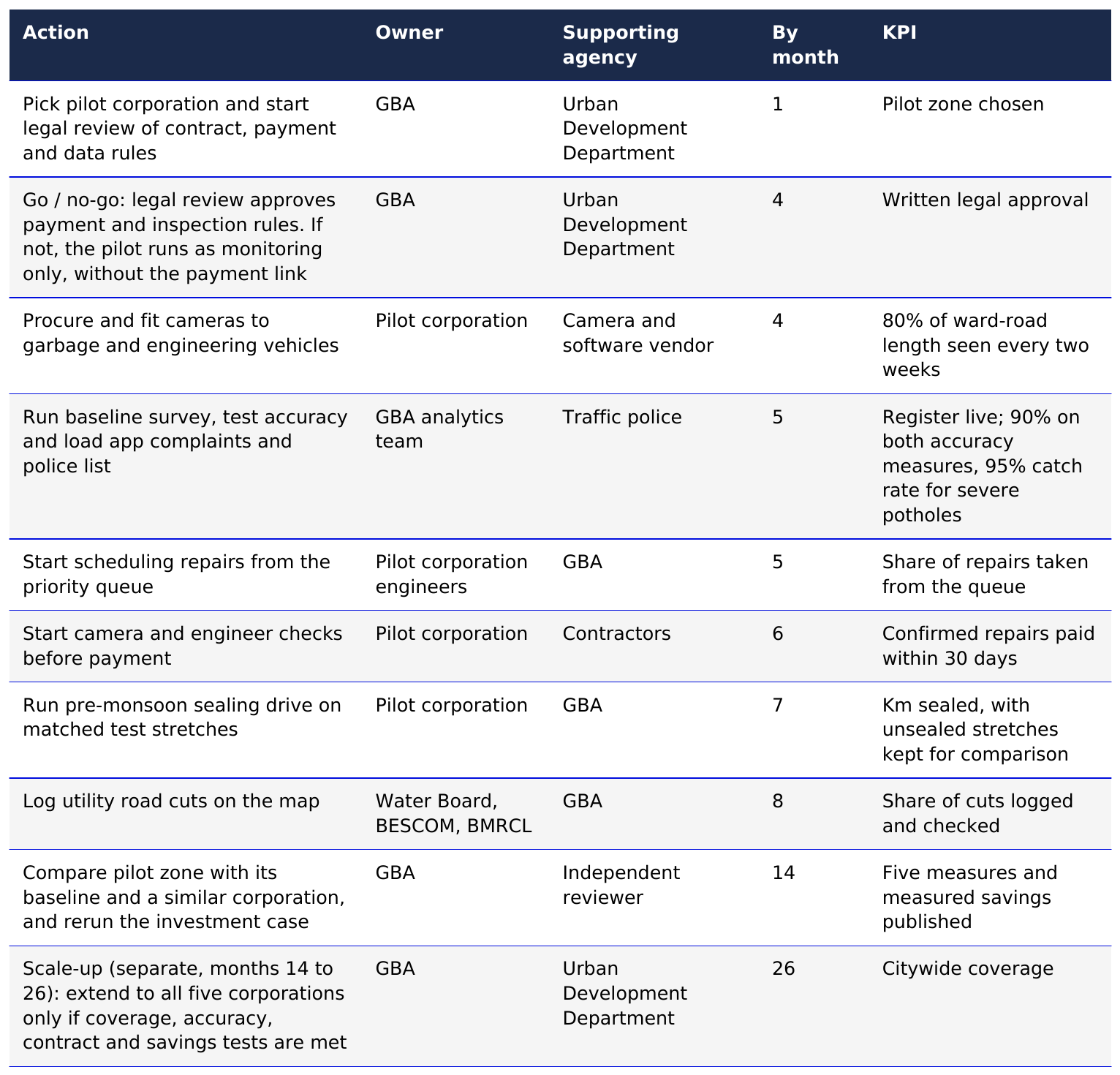
GBA and the five city corporations could lead the pilot using existing teams, subject to confirming procurement, data access and contract terms. A legal review has to approve the payment and inspection rules before they are used.
Greater Bengaluru Authority already runs the citywide pothole drives [3][15], so it should own the shared map and the priority score, set common rules for how damage is found, ranked and checked, and publish the five measures each month.
The five city corporations would run things day to day in their own areas: fitting cameras, scheduling repairs from the queue and holding contractor payments until a repair is confirmed. We haven’t checked whether camera-linked payment can be added to current contracts or needs new tender terms, so that should be one of the first things looked at.
The Urban Development Department, Government of Karnataka should look at extending the defect liability period on road repairs beyond one year [14]. Without that, the city will know which repairs failed but won’t be able to do much about it.
The Water Board, BESCOM and Bangalore Metro Rail Corporation should each log every road cut on the shared map and be responsible for putting the road back properly. This is the coordination problem the Chief Minister raised himself [2].
Bengaluru Traffic Police should feed their pothole reports and accident data into the same map instead of keeping a separate list [14], and help weight the priority score towards the most dangerous stretches.
Suggested timeline. Procurement, fitting cameras and testing accuracy will realistically take four to five months. The pilot would then run through one full monsoon, with results in about fourteen months. That gives the city a full monsoon in which to see how repairs hold up before it decides whether the results justify expanding. Scale-up would take roughly another year.
9. Final Recommendation
Bengaluru should test year-round road monitoring instead of relying mainly on pothole drives after the monsoon.
Bengaluru often learns about road damage through complaints, and its current reporting doesn’t consistently show whether repairs have lasted. Dangerous potholes still need fixing as they appear. GBA’s new road history platform will show what work was planned and done. Adding camera checks from vehicles already moving around the city would show what condition the roads are actually in, for about Rs 3 crore a year to run. We don’t think the city should take our savings estimate on trust. It should run the pilot, measure the repeat-repair rate and the real return on sealing, and decide from there. GBA should consider expanding the system only if the pilot shows reliable coverage, acceptable detection accuracy, workable checking and payment rules, and savings that justify the cost.
Sources and Methodology
Numbers in brackets in the text above correspond to the sources below.
Pothole-related deaths in India, 2020 to 2024 (9,438 total; 1,555 in 2020 and 2,385 in 2024): Ministry of Road Transport and Highways data tabled in Parliament, reported by The Logical Indian.
Chief Minister’s October 31 deadline, 14,795 potholes identified and 6,749 fixed, and call for coordination between agencies: ETV Bharat, “Fix potholes in Bengaluru by Oct 31, else engineers will face action”, 21 September 2025.
GBA’s Rs 65 crore pothole allocation, more than 30,000 potholes filled in three months, Rs 694 crore asphalting and Rs 1,700 crore white-topping of 141 km: Deccan Herald, “At Rs 5,500 crore spend, can Bengaluru build roads that last?”, 28 December 2025.
Quality concerns over rushed pothole filling, patches coming off within two to three weeks, and Rs 1,000 to Rs 2,000 spent per pothole: Deccan Herald, “GBA’s rush to fill potholes sparks quality concerns across Bengaluru”, 26 September 2025.
FixMyStreet data showing 61% of complaints on roads under 12 metres and a mismatch with work orders: Open City, Janaagraha and Ward Samithi Balaga data exercise, reported by Deccan Herald.
FixMyStreet receiving close to 2,500 complaints in 15 days: Deccan Herald.
Launch of the Raste Gundi Gamana app: Deccan Herald, 28 July 2024.
Resident and citizen group accounts of app complaints closed without repair, and the Sahaaya app’s lack of reopening or escalation: Deccan Herald, “BBMP’s Fix Pothole mobile app ineffective, say residents”.
Bengaluru’s deployment of 15 camera-fitted vehicles, modelled on the Electronics City Township Authority: Deccan Herald, 27 May 2024.
Jammu Municipal Corporation’s AI-based road monitoring, Rs 1.3 crore cold emulsion patching machine and nightly repairs of 150 to 200 metres: JMC press releases, 9 June 2026 and 30 June 2026.
NHAI’s network survey vehicle programme across 20,933 km in 23 states and its six-monthly survey requirement: NHAI press release, 22 October 2025.
Bombay High Court order of 13 October 2025 fixing Rs 6 lakh compensation for pothole deaths, recoverable from responsible officials or contractors: LiveLaw.
Returns of $6 to $10 per $1 spent on pavement preservation (Federal Highway Administration; National Center for Pavement Preservation) and the World Bank deterioration model estimate of around four times: US DOT National Transportation Library technical summary; Asphalt Magazine.
Traffic police list of 1,500 potholes and the one-year defect liability period in Bengaluru civic road contracts: Deccan Herald, 17 September 2025.
Missed October 31 deadline, new November 10 target, close to 18,000 potholes filled, and water leakage cited as a cause: Deccan Herald, 8 November 2025.
Planned PACE app with contractor-uploaded proof of repair and automated billing: Deccan Herald.
Rs 1,100 crore state allocation for Bengaluru roads after a pothole-linked school bus accident: The Logical Indian, September 2025.
Bengaluru needing about 4,200 garbage auto tippers, with officials suspecting far fewer were deployed: The News Minute, 2 May 2019.
Lokayukta finding that 200 to 300 garbage vehicles skip duty on any given day: Deccan Herald, 10 June 2026.
RoadMetrics windshield-camera road mapping, about 95% detection accuracy, 50,000+ km mapped and use on 419 km of Chennai bus routes: NITI Aayog Frontier Tech Hub, June 2025 (company-reported figures).
GBA executive committee to curb repeat road digging and the GIS-based Road History Platform requiring agencies to upload work plans six months in advance: The South First, 3 July 2026; GBA’s unified GIS platform with road histories and citizen pothole reporting: Open magazine, “Mapping Bengaluru’s Civic Memory”, 23 July 2026.
Sahaaya Plus, GBA’s single complaint system across agencies: Deccan Herald, “Single window system to track civic complaints across agencies”, 10 July 2026.
Rs 2,000 crore for 654 road works across 28 constituencies, mostly neighbourhood asphalting: Deccan Herald, 24 June 2026.
The priority score weights in Section 4.2, the 90% accuracy target, and in Section 6 every unit cost, the repeat-repair saving and the sealing share and return, are ICG planning assumptions and not measured figures. The pilot budget is also an ICG estimate. The inspection, payment, repeat-failure and footage rules are proposals for the pilot to test.
Cover photo: "Roads deformed T munnekollala Bengaluru" by Gangaasoonu, CC BY-SA 4.0, via Wikimedia Commons.