Water & Sanitation
Where Does Raebareli's Septage Go? A Tank-to-Plant Manifest for Uttar Pradesh's Underused Treatment Plants
October 6, 2026

Client: Nagar Palika Parishad Raebareli, with the Department of Urban Development, Uttar Pradesh (AMRUT and SBM-Urban 2.0) and the Uttar Pradesh Pollution Control Board
Engagement: Design a low-cost way to make sure septage emptied from homes and institutions actually reaches the town's 32 KLD faecal sludge treatment plant
Key Decision: Should Raebareli make a closed, verified tank-to-plant trip record a condition of every desludging licence, and link government desludging work to it
18 of 55 faecal sludge and co-treatment plants in Uttar Pradesh were running at 20 percent of capacity or less in April 2025, with Raebareli named among the towns unable to fill its plant [1]
10 to 20% share of monthly tanker trips that registered private operators in Uttar Pradesh take to a treatment plant, according to a CSE field study of 11 towns including Raebareli [3]
5,000 people: one 5,000 litre tanker of septage dumped in the open carries the same load as 5,000 people defecating in the open [8]
Executive Summary
Raebareli has already paid for the hard part of safe sanitation. The town has a 32 kilolitre per day faecal sludge treatment plant, built under AMRUT, handed over to the municipality, and now run by a team of women from local self-help groups [4][12]. What the plant does not have is sludge. A field survey by the Centre for Science and Environment (CSE) placed Raebareli among the plants receiving no sludge in January 2023, and a 2025 CSE study found that Raebareli still could not fill its treatment units, in part because private tanker operators often empty their loads into open fields and drains to save time and cost [2][4].
This is an incentive and record-keeping problem, not a question of intent. Our estimate suggests that driving a full tanker to the plant instead of the nearest drain can cost an operator Rs 336 to Rs 504 in extra fuel and running cost, against an average margin of about Rs 417 a trip in Raebareli [3]. And once a tank is emptied, nobody records where the load goes. The household pays and moves on. The plant only sees the trucks that choose to arrive.
We recommend that Raebareli adopt a Tank-to-Plant Manifest: every job gets a trip number when it is booked, the tanker's outlet is sealed with a numbered tag at the household, and the trip only closes when the plant confirms the seal is intact, the GPS route is clean and the volume received matches the volume collected. GPS proves where the vehicle went; the seal and the volume check prove where the sludge went. A payment of about Rs 400 per verified load closes most of the cost gap that makes dumping rational today, compliant operators get first access to the government-paid institutional desludging that Uttar Pradesh's 2024 guidelines already require, and repeated failures lead to fines and licence suspension, following the precedent set in Gonda [2][7]. The full first-year cost, including the payment, is about Rs 8 to 9 lakh, well below the Rs 17 to 23 lakh a year it costs to run a 32 KLD plant that currently sits largely idle [3]. The headline measure of success is the verified compliant disposal rate: the share of desludging trips that end with a confirmed, full delivery at the plant.
1. The Challenge
Uttar Pradesh has moved faster than most states in building faecal sludge treatment. More than 700 of its towns rely on septic tanks and pits rather than sewers, and the state has built over 50 faecal sludge treatment plants (FSTPs) and co-treatment facilities to serve them [1]. The problem is that a large share of that capacity is not being used.
The state's plants are running far below capacity. As of April 2025, 15 of 36 FSTPs and 3 of 19 co-treatment plants in Uttar Pradesh were operating below 20 percent of their capacity [2]. A plant designed to treat 32,000 litres a day that receives a few thousand litres is an asset that has been paid for but is not protecting anyone's health.
Raebareli is one of the clearest cases. CSE studied four towns with identical 32 KLD plants: Raebareli, Sitapur, Shikohabad and Gonda. Shikohabad and Gonda recorded steady inflows. Raebareli and Sitapur could not fill their treatment units [1]. In its January 2023 field survey, CSE listed Raebareli among the fully built plants receiving no sludge at all, even though it was one of only three FSTPs in the state that had already been formally handed over to the municipality [4].
The sludge exists, but it is going somewhere else. CSE found that in Raebareli and Sitapur, private operators often dump the waste in open fields or drains to save time and cost [2]. A separate CSE field study across 11 towns, Raebareli among them, found that operators usually decant within two to three kilometres of the household, sometimes work before municipal offices open at 10 am or on holidays to avoid being caught, and that even registered operators take only about 10 to 20 percent of their monthly trips to a treatment plant [3].
Raebareli depends heavily on septic tanks. The last published service-level benchmark for the town put sewer network coverage at about 32 percent in 2012-13, and a 2014 baseline study noted that sewage from the existing network reached the river untreated [5]. The town had 35,197 households in the 2011 Census [6]. Toilet coverage has risen sharply since then under the Swachh Bharat Mission, which means more homes now depend on a septic tank that will one day need emptying. These figures are dated, and a current household survey is one of the first things this engagement recommends.
Where the sludge ends up matters. Raebareli sits on the Sai river, a tributary of the Gomti, which in turn flows into the Ganga [16]. Sludge poured into open drains follows the town's drainage towards the river, and sludge dumped on open land can seep into groundwater and drinking water sources [2]. Each full tanker dumped in the open carries the load of roughly 5,000 people defecating in the open [8], which works against what the town gained by becoming open defecation free.
The rules to prevent this exist on paper but not yet in practice. Uttar Pradesh's 2019 septage management policy provides for city-level bye-laws covering operator registration, fees and penalties. As of January 2023, only 2 of the 59 towns with treatment plants had gazetted such bye-laws, and Raebareli was not one of them [4].
Taken together, this is not an infrastructure gap. Raebareli has the plant and the people to run it. What it lacks is any record of where each emptied load goes, and any reason for an operator to make the longer, costlier trip.
2. The Core Problem and Strategic Questions
The task is not to build more treatment capacity or to buy more vehicles. It is to make the path from a household's septic tank to the plant's gate visible and worth taking. The questions that matter are:
How much septage is Raebareli actually emptying, and how much of it reaches the plant today.
Why does a rational operator choose the drain over the plant, and what would change that choice.
What is the simplest record that can prove a load reached the plant, without depending on the operator or the household to report honestly.
How can compliance be rewarded, not only punished, so that small operators who took loans to buy their vehicles are not driven out of business.
Who in government needs to act, in what order, and how will they know whether it is working.
3. Diagnosing the Opportunity: The Sludge Balance and the Economics of a Dumped Load
Available data indicate that Raebareli could generate enough septage to use most of its plant, but current generation is not measured. Using the 2011 household count and the 2012-13 sewer coverage figure, roughly 23,900 households depend on septic tanks or pits [5][6]. CSE found that oversized tanks in these towns are often emptied only once every 10 to 15 years [2]. Because each input is uncertain, we model three cases rather than one.

The precise figure is uncertain, and the household count is likely understated since it predates fifteen years of growth and new toilets. Across every plausible case, however, the town generates several times the 2 to 5 kilolitres a day that would arrive if only 10 to 20 percent of trips reach the plant [3], which is consistent with what CSE observed on the ground. The plant's problem is not a shortage of sludge in the town.
One private operator surveyed by CSE in Raebareli made about 1,080 trips a year [3]. We use this operator only to illustrate trip economics below, not to estimate the size of the town's desludging market.
The operator's choice is a rational one under current rules. CSE's cost data for a Raebareli private operator shows a charge of Rs 1,200 per trip against an average operating cost of about Rs 783, leaving a margin of about Rs 417 [3]. CSE puts the running cost of a desludging vehicle in a medium town at about Rs 42 per kilometre [3]. The plant is less than 10 kilometres from the town but is reached by an unmetalled road [4], while a drain is usually within two to three kilometres. If going to the plant adds 8 to 12 kilometres to a round trip, the extra cost is Rs 336 to Rs 504, which can wipe out the entire profit on that job.
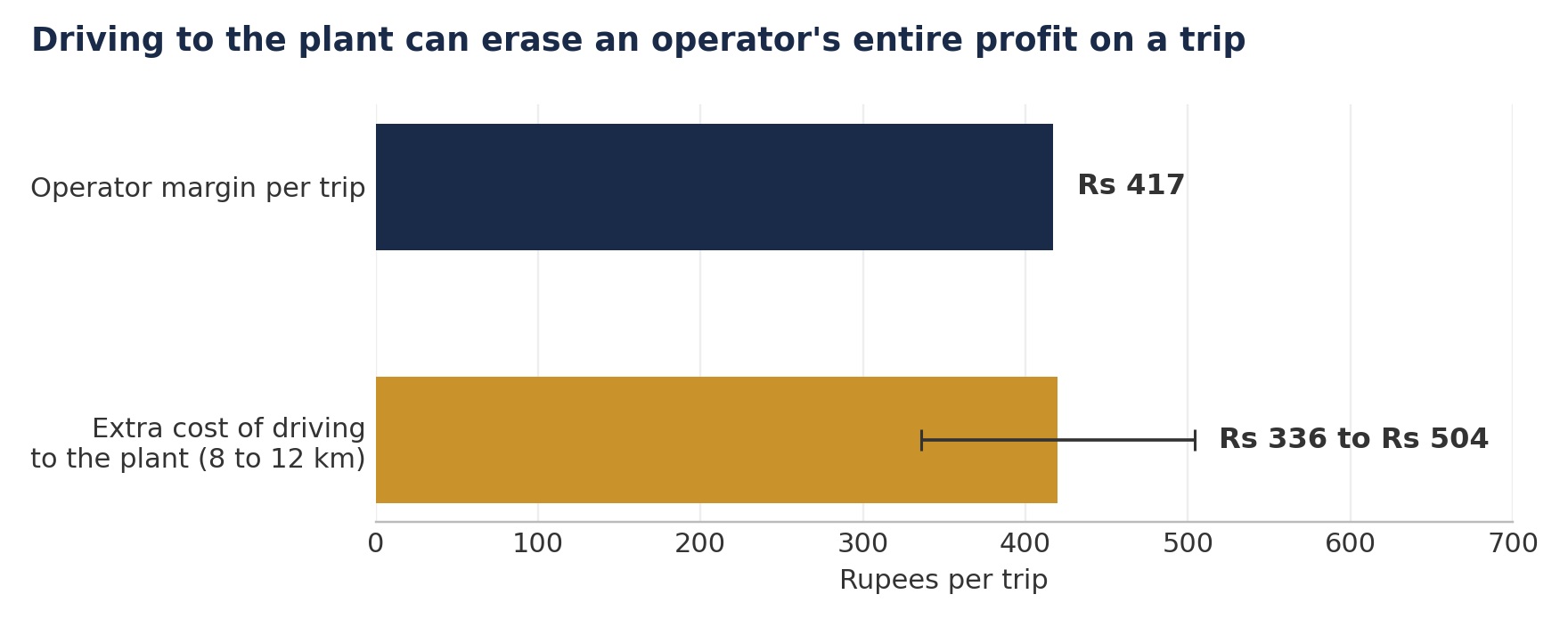
The detour distance is our assumption, since trip-level GPS data does not yet exist for Raebareli. That is exactly the point: the town cannot currently see this cost, measure it, or design around it.
The full cost of compliance is larger than fuel alone. It also includes waiting time at the plant gate, wear on the vehicle from the unmetalled approach road, any disposal fee and the job an operator cannot take while making the longer trip. Written out, the operator's decision is:
Compliance gap per trip = extra distance cost + waiting and road cost + any disposal fee + lost job time, minus any reward for compliance, minus the expected cost of being caught
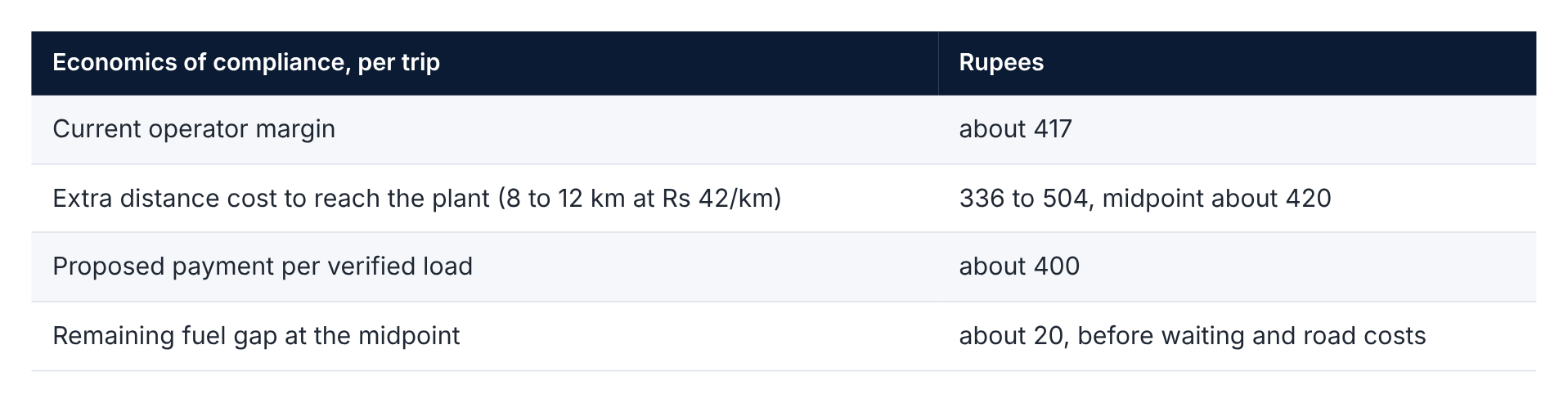
Today the expected cost of being caught is close to zero and there is no reward, so the compliant trip loses money. The policy question this case answers is therefore not only how to detect dumping, but who pays to close the compliance gap: the municipality through a per-load payment, institutions through scheduled desludging contracts priced at a fair rate, households through a fee schedule that reflects distance to the plant, or the operator. Section 4.3 sets out a combination.
This produces a clear diagnosis. Dumping in Raebareli is driven by three things acting together. There is no record that links an emptied tank to a delivered load. There is a real cost to compliance that today falls entirely on a small operator. And there is little chance of being caught, because enforcement depends on someone happening to see a truck at a drain. A solution has to address all three. Surveillance alone will push operators to work at odd hours, which CSE already observed [3]. Incentives alone will not stop the operator who still finds the drain cheaper.
The disposal decision sits with the operator, while the household pays for the service and has little visibility over where the load goes. Any mechanism that relies on households reporting dumping will fail. The mechanism has to verify the load directly, at the two points the operator cannot avoid: the household where it is collected and the plant where it should be delivered.
4. The Solution: A Tank-to-Plant Manifest
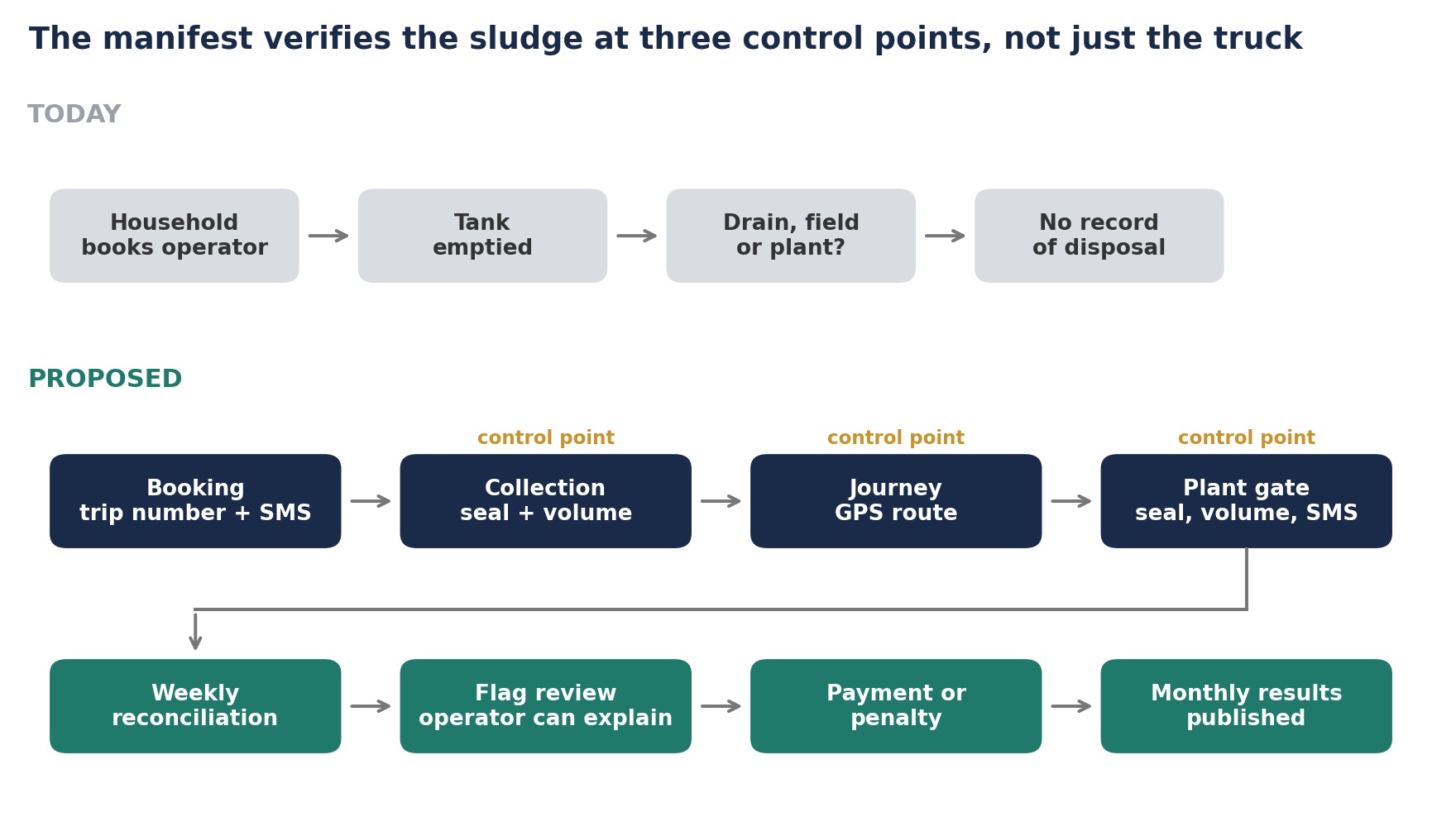
The manifest has three parts: a trip record that starts at booking, a chain of custody that proves the sludge, not just the vehicle, reached the plant, and an economic model that makes the compliant trip worth taking.
4.1 Every job gets a trip number
Every desludging vehicle operating in the town, government or private, is registered with the Nagar Palika Parishad, with its tank capacity recorded, and fitted with a basic GPS tracking unit. When a household or institution books a desludging, through a helpline, the municipal office or the national UPYOG platform's desludging module, a trip number is created and linked to that vehicle and address [15]. The household receives the trip number by SMS, and a second SMS once the load has been received at the plant. This gives the household proof of safe disposal without making it responsible for enforcement, and a household that is refused a trip number can report it to the municipal helpline.
GPS tracking of desludging vehicles is already proven in India. Odisha fits GPS units to all cesspool vehicles and monitors them through the Smart Cities command centre in Bhubaneswar [9]. Berhampur began tracking every trip in 2018, with the buy-in of private operators, and penalises violations [10]. Tamil Nadu's 2022 amendment to its urban local bodies law requires desludging vehicles to carry GPS devices to monitor desludging and decanting [11]. In May 2026, Raipur launched a UPYOG-based septage management dashboard that lets households book desludging online [15].
4.2 A chain of custody, not just a GPS track
GPS establishes vehicle movement, not material movement. An operator could collect 3.5 kilolitres, release most of it into a drain, and still drive to the plant with the rest. A trip record that closes on arrival alone would count that as a success. The manifest therefore closes a trip only when three independent checks agree.
Seal. After emptying the tank, the crew closes the tanker's outlet valve with a numbered, single-use tamper-evident seal, and records the seal number, a photo of the tank level and the declared volume against the trip number on a phone app. Lockable outlets that prevent discharge away from the plant are already available on Indian desludging machines [13].
Route. The GPS track from the household to the plant is checked for unscheduled stops. A stop of more than a few minutes away from a road junction is flagged.
Volume. At the plant gate, the staff check that the seal is intact, break it themselves, and record the volume received using the level markings in the receiving tank. If the volume received falls more than a set tolerance below the declared volume, for example 15 percent, the trip is flagged rather than closed.
Raebareli's plant already has staff on site, run under the AMRUT Mitra pilot by women from self-help groups [12]; a tablet at the gate is enough for this step. Each week, the municipality reviews every flagged or unclosed trip. A flag triggers a human review and a chance for the operator to explain, such as a GPS signal drop, before any penalty. This is the step that turns a tracking device into accountability: it no longer depends on anyone seeing a truck at a drain, because a broken seal, a gap in the route or a missing volume is itself the evidence.
4.3 Make the compliant trip worth taking
Compliance has to pay. We recommend a combination of four measures, so that no single budget carries the full gap.
A per-load payment of about Rs 400 for every trip that closes cleanly, funded by the municipality. CSE recommends that FSTP operating costs be met from Central and State Finance Commission grants or the municipality's own revenue [3], and this payment is a small addition that directly buys plant utilisation. The amount should be reset after three months, once GPS data shows the real detour distances.
A fee schedule in the bye-laws that reflects distance to the plant, using CSE's indicative desludging fee table for Uttar Pradesh, which already sets higher fees for longer trips [3]. Households in wards farther from the plant pay slightly more, rather than the operator absorbing the cost.
No disposal fee at the plant gate, so that the plant never adds to the cost of compliance.
First access to scheduled institutional desludging. Uttar Pradesh's Department of Urban Development issued guidelines on 13 September 2024 requiring AMRUT towns to desludge government-owned and managed buildings on a fixed schedule, including community and public toilets, offices, hospitals, schools and housing colonies [7]. This creates a steady, government-paid stream of desludging work. Raebareli can make a clean manifest record the condition for getting that work, so the operators who make the longer trip also get the most reliable business.
The approach is paired with a graded response for operators who do not comply: a warning, then a fine, then licence suspension. Gonda provides a relevant precedent for combining operator oversight with fines, and is one of the two towns in CSE's study where the plant receives steady inflows [2]. The municipality should also fix the unmetalled approach road to the plant [4], which cuts both travel time and vehicle wear.
4.4 Designing it with the people who do the work
The manifest affects four groups with different interests, and each needs to be part of the design.
Tanker owners. Most private operators in Uttar Pradesh are small businesses: CSE found that owners of a single vehicle hold about 60 percent of the market, and that operators typically took loans of Rs 5 to 10 lakh to buy their vehicles [3]. Rules should not be imposed on them overnight. The sequence should be consultation with operators, then agreement on the payment and fee schedule, then GPS fitting at the municipality's cost, then a grace period, and only then enforcement.
Drivers and helpers. The crew carries out the work and faces the health risks. Licence conditions should require protective equipment and mechanised emptying, and link crews to existing support such as the NAMASTE scheme and the Swachhta Udyami Yojana, which has already helped a sanitation worker in Jhansi buy a desludging vehicle [13]. Safer, steadier work is an outcome to design for and measure, not something the manifest delivers on its own.
Plant staff. The gate check adds work for the self-help group team running the plant [12]. It should come with training, a tablet and a clear rule that staff record what they see but do not enforce.
Households. Households receive a trip number and a disposal confirmation, as described in Section 4.1, and an easy way to report a refused trip number.
Who owns the data. The manifest creates a record of addresses, routes and trip histories. The Nagar Palika Parishad should be the data owner, access should be limited to named officers, records should be kept only as long as needed for enforcement and audit, for example two years, and every operator should be able to see and challenge the data behind any flag.
4.5 Why this is a new operating model, not a new technology
Every part of this already exists somewhere in India. GPS on cesspool vehicles runs in Odisha and is law in Tamil Nadu [9][11]. Scheduled institutional desludging is already Uttar Pradesh policy [7]. Plant gate logs and lockable outlets already exist [13]. What our research did not find is any Uttar Pradesh town that combines these into a closed chain of custody, where a desludging licence depends on every trip being verified by seal, route and volume, and where the compliant trip is made economically neutral. That is a claim about the absence of a documented precedent in the state, not proof that no town has tried it, and it should be confirmed with the Department of Urban Development before the pilot begins.
5. Strategic Options
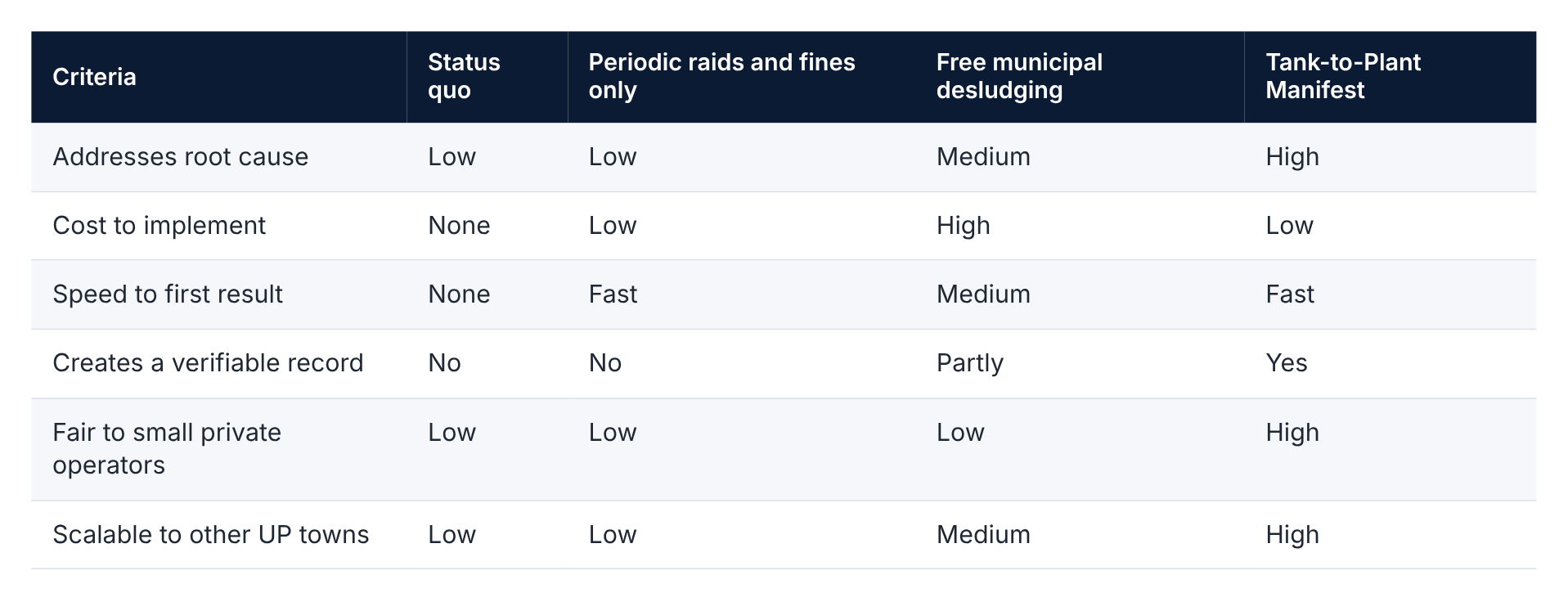
The ratings are a qualitative assessment of how far each option changes operator economics, creates trip-level accountability and can be run within existing municipal structures.
Continuing as today leaves the plant idle. Raids and fines alone depend on catching trucks in the act, and CSE's finding that operators already shift their hours to avoid officials suggests they would simply adapt [3]. Making desludging free, as Shikohabad did, raised demand there, but CSE expects part of that spike to be temporary, and it does not by itself ensure that loads reach the plant [2]. Among the options assessed, the manifest offers the most direct way to create a verified record for every trip at low cost, while giving compliant operators a reason to stay in the formal system.
6. The Investment Case
The manifest does not need new capital works. For an illustrative fleet of about 10 vehicles, since every AMRUT town has at least three government desludging vehicles plus private operators [13], GPS units cost Rs 3,500 to Rs 12,000 each, with annual data and platform charges of Rs 1,000 to Rs 2,500 per vehicle [14]. Adding a gate tablet, numbered seals and part-time data support for weekly reconciliation, the set-up and running cost is roughly Rs 2.5 to 3.5 lakh in the first year. The per-load payment of about Rs 400 adds about Rs 5.7 lakh a year in the base case below, bringing the full first-year cost to about Rs 8 to 9 lakh. The payment cost rises as compliance rises, which is the intended result: the municipality pays only for sludge that is verified as treated.
On the other side of the ledger, running a 32 KLD FSTP costs Rs 1.4 to 1.9 lakh a month, or about Rs 17 to 23 lakh a year, and the stipulated contract for desludging services and plant operations in Uttar Pradesh is about Rs 1.25 crore a year for plants of this size [3]. That money is spent whether the plant treats 3 kilolitres a day or 30. The value of the manifest is that it turns the same spending into treated sludge.
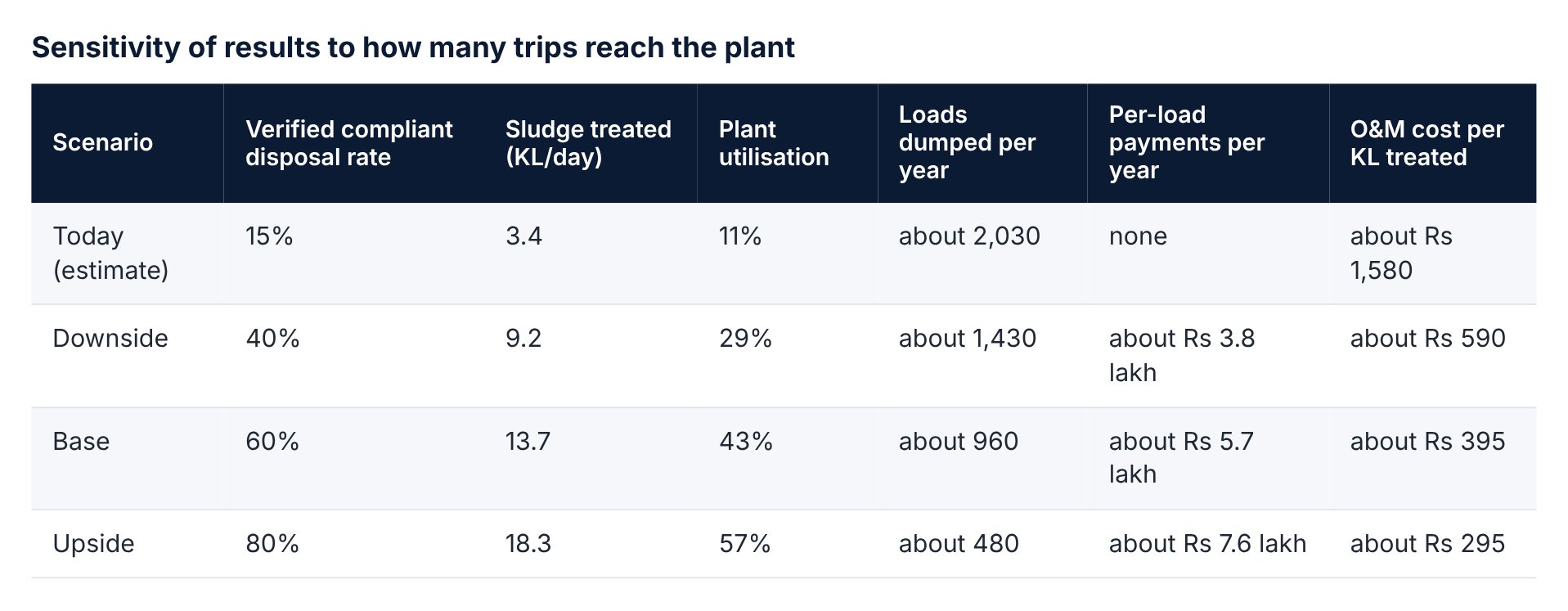
In the base case, about 1,070 fewer loads a year are dumped into drains and fields, and the cost of treating each kilolitre falls by roughly three quarters. These figures do not include the extra sludge from scheduled institutional desludging, which CSE estimates could raise plant utilisation across Uttar Pradesh from 40 percent to as much as 64 percent [7], or the example of Saharanpur, where it lifted a co-treatment plant from 10 percent to over 90 percent utilisation [7].
The table applies the base case of about 2,390 desludging jobs a year from Section 3. It uses sourced unit costs, but the household count, the 10 year emptying cycle, the 3.5 kilolitre average load, the Rs 400 payment and the scenario shares are ICG planning assumptions, with O&M cost taken at the midpoint of about Rs 19.8 lakh a year. It is a template the Nagar Palika Parishad can re-run once the first three months of manifest data show the real numbers.
7. Implementation Operating Model
How success will be measured. Plant utilisation alone is not enough, because a plant can receive more sludge while dumping continues elsewhere. The pilot should report five measures every month:
Verified compliant disposal rate: the share of booked trips closed with an intact seal, a clean route and a matching volume
Kilolitres a day received at the plant
Share of trips flagged or left unclosed, and how many were explained on review
Median operator cost per compliant trip, from GPS distance data
Plant utilisation
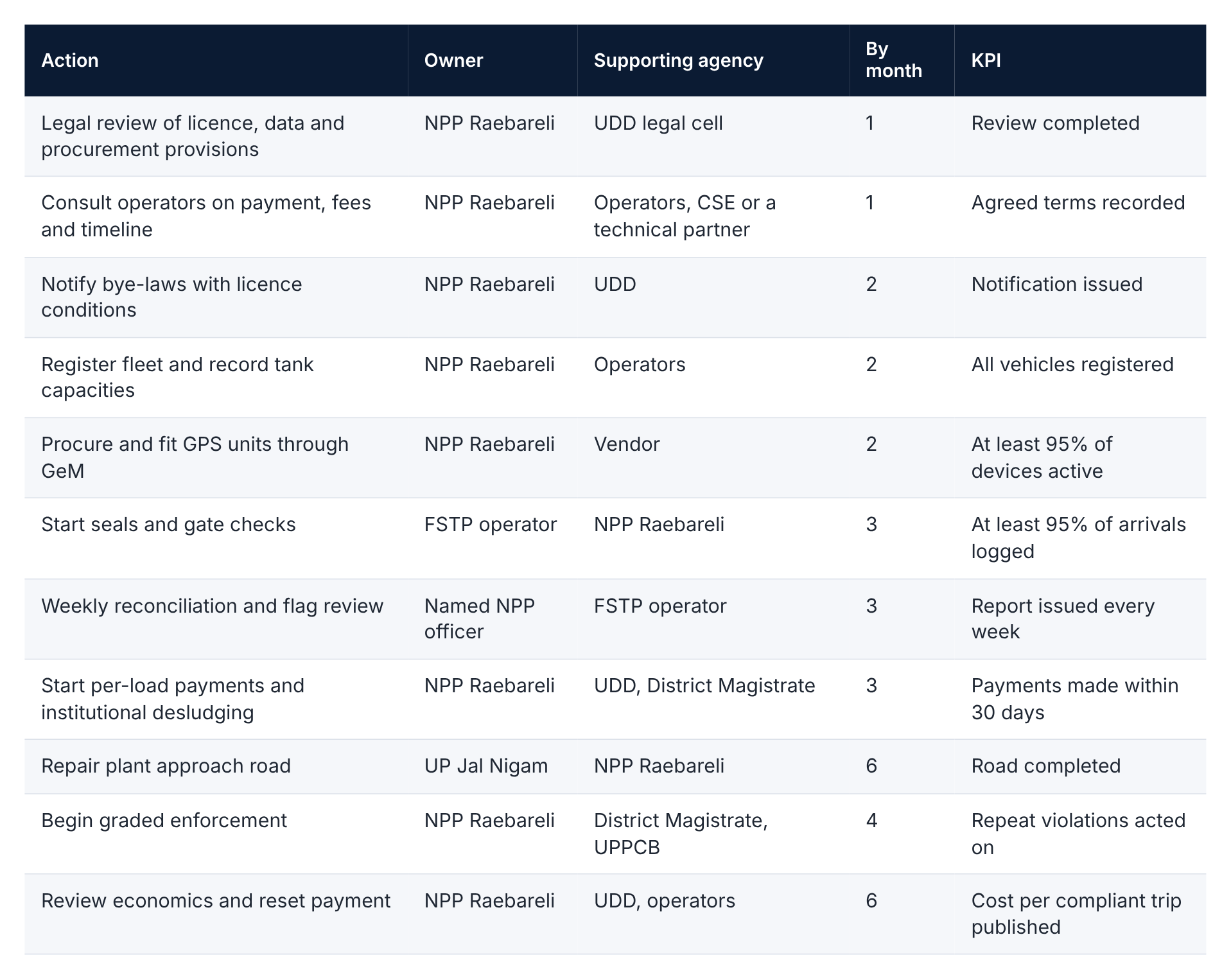
Escalation. Flags unresolved for two weeks go to the Executive Officer, and repeat violations to the monthly district review chaired by the District Magistrate. A household survey of septic tanks should run alongside, to replace the 2011 and 2012-13 baselines. From month 12, the model can be packaged for other Uttar Pradesh towns with underused plants, starting with Sitapur, which faces the same problem [1].

8. What Government Needs to Do, and Who Needs to Do It
The pilot can be designed largely within existing municipal and state septage management frameworks. A legal review should confirm the licensing, data and procurement provisions before enforcement begins.
Nagar Palika Parishad Raebareli should notify septage bye-laws, license and register every desludging vehicle, own the manifest data, run the weekly reconciliation, fund the per-load payment, and apply the graded response.
The Department of Urban Development, Uttar Pradesh, through the AMRUT and SBM-Urban 2.0 missions, should support the legal review, enable the UPYOG desludging module for Raebareli, and link institutional desludging work to manifest compliance statewide once the pilot proves out.
The District Magistrate should chair a monthly district review of the five measures and ensure government institutions follow the desludging schedule.
Uttar Pradesh Jal Nigam should repair the approach road to the plant, and the Uttar Pradesh Pollution Control Board should treat repeated dumping confirmed by the manifest as a water pollution matter.
Suggested timeline. Consultation, registration, GPS fitting and gate checks can be in place within one quarter, and the first reliable comparison of sludge emptied against sludge received can be available within six months.
9. Final Recommendation
The recommendation is not to build another plant or buy more tankers. It is to make every emptied tank traceable to the plant, and to make that trip worth taking.
Raebareli's treatment plant is not underused because the town lacks septage. It is underused because nobody verifies where each load goes, and because the compliant trip costs an operator more than the non-compliant alternative. A Tank-to-Plant Manifest, which verifies the sludge and not just the truck, backed by a licence condition and a payment that makes compliance economically neutral, can close that gap for under Rs 10 lakh a year. It can reduce the risk of untreated septage entering the town's drains, waterways and groundwater, give small operators steadier formal work, and offer every other Uttar Pradesh town with an idle plant a tested model to follow.
Sources and Methodology
Numbers in brackets in the text above correspond to the sources below.
State plant utilisation (18 of 55 plants at 20 percent of capacity or less as of April 2025) and the four-town comparison of Raebareli, Sitapur, Shikohabad and Gonda: Down To Earth, "Flushed and forgotten", 3 November 2025, reporting the CSE report "Decoding Desludging Challenges in Towns of Uttar Pradesh".
Dumping by private operators in Raebareli and Sitapur, Gonda's enforcement and fines, Shikohabad's free desludging, oversized tanks emptied every 10 to 15 years, and April 2025 plant-level figures: Down To Earth, "Hidden in hindsight: Decoding desludging challenges in Uttar Pradesh", 16 July 2025, summarising the same CSE study.
Operator economics in Raebareli (1,080 trips a year, Rs 1,200 charge, about Rs 783 cost per trip), per-kilometre running costs, the indicative distance-based fee table, funding of O&M from Finance Commission grants, the 10 to 20 percent share of trips taken to plants, decanting within two to three kilometres, market structure and loans, FSTP O&M cost and the Rs 1.25 crore contract figure: Centre for Science and Environment, "Guidance Note on Operation and Maintenance of FSSM Projects and Economics of Desludging in Uttar Pradesh".
Raebareli FSTP handover, its "no sludge" status, distance under 10 km, unmetalled approach road, and bye-law status across 59 towns: CSE, context-setting presentation for the AAETI webinar, 29 May 2023, based on a CSE field survey as of January 2023.
Raebareli sewer coverage of 32.14 percent (2012-13 SLB indicators) and untreated discharge to the river: PRIA, "Water and Sanitation Services in Raebareli, Baseline Survey for SLB Connect", synthesis report, 2014.
Raebareli population of 191,316 in 35,197 households: Census of India 2011.
The 13 September 2024 guidelines on scheduled institutional desludging, CSE's modelled rise in utilisation from 40 to 64 percent, and Saharanpur's results: Down To Earth, "Why a step-down scheduled desludging approach could improve treatment plant utilisation in Uttar Pradesh", 12 March 2025.
A 5 cubic metre truck of faecal sludge dumped in the open equals 5,000 people defecating in the open: NITI Aayog and NFSSM Alliance, "Faecal Sludge and Septage Management in Urban Areas: Service and Business Models", 2021.
GPS monitoring of all cesspool vehicles in Odisha through the Bhubaneswar command centre: Down To Earth, "Digitalisation is revolutionising faecal sludge and septage management in India", June 2024.
GPS tracking of every cesspool trip and penalties for violations in Berhampur: Odisha Water Supply and Sewerage Board and EY, "Digital interventions in FSSM in Berhampur, Odisha", July 2018.
GPS requirement for desludging vehicles under the Tamil Nadu Urban Local Bodies (Amendment) Act, 2022: African Water Association knowledge platform, "A monitoring technique of desludging and decanting faecal sludge", 2023; licensing and monitoring provisions in the Tamil Nadu Urban Local Bodies Rules, 2023.
Women from self-help groups running the Raebareli FSTP under AMRUT Mitra: Down To Earth, August 2024 and June 2025.
At least three desludging vehicles in every AMRUT town, lockable outlets on Indian desludging machines, and the Swachhta Udyami Yojana example from Jhansi: CSE, "Inclusive Urban Sanitation: Addressing the Desludging Challenges of Narrow Lanes in UP", June 2024.
GPS device and annual subscription costs: Fleetx, AIS 140 GPS device buyer's guide, 2026.
UPYOG desludging service module and Raipur's UPYOG-based septage dashboard: UPYOG platform documentation; Patrika, 5 May 2026.
Raebareli's location on the Sai river, a tributary of the Gomti: Raebareli district profile and Sai river references.