Water & Sanitation
Safe Water Behind the Tap: Groundwater Contamination and Drinking-Water Quality in Bihar
October 12, 2026

Abstract
Bihar has moved fast on piped water. Official figures show tap connections in rural homes rising from about 2 per cent in August 2019 to 96 per cent by December 2023. Yet the same state reports that groundwater in roughly 30,000 rural wards, about 26 per cent of all rural wards in 31 of 38 districts, exceeds permissible limits for arsenic, fluoride or iron. A 2025 performance audit by the Comptroller and Auditor General found that many quality-affected wards still lacked working treatment plants, that testing capacity was thin, and that reported coverage was overstated.
This article sets out the problem in numbers, explains why a tap connection is not the same as safe water, and reviews what other arsenic- and fluoride-affected regions have learned. Its central argument is that Bihar's next phase should shift from counting connections to proving water quality at the tap: source substitution first, treatment only where it can be kept running, testing that reaches private wells and the food chain, and community ownershipof operation and maintenance. It closes with a phased action planand a short list of indicators that would show whether the effort is working.
1. Introduction
Bihar is home to more than 100 million people, most in rural areas, and groundwater supplies most of their drinking water. One study of rural Bihar's water access found that more than 80 per cent of drinking water came from groundwater. For decades the instrument of choice was the hand pump: cheap, private, and installed household by household. The 2002 discovery of arsenic in hand-pump water at Simaria Ojhapatti village in Bhojpur district changed that picture.
Two decades later, the state faces three overlapping problems.
The first is chemical: arsenic along the Ganga, fluoride across parts of south and central Bihar, and iron in the Kosi basin and elsewhere.
The second is microbiological: floods, damaged hand pumps and unchlorinated supply can introduce bacteria into water that is chemically acceptable.
The third is institutional: the state has built a very large piped-supply system quickly, and the question is now whether the system delivers water that is tested, treated and trusted.
2. Problem Statement
A large share of Bihar's rural population still draws, or is at risk of drawing, drinking water from sources contaminated with arsenic, fluoride and iron above permissible limits. Piped supply has expanded rapidly, but water-quality assurance (treatment, disinfection, testing, monitoring and community oversight) has not kept pace. As a result, a household can have a functional tap connection and still be exposed to unsafe water, with measurable consequences for cancer, skeletal and dental fluorosis, child health and the food chain.
2.1 Scale of chemical contamination
The Bihar Economic Survey 2021-22 reported chemical contamination in groundwater in 30,272 rural wards across 31 of 38 districts. Of these, 4,742 wards in 14 districts along the Ganga were affected by arsenic and 3,791 wards in 11 districts by fluoride, with excess iron concentrated in nine Kosi-basin districts. The Economic Survey 2024-25 gives a similar picture: arsenic above permissible limits in 4,709 wards, fluoride in 3,789 wards and iron in 21,709 wards, which together amount to about 26 per cent of rural wards in 31 districts.
The headline numbers have barely moved in three years. That is partly a sign that the problem is geological and persistent, and partly a sign that the reporting category is the ward, not the household that is actually exposed.
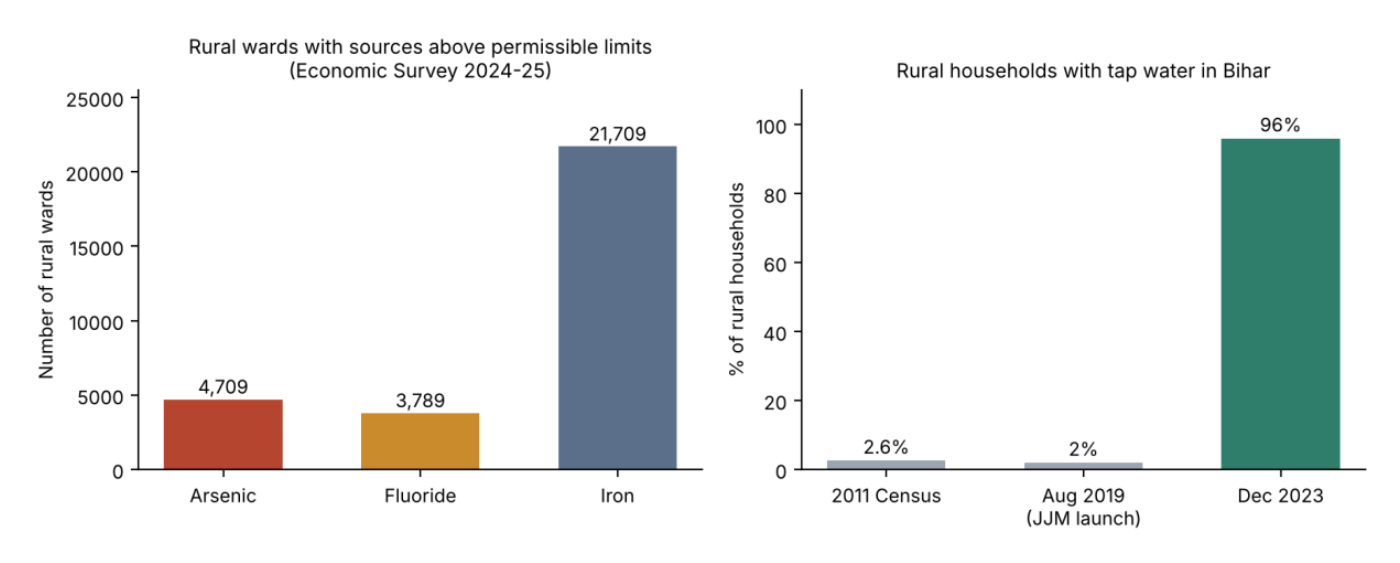
Figure 1. Left: rural wards with sources above permissible limits (Bihar Economic Survey 2024-25, as reported by PHED). Right: rural tap-water coverage (2011 Census, Jal Jeevan Mission launch, and December 2023 figures from the Ministry of Jal Shakti and CAG).
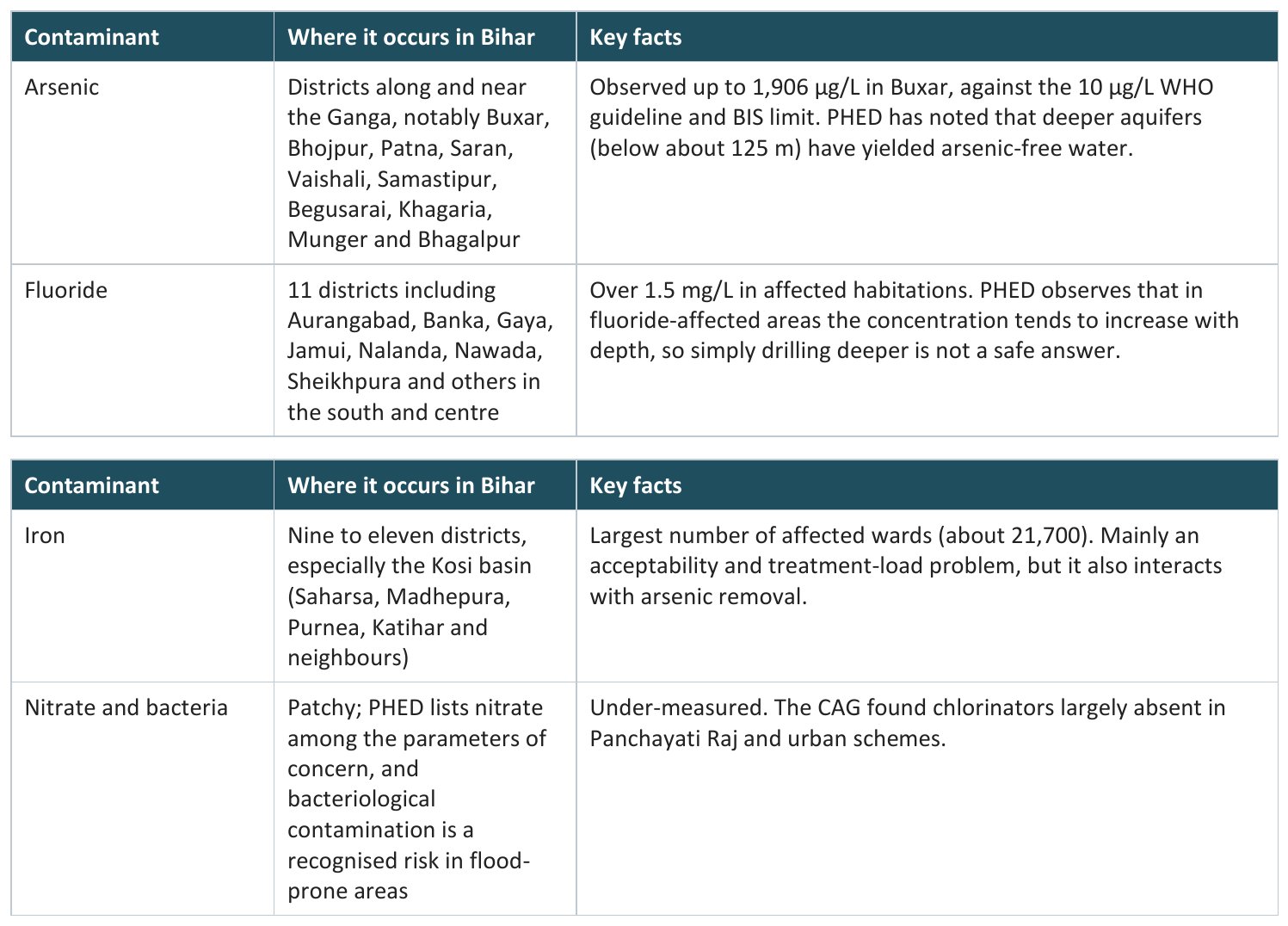
Table 1. Contaminants of concern in Bihar. Sources: Bihar PHED, Bihar Economic Survey, BSPCB-linked studies, ADRI/ENVIS, CAG (2025).
2.2 Health consequences
Arsenic is classified by the International Agency for Research on Cancer as carcinogenic to humans (Group 1). WHO's provisional guideline for drinking water is 10 µg/L, set as a practical quantification limit rather than a level that is risk-free. Chronic exposure above that level is associated with skin lesions and cancers of the lung, bladder, kidney and liver.
Bihar-specific evidence is now substantial. A study at the Mahavir Cancer Sansthan and Research Centre in Patna analysed blood arsenic in 2,000 cancer patients between 2017 and 2019 and linked exposure to cancer incidence in the Gangetic districts. A separate analysis published in Cancer Epidemiology, Biomarkers & Prevention linked arsenic in drinking water to gallbladder cancer in Bihar and Assam. Village-level investigations in Buxar, Darbhanga and Patna districts have documented elevated blood arsenic and skin disease in exposed populations, and in the Gyaspur-Majhi village study skin and breast cancers were also reported.
Fluoride above 1.5 mg/L causes dental and skeletal fluorosis; Indian government replies to Parliament name skeletal fluorosis as the principal outcome. Iron is not a major toxicity concern at typical levels, but it stains, tastes metallic and pushes households back to alternative, unsafe sources.
2.3 The food-chain dimension
Drinking-water interventions alone will not eliminate arsenic exposure in Bihar. Contaminated groundwater is also used to irrigate rice, wheat, potato and vegetables. A dietary assessment covering 91 households in 19 villages across eight arsenic-affected districts found elevated arsenic in cooked rice, wheat flour and potato, and in several samples the food contained more arsenic than the household's drinking water. The researchers estimated a median excess lifetime cancer risk of 2 in 10,000 from food arsenic alone. In 2025 the Bihar government told the Assembly that arsenic had been found in leafy vegetables, root vegetables including potatoes, and other produce in certain districts.
This matters for policy design. A village that receives arsenic-free tap water but continues to irrigate with arsenic-laden groundwater has addressed only part of the exposure.
2.4 Why hand pumps are hard to regulate
A survey-based study in the Journal of Water, Sanitation and Hygiene for Development found that hand pumps are the dominant drinking-water source in rural Bihar and that privately owned shallow hand pumps outnumber government-installed ones. Between 24 and 31 per cent of hand pumps were dysfunctional, and official quality mapping, built mostly on government sources, did not reflect what households were actually drinking. The study called for mandatory testing of private sources, interim use of affordable point-of-use filters, and researchon whether large-scale motorised pumping for supply schemes and irrigation could draw arsenic into currently clean aquifers.
2.5 A note on data: why the numbers disagree
Three official data series describe the same reality in different ways, and a reader comparing them will see apparent contradictions.
Ward-level survey data. PHED defines a rural ward as quality-affected if any drinking-water source in it tests above the permissible limit. This is the basis for the Economic Survey figures of about 30,000 affected wards.
Habitation-level reporting to the Centre. Under the Jal Jeevan Mission's management information system, a habitation counts as affected only if safe supply has not yet been provided. As of 18 July 2024, the Ministry of Jal Shakti told Parliament that, as reported by Bihar, no rural habitations in Bihar were affected by arsenic or fluoride in drinking-water sources, and that 51 habitations in Saharsa were marked iron-affected.
Audit findings. The CAG performance audit (2017-18 to 2022-23, field work in 12 districts in 2023) found that quality-affected wards were not all covered, and that treatment plants were often missing or non-functional.
Reading these together: the contamination in aquifers has not gone away, the national dashboards report that exposure has been closed off through alternative supply, and the auditor found that the alternative supply is not always in place or working. For policy purposes, the right question is not how many wards have bad groundwater but how many households are receiving tested, safe water at the tap today. That number is not currently published.
3. Current Policy Response and Its Gaps
3.1 What the state has done
Bihar launched the Har Ghar Nal Ka Jal (HGNJ) scheme in December 2015 as one of the seven resolves (Saat Nischay) ofthe state government,with the aim of piped water to every householdand an end to dependence on hand pumps for drinking. It is implemented through the Panchayati Raj Department, the Public Health Engineering Department (PHED) and the Urban Development and Housing Department. Between 2017-18 and 2022-23 these departments allocated about ₹30,501 crore to the scheme. At the 2011 Census only 2.6 per cent of rural and 20 per cent of urban households had tap water. By 3 December 2023 the Ministry of Jal Shakti reported that 160.34 lakh of 166.30 lakh rural households (96 per cent) had tap water supply, up from 3.16 lakh (2 per cent) at the launch of the Jal Jeevan Mission in August 2019.
For quality-affected areas the state has pursued several tracks: multi-village piped schemes drawing on surface water (for example, Maner in Patna, Maujampur in Bhojpur and Simari in Buxar), schemes drawing on safer deeper aquifers, solar mini piped schemes with arsenic and iron treatment units, and hand pumps fitted with fluoride treatment attachments. In September 2024, a ₹1,347 crore project to supply treated Son River water to Aurangabad, Dehri and Sasaram was launched, and the Ganga Water Supply Scheme, begun in 2023, supplies Gaya, Rajgir and Nawada. The PHED minister has said the aim is to make rural Bihar hand-pump free for drinking.
On testing, Bihar reports a network of 115 water-testing centres: the state laboratory at Chhajjubaag in Patna, 38 district laboratories and 76 sub-divisional laboratories. Fifteen district laboratories have received NABL accreditation, and others are under evaluation. Testing covers 16 parameters, including pH, TDS, turbidity, hardness,chloride, sulphate, fluoride,arsenic, nitrateand bacteria. In2023-24,morethan1.46lakh water sources, 34,379 schools and 44,052 Anganwadi centres were tested.
3.2 What the CAG audit found
The audit, tabled in 2025, is the most detailed independent assessment available. Its main findings relevant to water quality were:
Reported coverage of rural households (98.70 per cent in March 2023) was higher than the 95.71 per cent shown on the Jal Jeevan Mission dashboard in November 2025. PHED could not cover 11.22 lakh households in 46,633 rural wards, including 8.07 lakh households in quality-affected wards.
Many quality-affected wards were not covered or lacked functional water treatment plants. In 41 PHED and urban wards, schemes were built without any treatment plant, and 77 quality-affected wards were handled by community committees without treatment plants.
In 1,000 fluoride-affected habitations, schemes were taken up without detailed project reports or surveys. Fluoride removal plants costing ₹2.77 crore were installed in 15 schemes in habitations where the water was not affected by fluoride.
Chlorinators were largely absent in Panchayati Raj and urban local body schemes, which weakens disinfection.
Testing was inadequate because of infrastructure gaps, manpower shortages, unused test kits and non-operational mobile laboratories. NABL accreditation covered only a few laboratories.
Community monitoring through Lavuk Committees, Jal Choupals and health camps was minimal; online monitoring platforms were unreliable; grievance systems were weak. In five divisions, ₹2.31 crore was paid for works not actually executed.
The audit's recommendations are directly useful: universal coverage of quality-affected wards with functional treatment plants, upgraded laboratories with adequate staff, timely remedial action when contamination is detected, filling vacancies in quality monitoring, third-party certification of materials, and activation of community monitoring.
4. Lessons from Around the World
Arsenic and fluoride in groundwater are global problems, and several regions have been working on them for longer than Bihar. The cases below were chosen because each teaches something specific about what works, what fails, and why.
4.1 Bangladesh: testing, deep tube wells and the cost of scale
Arsenic in Bangladeshi tube wells was first detected in 1993. Because nearly 90 per cent of rural people used tube wells, a programme that had cut infant mortality by providing safe-from-germs water had unintentionally exposed tens of millions of people to arsenic; estimates of those exposed range from 35 to 77 million. About 6 million tube wells have since been tested. The early BRAC action-research project (1999-2000) found around 27 per cent of tube wells above the national limit of 50 µg/L and tested 51,685 tube wells in two sub-districts, painting wells red or green so that the community could see which were safe. The community-based safe-water options that followed covered 531 villages and nearly 500,000 people.
BRAC's later WASH programme reported 4,156 deep tube wells, 647 arsenic filters and safe-water services for 2.5 million people. A midline assessment across 11 sub-districts found that the share of arsenic-free tube wells rose only modestly, from 58 to 60 per cent, but that 83 per cent of households were drinking arsenic-free water, mainly by switching to known safe wells. The study noted that the poorest households struggled to pay for new wells and responded well to monthly instalments.
What Bihar can take from this: (i) make the test result visible at the source (colour-coding), (ii) combine testing with a switch option within walking distance, (iii) design finance for the ultra-poor, and (iv) recognise that arsenic-free tube-well water is not necessarily microbiologically safe. Studies in rural Bangladesh found E. coli in approximately 41% of sampled shallow tube wells or water samples, depending on the study. Therefore, any hand-pump strategy in Bihar should combine arsenic testing with bacteriological testing, sanitary risk assessments and appropriate water-safety measures, particularly during the monsoon.
4.2 West Bengal: why treatment plants fail, and what worked instead
West Bengal is Bihar's closest neighbour in both geology and policy. It installed about 1,900 arsenic removal plants in arsenic-affected districts. A field study of 577 of them found that 475, or 82.3 per cent, were not useful. Among 264 plants with raw-water arsenic above 50 µg/L, 53 per cent failed to bring treated water under the WHO guideline, and in some cases the treated water contained 705 µg/L. Eighty-one per cent of the plants failed to remove iron adequately, and many produced water that discoloured on standing. A separate study in Nadia, Hooghly and North 24 Parganas found removal efficiencies of only 23 to 71 per cent.
The failures were attributed to poor siting (some plants were installed where raw water was already below the limit), weak maintenance, spent media that nobody replaced, and lack of community ownership. Against this, a chemical-free in-situ arsenic removal plant developed by European and Indian researchers at Kasimpore, near Kolkata, produced water below 10 µg/L, generated no sludge, and cost about US$1 a day for 2,000 litres. West Bengal has also invested in surface-water-based piped schemes, such as those around Kulpi, and has commissioned health and socio-economic baseline and impact studies around them.
Bihar's own audit finding that fluoride removal plantswere installed in placeswithout fluoride is a closeecho. The lesson is blunt: treatment technology succeeds or fails on siting, operation and maintenance, not on the process chemistry.
4.3 Nepal's Terai: a filter designed for the user
IntheTeraiplainsofNepal,whichborderBihar,about90percentofpeopledependongroundwater.Roughly 1.8 per cent of wells exceeded the Nepali standard of 50 µg/L, with Nawalparasi the worst affected district. The Kanchan Arsenic Filter, designed at the University of Calgary and refined by MIT, ENPHO and the Rural Water Supply and Sanitation Support Programme, combines slow sand filtration, which removes bacteria, with rusty iron nails, which adsorb arsenic. It was supported by a plan to build local entrepreneurs and a central technology hub, and was distributed to tens of thousands of households. A 2016 assessment by Nepal's Department of Water Supply and Sewerage with JICA examined the filter's field performance in Nawalparasi, and academic reviews continue to discuss what is needed to improve it. US EPA-funded work notes that earlier mitigation efforts in the region had failed because of inappropriate technology and unsustainable implementation.
The relevance to Bihar is the design principle: a household filter that handles both arsenic and bacteria, built from local materials, and sold or distributed through local entrepreneurs, can bridge the years before piped supply is complete and can also back up the piped system in flood season.
4.4 Vietnam's Red River Delta: sand filters and the iron condition
Arsenic in the Red River Delta was discovered in 1998, with concentrations above 500 µg/L on both banks of the river. Swiss and Vietnamese researchers studied household sand filters in 43 households and found a mean arsenic removal of 80 per cent for groundwater containing 10 to 420 µg/L arsenic. High dissolved iron enhanced removal, while high phosphate reduced it. The filters used local materials, needed no chemicals, and were easy to copy. A later field study, however, found that some filters did not remove arsenic when the iron-to-arsenic ratio in the well water was low, even though iron and manganese were removed.
This is directly relevant because iron and arsenic overlap in parts of Bihar. A sand filter can be an effective low-cost interim option where water is iron-rich, but it must be validated well by well, not assumed to work everywhere.
4.5 Taiwan and Chile: switching to safe supply works, but latency is long
In south-western Taiwan, residents suffered blackfoot disease in the 1950s from arsenic-contaminated well water. After arsenic-safe tap water replaced groundwater for drinking in the 1970s, cases fell sharply. In northern Chile, arsenic in the water supply of Antofagasta averaged about 870 µg/L in 1958-70 and declined after treatment plants were installed in the 1970s; mortality studies have since documented cancer effects decades later. These cases show that source substitution is effective at ending new exposure, and that health burdens persist for a generation, so health surveillance and treatment must continue long after the water is fixed.
4.6 Argentina and Denmark: standards that bind
Around four million people in Argentina are estimated to be at risk from arsenic, mainly in the Chaco-Pampean plain. The country has written the 10 µg/L limit into its Food Code, but its application has been on hold. Denmark, by contrast, had a 50 µg/L guideline until 2003 and then moved de facto to 5 µg/L for all public waterworks, with measurable compliance at each waterworks. Between them they illustrate that a standard matters only when it is enforced with testing and public reporting.
4.7 Comparison
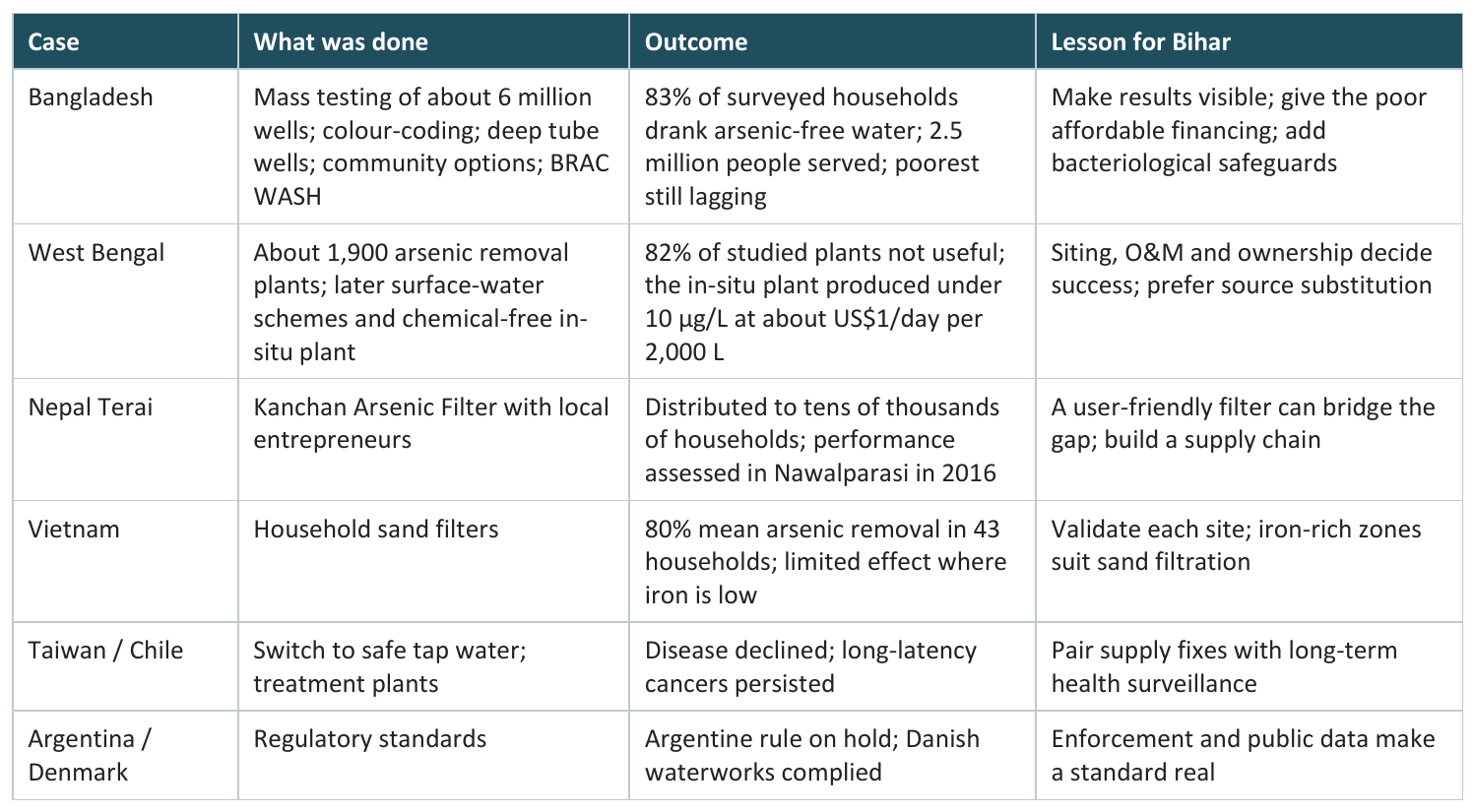
Table 2. Summary of international experience.
5. Solutions Relevant to Bihar
The solutions below follow a simple hierarchy. First, stop exposure by switching to a safe source. Where that is not yet possible, treat water at the point where it can be maintained. Throughout, measure and publish what comes out of the tap, and extend the effort to food and irrigation.
5.1 Switch to safe sources first
Surface-water multi-village schemes. Bihar sits on the Ganga, Son, Gandak, Kosi and other major rivers. Treated surface water is the most reliable long-term answer for arsenic-affected belts within about 20 km of the Ganga, where PHED itself has acknowledged the problem concentrates. Examples already under way, such as Maner, Maujampur, Simari and the Son and Ganga schemes, should be prioritised over new groundwater schemes in affected blocks. The sustainability risks are intake reliability in the dry season, sediment during floods, and power for pumping.
Safe deep-aquifer schemes, with caution. PHED reports that wells deeper than about 125 m have yielded arsenic-free water in arsenic areas. However, fluoride tends to increase with depth in fluoride-affected areas, and the academic concern that heavy pumping might draw arsenic downward has not been resolved. Deep wells should be used only with hydrogeological mapping, depth-specific screening, sealing of upper aquifers and long-term monitoring.
Rainwater harvesting. In North Bihar, with its high rainfall, roof-collected rainwater with first-flush diversion and chlorination is a useful backup for drinking and cooking during treatment-plant outages, as Vietnam's Mekong Delta communities use it. It should supplement, not replace, piped supply.
5.2 Treat where treatment is the only option, and keep it running
Match technology to chemistry. Iron removal by aeration and filtration is simple and mature. Arsenic removal by oxidation, co-precipitation and adsorption works best where iron is naturally present. Fluoride removal uses activated alumina, bone char or contact precipitation. The choice should follow a water analysis at each site, as the audit's fluoride-plants-without-fluoride finding shows.
Contract for performance, not installation. West Bengal's experience shows plants fail after handover. Contracts should pay for treated water that passes a test, run for five to ten years of operation, and include media replacement, sludge disposal and spares.
Community-scale plants and household filters as bridges. Community water purification plants delivering 8 to 10 litres per capita per day for drinking and cooking are already allowed under Jal Jeevan Mission guidance for arsenic- and fluoride-affected habitations while piped supply is built. Household options such as Nepal's Kanchan filter or tested sand filters can be promoted through local entrepreneurs, with a certified list of approved designs.
Disinfect every scheme. Chlorination should be mandatory in every piped scheme, irrespective of which department builds it, with residual chlorine measured at the tap. This is the CAG's second recommendation and the cheapest quality gain available.
5.3 Build a testing and surveillance system people can trust
Complete NABL accreditation for all district laboratories, fill laboratory and quality-monitor vacancies, and make mobile laboratories operational, as the audit recommends.
Test private hand pumps, which are the main source of exposure and are outside current government sampling. Offer free field-kit screening with confirmatory laboratory tests, and mark each well with a visible colour code, as BRAC did in Bangladesh.
Test at the tap, not just at the source. Publish ward-wise results on the Jal Jeevan Mission water quality portal in near-real time, with arsenic, fluoride, iron, nitrate, turbidity, residual chlorine and bacteria.
Train and pay local women's groups to use field-testing kits and report results, using the Lavuk Committee and Jal Choupal structures that the audit found under-used.
Run a periodic independent audit of water quality at household taps, using sampling by an outside institution, to reconcile the ward-level and habitation-level data discussed in Section 2.5.
5.4 Protect the food chain
Map arsenic in irrigation wells in the Ganga belt and discourage use of the worst wells for rice and vegetables; promote canal or surface irrigation where feasible.
Pilot irrigation and soil management practices that reduce arsenic uptake in rice, drawing on the IWMI review of interventions in West Bengal and Bangladesh and on research by agricultural universities on crop varieties and soil amendments.
Advise households in affected areas to cook rice with plenty of water and avoid using contaminated water for cooking, consistent with the dietary findings that cooked rice can carry higher arsenic than raw rice.
5.5 Health systems and flood resilience
Screen for arsenicosis (skin lesions) and fluorosis in the worst-affected blocks through primary health centres and Ayushman Arogya Mandirs, link cases to water-source action, and maintain a registry given the long latency seen in Taiwan and Chile.
Prepare a flood protocol: pre-positioned chlorine tablets, household filters and emergency tankers in flood-prone districts, because floods damage hand pumps and contaminate sources. Research on Bihar's floods has stressed that lack of clean water and sanitation is a major cause of avoidable illness among children.
5.6 Governance and finance
Resolve the ward-level versus habitation-level data gap by adopting a household-level indicator: share of households receiving tap water that passed all required tests in the last quarter.
Clarify which department is responsible for each ward between PHED and Panchayati Raj, as the audit found overlapping and unclear responsibilities.
Ring-fence HGNJ spending and report it separately within the Saat Nischay programme, as the CAG recommends, and fund operation and maintenance from the start, including electricity and part-recovery through user charges.
Make third-party quality certification of pipes, pumps and treatment media mandatory, and improve grievance redress with a toll-free line and published response times.
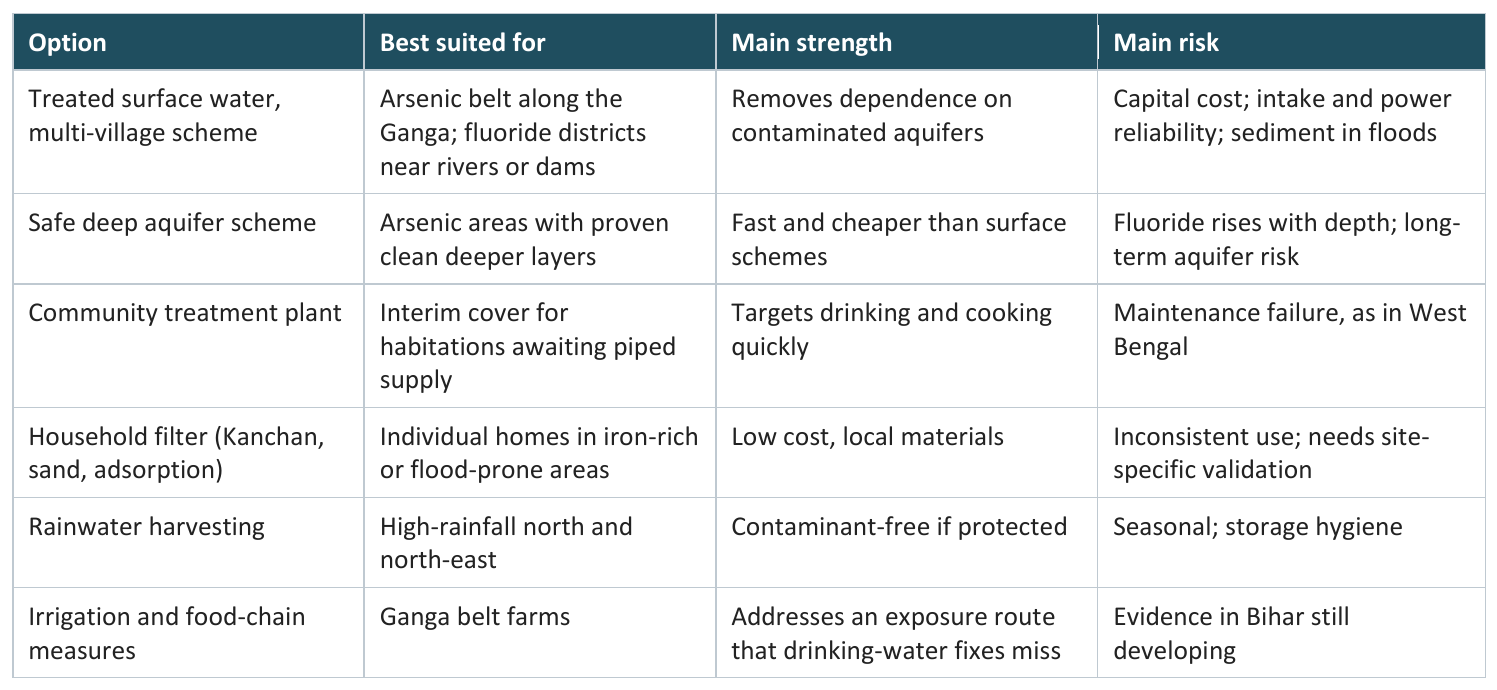
Table 3. Options matrix for Bihar.
6. Implementation Roadmap
A realistic plan separates what can be done within a year from what needs several years of construction.
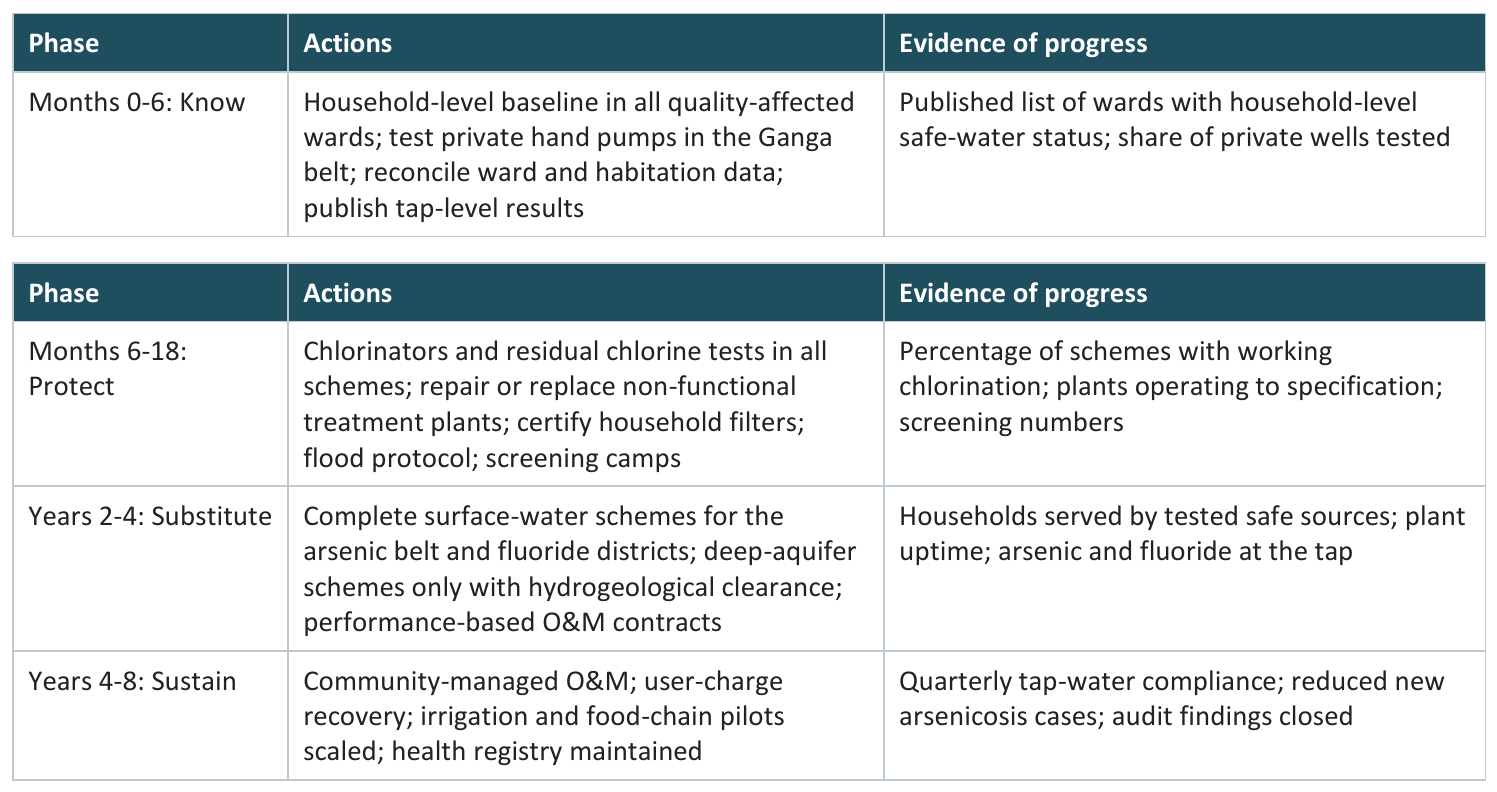
Five headline indicators would let the public and the legislature judge progress: (1) share of households whose tap water passed all required tests in the last quarter; (2) share of private hand pumps in affected blocks tested and labelled; (3) share of treatment plants operating to specification; (4) number of NABL-accredited laboratories and filled quality-monitor posts; (5) new cases of arsenicosis and fluorosis detected per year in affected blocks.
7. Conclusion
Bihar has done what many states have not: it has built a near-universal piped supply in a few years. That achievement should be recognised, and it creates the delivery channel through which safe water can now reach every home.But theevidence fromthe state'sown surveys, from theCAG audit and fromneighbouring regions points to the same conclusion. A tap is a means, not the goal. The goal is water that is tested, disinfected, free of arsenic, fluoride and excess iron, and trusted by those who drink it.
International experience suggests the order of priorities. Replace contaminated sources with safe ones wherever possible, as Taiwan and Chile did. Where treatment is needed, avoid the West Bengal pattern of installing plants nobody maintains, and instead contract for performance and train local operators. Use local, validated household options to bridge the gap, as in Nepal and Vietnam. Make test results visible, as BRAC did in Bangladesh. Do not forget food and irrigation, because Bihar's own studies show they can contribute as much arsenic as the water in the glass. And measure what matters, which is water at the tap, in every household, every quarter.
The cost of delay is not abstract. The cancers and skeletal damage that follow chronic exposure appear years later, and the experience of Taiwan and Chile is that the burden outlives the fix. The window for acting is now.
Sources
Bihar Economic Survey 2021-22, as reported by National Herald / PTI: "Massive groundwater contamination in 31 of 38 districts in Bihar" (nationalheraldindia.com).
Bihar Economic Survey 2024-25, as reported by Patna Press and Maktoob Media (March 2025): "Bihar's groundwater crisis: 30,000 rural wards affected by toxic contamination".
Government of Bihar, report in OA No. 728 of 2023 before the National Green Tribunal (greentribunal.gov.in).
Public Health Engineering Department, Government of Bihar: Water Quality pages (phedbihar.gov.in) and Multi-Village Scheme note (bihar.gov.in, May 2024).
Comptroller and Auditor General of India (2025): Performance Audit Report on Implementation of Har Ghar Nal Ka Jal Yojana in Bihar, Executive Summary and Chapter I (cag.gov.in).
Ministry of Jal Shakti, replies in Parliament: Lok Sabha AU789 (December 2023); Rajya Sabha PQ 265 (22 July 2024); Lok Sabha AU4009 (December 2024); Lok Sabha AU5255 (2019).
NABL certification of water testing laboratories in 15 Bihar districts, Patna Press.
Saha, D. (2009). Arsenic groundwater contamination in parts of middle Ganga plain, Bihar. Current Science 97(6): 753-755.
Chakraborti, D. et al. (2003). Arsenic groundwater contamination in Middle Ganga Plain, Bihar, India: a future danger? Environmental Health Perspectives.
Mahavir Cancer Sansthan study: Arsenic exposure in Indo-Gangetic plains of Bihar causing increased cancer risk. Scientific Reports (2021), doi:10.1038/s41598-021-81579-9.
Arsenic in drinking water and gallbladder cancer in Bihar and Assam. Cancer Epidemiology, Biomarkers & Prevention; reported by PTI / Business Standard (January 2023).
Arsenic in the food chain in Bihar: Down To Earth, "Arsenic now in wheat, potato, and more than that in drinking water in rural Bihar"; India Water Portal (March 2021).
Access, monitoring and intervention challenges in the provision of safe drinking water in rural Bihar, India. Journal of Water, Sanitation and Hygiene for Development; summarised by India Water Portal.
Ensuring safe water and sanitation during floods in rural communities of Bihar State, India. Practical Action Publishing.
ADRI / ENVIS, Spread of common waterborne contaminants in India and Bihar (adriindia.org).
Arsenic in drinking water: WHO fact sheet no. 372 and background materials; IARC Group 1 classification (GreenFacts summary).
Bangladesh arsenic mitigation programs: lessons from the past (PMC3342680); BRAC WASH arsenic mitigation briefing; BRAC RED (2000) Combating a deadly menace; BRAC WASH midline assessment (dspace.bracu.ac.bd).
Hossain, M. A. et al. (2005). Ineffectiveness and poor reliability of arsenic removal plants in West Bengal, India. Environmental Science & Technology; and Million-dollar arsenic removal plants in West Bengal, India: useful or not? Water Quality Research Journal of Canada.
Sen Gupta, B. et al. (2009). A simple chemical free arsenic removal method for community water supply: a case study from West Bengal, India. Environmental Pollution 157(12): 3351-3353.
Bhakta, J. N. et al. (2016). Current status of arsenic contamination in drinking water and treatment practice in some rural areas of West Bengal, India. Journal of Water Chemistry and Technology 38(6).
Ngai, T., Murcott, S., Shrestha, R. (2004). Kanchan Arsenic Filter (KAF): research and implementation of an appropriate drinking water solution for rural Nepal; Baidya, M. and Ogata, R. (2016), Assessment of the performance of the KAF in Nawalparasi (DWSS / JICA); IRIN / The New Humanitarian and Fides reports on Terai filters; US EPA grantee project summary.
Luzi, S. et al. (2004). Household sand filters for arsenic removal. EAWAG technical report; Nagoya University study, Limited effectiveness of household sand filters for removal of arsenic from well water in North Vietnam.
Taiwan blackfoot disease and Chile Antofagasta mortality data: Environmental Health (2014) review tables; Tseng, C.-H. (2007), Blackfoot disease in Taiwan: its link with inorganic arsenic exposure from drinking water, Ambio.
Litter, M. et al. (2019). Arsenic in Argentina: occurrence, human health, legislation and determination. Science of the Total Environment 676: 756-766; Schullehner, J. et al., Arsenic concentrations as low as reasonably possible (Denmark).
Osborne, T. H. et al. (2018). Reservoirs of faecal indicator bacteria in well-head hand pumps in Bangladesh. Journal of Water and Health 16(3).
Senanayake, N. and Mukherji, A. (2014). Irrigating with arsenic contaminated groundwater in West Bengal and Bangladesh: a review of interventions. Agricultural Water Management 135: 90-99.
This article draws on publicly available government documents, parliamentary replies, the CAG audit executive summary, news reports of the Economic Survey, and peer-reviewed or institutional studies accessible online in October 2026.
Cover photo: "Hand pump in Rajasthan, India" by Deccantrap, CC BY-SA 3.0, via Wikimedia Commons.