Water & Sanitation
Resilience and Rejuvenation: Rethinking Jaipur's Urban Flooding
September 18, 2026

Why the Pink City floods every monsoon and how it can build itself out of the problem
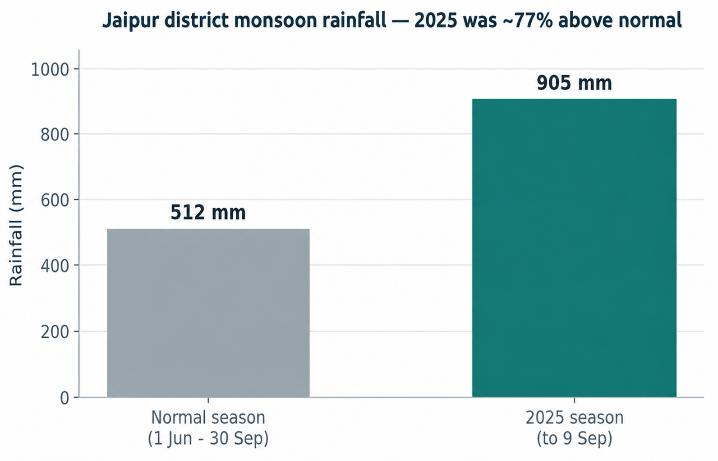
~905 mm Jaipur district monsoon rain in 2025, about 77% above normal
~62% share of the city's sewage that installed plants can treat
Jaipur's drainage network comprises hundreds of small drains alongside a smaller number of major channels, and yet even 40 mm of rain can leave arterial roads under water
Introduction
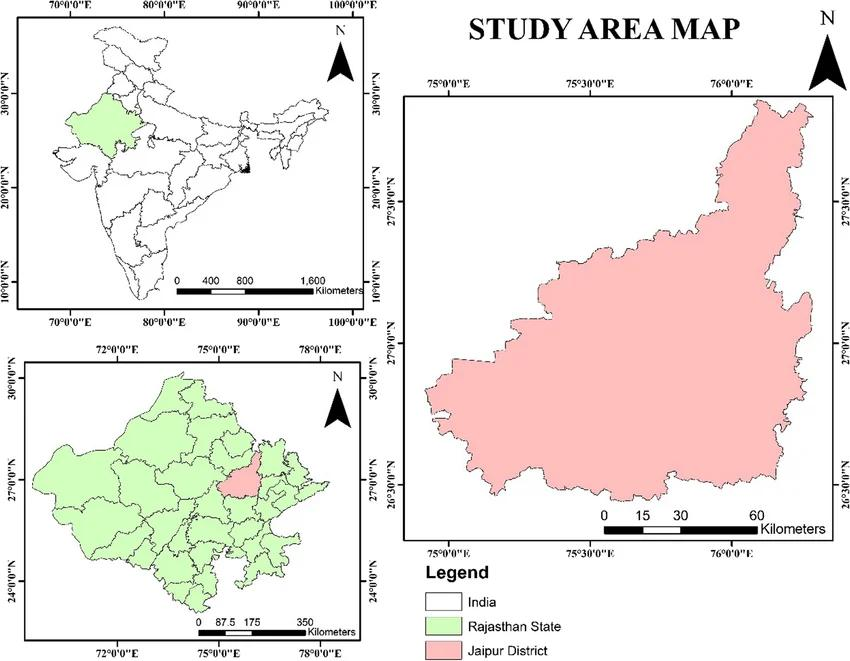
Jaipur was laid out in 1727 as a city that understood water. Its canals, kunds, bawris and a ring of talabs were designed to catch the monsoon, hold it, and let it soak back into the ground. Three centuries later the same city goes under water almost every time it rains hard. In August 2026 sustained rain left the walled city, the railway station and the Tonk Phatak corridor waterlogged and traffic at a standstill (Press Trust of India, 2026); in the 2024 monsoon a single morning's downpour, the heaviest since 2015, killed four people, three of them in a flooded basement (News on AIR, 2024). These are not freak events. They are the predictable result of a widening gap between how much the city has grown and how little of its water-carrying capacity has survived.
This case study treats Jaipur's flooding not as a drainage-capacity problem to be solved by building bigger pipes, but as a combined physical and governance failure. Rainfall is getting heavier: the 2025 monsoon was Rajasthan's second-wettest since 1901, and four of the state's ten wettest seasons on record have now occurred since 2019 (India Meteorological Department, 2025; Down to Earth, 2026). At the same time, the city's natural buffers, its river, nallahs, stepwells and ponds, have been encroached upon, filled or clogged; its ground has been paved over, and the agencies responsible for water sit in separate silos with plans that rarely reach execution.
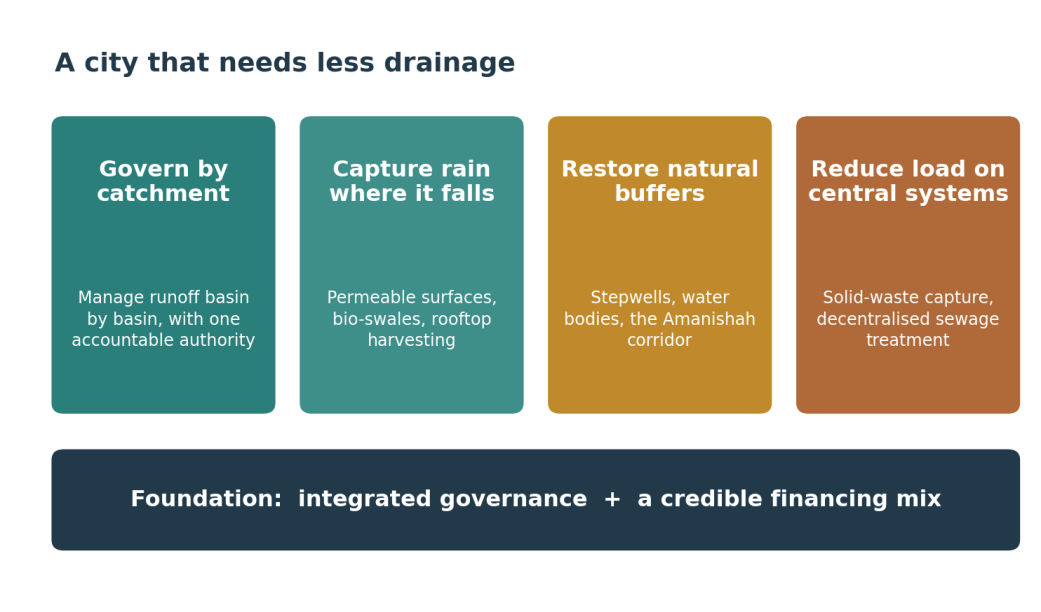
The recommendation is to build a city that needs less drainage. That means four things done together, on one institutional and financial foundation: govern stormwater catchment by catchment under a single accountable authority; capture rainfall where it falls through permeable surfaces, bio-swales and rooftop harvesting; restore the stepwells, ponds and the Amanishah-Dravyavati corridor that once did this work for free; and reduce the load on central systems by keeping solid waste out of drains and treating sewage closer to source. None of this is speculative since Jaipur has already built and then abandoned a working porous-pavement pilot, and comparators in Singapore and Chennai show both the accountability model and the financing model that make such a programme durable.
The core message for decision-makers is that Jaipur does not need another headline drainage scheme that stalls between announcement and delivery. It needs to fix the institutions that manage water, restore the landscape that used to absorb it, and finance the work through a credible mix of municipal borrowing, state funds and national missions, so that every rupee reduces the depth and duration of flooding rather than adding one more channel that silts up and overflows.
1. The Challenge: A Water-Wise City That Now Floods
For Jaipur, the monsoon each year is a test the city keeps failing. Heavy rain quickly becomes waterlogged roads, stalled traffic, inundated homes and shops, and days of disrupted economic activity. Water that takes days to drain then becomes a breeding ground for mosquitoes, feeding seasonal spikes in dengue and malaria (ANI, 2026). The damage to homes and small businesses along the worst-hit corridors is real and recurring, even though almost none of it is ever officially recorded.
The underlying cause is a growing mismatch between the city's expanding footprint and its shrinking capacity to move water. Jaipur's drainage network comprises hundreds of small drains alongside a smaller number of major drainage channels, and yet even 40 mm of rain can leave arterial roads under the water (Chhajer and Choudhary, n.d.). The problem is not a single broken component, it is the interaction of heavier rainfall, a decayed and undersized drainage network, the loss of the natural features that used to absorb runoff, and a governance structure that struggles to plan and deliver.
2. The Evidence: What Recent Monsoons Show
The scale of disruption is already visible. In 2025, Jaipur district received about 905 mm of rain between June and early September. Across Rajasthan, the season closed about 64% above normal at 715 mm, the second-highest total since records began in 1901, behind only 1917 (India Meteorological Department, 2025). During the season, single-day totals repeatedly overwhelmed local drainage; schools were shut across a dozen or more districts on the worst days, and low-lying stretches of the city went under within an hour of heavy rain.
Four of Rajasthan's ten wettest monsoons on record (2019, 2022, 2024 and 2025) have occurred in the last seven years, and by 10 June 2026 the state was already running about 154% above normal before the monsoon had properly set in (Down to Earth, 2026). A desert state is now regularly absorbing near-record volumes of rain. For a city whose drainage was never designed for such intensity, the direction of travel is unambiguous, the events that flood Jaipur are becoming more frequent, not less.
The human cost tracks the trend. The 2024 cloudburst that killed a family sheltering in a basement in the Vishwakarma Industrial Area (News on AIR, 2024), the August 2026 shutdown of the walled city and railway-station area (Press Trust of India, 2026), and the annual submergence of corridors such as Tonk Phatak and Moti Dungri Road all point to the same conclusion. This is a compound urban-flood problem that will intensify, which is why the useful question has shifted from how to respond to each flood toward where and how to invest so that the next one does less damage.
3. Diagnosing the Problem
Jaipur's flooding is best understood as several failures stacked on top of one another. Each is individually fixable, together they produce a city that cannot cope with an ordinary monsoon.
3.1 A drainage network overwhelmed and out of date
The historic network that once captured and channelled rainwater, the Jhotwara River, the Amanishah Nallah, and the kunds and bawris that fed off them, has been progressively disabled by encroachment, disappearing water bodies, rising road levels and clogged channels (Jaipur Uncharted, n.d.; Times of India, 2012). Metro construction has reportedly cut across historic drainage tunnels; repeated layers of tarmac have raised road levels so that runoff now flows toward, not away from, low-lying neighbourhoods; and illegal basements, solid-waste dumping and unplanned expansion continue to obstruct the channels that remain (Times of India, 2025b). Rainfall that should be temporarily stored, infiltrated, or safely carried away instead pools exactly where people live and work.
3.2 The 1981 hinge point and the loss of the riverbed
Much of today's vulnerability traces to a single season. In the 1981 monsoon, Jaipur received about 32.5 cm of rain in three days, eight people died, and every check dam on the Amanishah Nallah was washed away. In the aftermath, land occupation of the exposed riverbed spread rapidly, often with official patronage. Rather than clearing the encroachments, successive state governments regularised many of them and allotted riverbed land for colonies and industry, permanently altering the city's natural hydrology (Asian Age, 2017; India Today, 2018). The river that was meant to carry Jaipur's stormwater was, in effect, built over. Everything downstream has been coping with that decision ever since.
3.3 Vanished water bodies and hardened ground
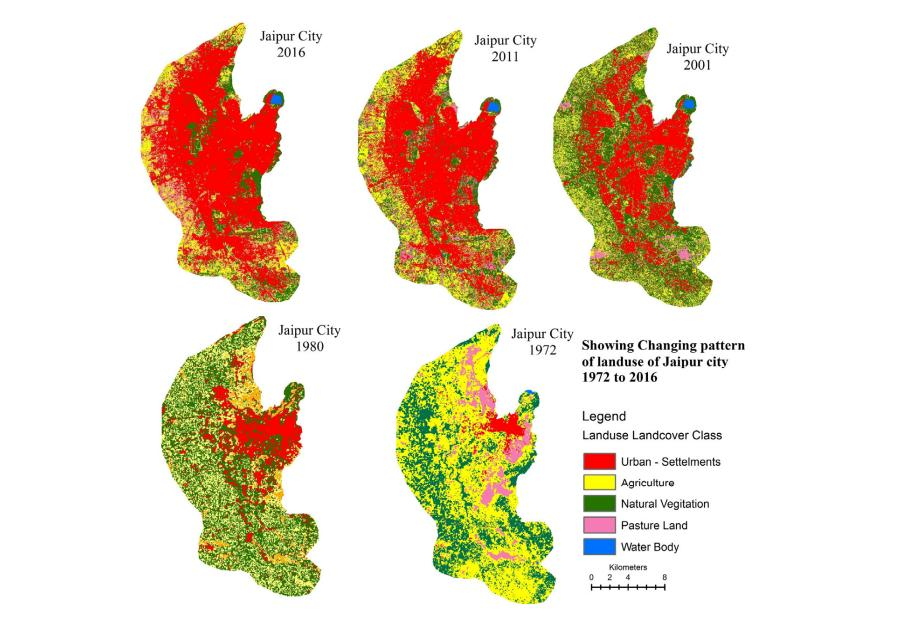
Jaipur's traditional water security rested on storage: talabs, kunds, and roughly 800 wells and stepwells that held rainwater and recharged the aquifer. Many have been filled, encroached, or turned into dumping grounds, and Rajamal ka Talab, which historically absorbed excess flow, no longer exists, a housing complex having risen on the marshy land. As storage disappeared and built-up area expanded, the ground's natural ability to absorb rain fell sharply. The same loss shows up on the supply side of the ledger: Jaipur now depends heavily on the Bisalpur dam some 150 km away, while local reservoirs such as Ramgarh, which once held enough water to host the 1982 Asian Games rowing events, have run dry. Flood and drought are two sides of the same coin, a city that cannot hold its monsoon is also a city that must import its drinking water.
3.4 Waste that clogs the system
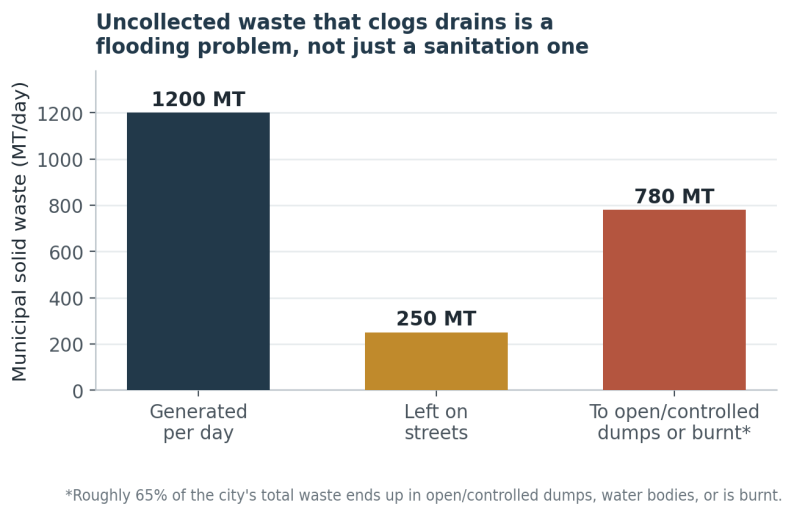
A drainage network is only as good as its weakest, most blocked channel. Jaipur generates about 1,200 tonnes of solid waste a day, of which roughly 250 tonnes is left uncollected on the streets, and an estimated 65% of the total ends up in open or controlled dumps, water bodies, or is burnt (Chhajer and Choudhary, n.d.). Much of the uncollected fraction washes into and lines the underground drains, cutting their effective capacity well before the rain arrives. Cost recovery in the solid-waste system is negligible, which starves the very collection function that would keep the drains clear. Solid-waste management is therefore not a separate civic issue from flooding, it is part of the flooding problem.
3.5 Sewage: the network cannot keep up
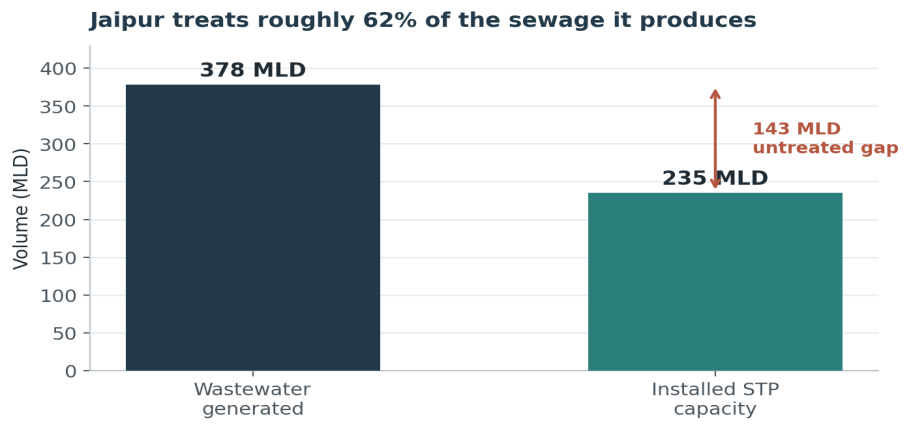
The same capacity gap runs through the wastewater system. Jaipur generates roughly 378 MLD of wastewater against installed treatment capacity of about 235 MLD, so only around 62% of the city's sewage can be treated, and the balance ends up in drains and water bodies (Chhajer and Choudhary, n.d.). The city's flagship response, the Dravyavati (Amanishah) rejuvenation, was designed to intercept and treat about 170 MLD, but its plants have reportedly been running well below that, on the order of 125 MLD, leaving both the treatment gap and the pollution load only partly addressed (Dainik Bhaskar, 2025). Untreated flow in the channels reduces their conveyance during storms and turns routine waterlogging into a public-health hazard.
3.6 The governance gap
Beneath the physical failures lies an institutional one. Responsibility for water in Jaipur is split across the Jaipur Development Authority, the municipal corporation, the Public Works Department and the Public Health Engineering Department, which continue to operate without structured coordination (Chhajer and Choudhary, n.d.). The instability is structural as well as operational, the municipal body was split into two corporations in 2019 and then merged again in 2025, disrupting accountability for basic services. Comprehensive planning has followed a similar pattern, the Master Development Plan 2025 was actually prepared back in 2011 (Jaipur Development Authority, n.d.) and successive drainage-investment proposals, ranging from about Rs 400 crore to over Rs 1,000 crore, have repeatedly failed to move efficiently from planning to execution. The result is an execution gap, the money and the plans exist on paper, but the outcome on the ground does not follow.
4. A Strategy: Build a City That Needs Less Drainage
The way forward is to restore the city's natural capacity to absorb and channel water, redesign urban space to retain rainfall, and strengthen the institutions that manage it, moving from a drainage-centric approach to an integrated blue-green strategy, in the spirit of the sponge city model now applied across urban China (Chan et al., 2018). Four lines of action, done together and resting on a shared governance-and-finance foundation, make up that strategy.
4.1 Govern drainage by catchment
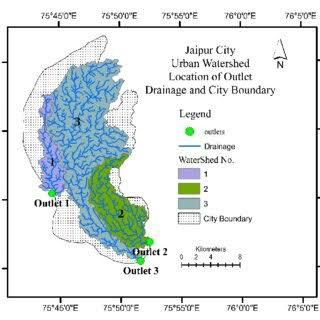
Rather than letting runoff drain into a single overwhelmed outlet, Jaipur should manage the runoff according to its natural drainage units, the Jhotwara River, the Amanishah Nallah / Dravyavati, the Ganda Nallah, the Jawahar Nallah, Nag Talai and the Dhundh River. The Ganda and Jawahar nallahs are tributaries that merge into the Amanishah before it joins the Dhundh (Jaipur Uncharted, n.d.; Nagar Nigam Jaipur, n.d.), so these are better treated as nested sub-catchments than as six independent basins. Catchment splitting isolates, manages and disposes of stormwater locally within each micro-zone, so that a failure in one part of the city does not cascade across all of it.
Two international comparators are instructive for different reasons. Singapore shows the value of single-agency accountability: its national water agency, PUB, manages the entire loop from stormwater capture through treatment to supply, with two-thirds of the island managed as catchment drained by some 8,000 km of drains and canals into 17 reservoirs (PUB, n.d.). Under its Active, Beautiful, Clean Waters programme, it divided the island into three catchments and appointed a dedicated consultant for each, matching design to local land use and topography (National Library Board). The transferable lesson is less about where boundaries are drawn than about who is answerable for each. Chennai shows how basin-wise delivery can be financed: it divided its drainage into four basins and pursued an integrated stormwater project basin by basin, the Kosasthalaiyar basin at roughly Rs 3,200 crore with Asian Development Bank support and the Kovalam basin at roughly Rs 1,700 crore with KfW funding, and in May 2025 added a Rs 200 crore municipal bond, rated AA+ and oversubscribed several times over (Greater Chennai Corporation, n.d.; Adyar Times, 2025). The lesson is that a basin approach is fundable, and that municipal bonds belong in the mix alongside multilateral and state money, not in place of it.
4.2 Capture rainfall where it falls
The volume and speed of runoff should be checked before it reaches the constrained drain network. Street-level interventions such as permeable surfaces, bio-swales, roadside recharge and rooftop harvesting should be rolled out across suitable parts of the city, which is feasible because Jaipur's alluvial plains in the Amanishah-Jawahar confluence zone can absorb and infiltrate water (Nagar Nigam Jaipur, n.d.).
Local feasibility has already been demonstrated. In 2012 the JDA built what was then India's only porous-asphalt parking lot, at Gandhi Nagar railway station, designed under Professor Prithvi Kandhal. Rainwater percolates through the surface into a 225 mm open-graded stone bed and infiltrates gradually into the soil, with an infiltration capacity of roughly 0.8 against about 0.3 for ordinary cropped land, at a cost some 18 to 32% above conventional surfacing. It performed well through two monsoons but the JDA then stopped maintaining it, and construction material stacked on the strip choked the surface (India Water Portal, 2015). This is the most directly relevant precedent in Jaipur's flood story, and it cuts both ways, the engineering worked, the custodial arrangement did not. Any scaling programme must therefore name the maintenance authority, the cleaning cycle and the budget line before the first square metre is laid.
4.3 Restore the city's natural buffers
Much of Jaipur's effective flood management already exists in its landscape and only needs to be recovered. Restoring the historic stepwells as decentralised retention and recharge basins, and protecting the surviving drainage network from further encroachment, revives a water-management tradition rather than replacing it with new infrastructure. Across India, stepwells that fell into disrepair as piped supply displaced them are now being treated as working recharge assets rather than heritage curiosities (BBC Future, 2021). Because restoration of urban water bodies and management of urban aquifers is an explicitly funded component of national urban water policy (Ministry of Housing and Urban Affairs, 2021), stepwell and pond rehabilitation is both the better-funded half of this strategy and the more straightforward place to begin, along with the added benefit of easing Jaipur's dependence on distant sources such as Bisalpur.
4.4 Reduce the load on central systems
Tackling solid waste and wastewater together relieves pressure on the centralised network. The unmanaged waste that washes into and clogs the drains should be intercepted through reliable street-level collection (Times of India, 2025b), while decentralised, neighbourhood-scale sewage treatment, for example, small plants sited in local parks that treat grey water for landscaping, can close part of the 143 MLD treatment gap without waiting for a single mega-plant.
The operational disconnect in large projects must also be resolved. The Dravyavati rejuvenation, awarded in 2016 to a Tata Projects-Shanghai Urban Construction Group consortium, with construction of about Rs 1,471 crore and ten-year operation and maintenance of about Rs 206 crore, for a combined value near Rs 1,677 crore over a 47.5 km corridor (Jaipur Development Authority, n.d.), listed flood mitigation among its objectives (Construction World, 2017). Yet it has been dogged by missed deadlines and payment disputes still being settled in 2025 (First India, 2025); tributary channels such as the Kartarpura nulla were left outside its scope, and it has not visibly reduced waterlogging in the catchment it drains. A scheme of that scale that does not reduce flooding where it matters is precisely the execution gap identified in this study. The fix is structural: link municipal stormwater networks to the central river corridor so that they actually function for flood control, and make one authority answerable for the outcome.
5. Governance and Finance: The Foundation
None of the four interventions above will hold without the foundation beneath them, which is where Jaipur has most consistently fallen short. Two things need to change.
Single, catchment-level accountability. The clearest lesson from Singapore is not a design choice but an organisational one: someone must be answerable for each catchment end to end. Jaipur should establish clear roles and shared accountability across the JDA, the municipal corporation, the PWD and the PHED, ideally through a standing water body or empowered cell that owns the full stormwater loop for each basin, sets and publishes performance targets, and is not dissolved with the next administrative reshuffle. Without this, isolated projects will keep being delivered into a system that no one owns.
A credible, blended financing mix. Jaipur should not rely on any single source. Municipal bonds, on the Chennai model, are a realistic addition for a corporation with a defined revenue base, but they work alongside and not instead of multilateral loans and state and national programmes. A caveat matters here: AMRUT 2.0 ran from 2021-22 to 2025-26 and concentrated its money on household water supply and sewerage, capping water-body rejuvenation at roughly 4% of project funds and green spaces at about 1% (Ministry of Housing and Urban Affairs, 2021). Permeable paving and blue-green works were never headline-funded items under the project. Jaipur should therefore plan around a successor mission cycle, state urban-development funds, disaster-mitigation funds, and the dedicated water-bodies window, and match each intervention to the source most likely to fund it, rather than assuming one scheme will cover everything.
The table below maps each problem to the intervention that addresses it, the precedent that shows it can work, and the most plausible way to pay for it.
Runoff overwhelms a single outlet: manage stormwater catchment by catchment under one authority, following the Singapore PUB and Chennai four-basin precedents, financed through a multilateral loan plus state funds plus a municipal bond.
Rain hits hard on impervious ground: roll out permeable surfaces, bio-swales and rooftop harvesting, following the Gandhi Nagar porous-asphalt pilot (2012), financed through state urban funds and a successor to AMRUT 2.0.
Lost storage and recharge: restore stepwells, ponds and the river corridor, following national stepwell restoration and the sponge-city model, financed through the AMRUT water-bodies window, an already-funded component.
Waste and sewage clog the network: street-level waste capture and decentralised sewage treatment plants, following the neighbourhood-park STP model, financed through the municipal budget and disaster-mitigation funds.
Plans stall before delivery: one accountable authority with published KPIs, following the single-agency accountability model of Singapore's PUB, a low-cost, high-leverage governance reform rather than a funded intervention.
6. Recommendation
For Jaipur, the recommendation is a targeted blue-green strategy that involves capturing, restoring, and reducing the load, governed catchment by catchment and financed through a blended mix, rather than another citywide drainage scheme announced and then left half-built. The city should first identify where flooding is deepest and longest-lasting, direct investment to where heavy rain, vulnerable neighbourhoods and weak existing protection overlap, and hold one authority answerable for the result. Every intervention should be judged by the same simple chain: investment, then reduced flood depth and duration, then people and assets protected, with priority to the measures that deliver the most resilience per rupee.
The objective for Jaipur should not be to build a bigger drainage system, but to build a city that needs less of one, by capturing water where it falls, restoring the spaces where it once flowed, and revitalising the institutions accountable for the outcome.
References
Adyar Times (2025) 'CM Stalin rings bell for Chennai Corporation's Rs 200 crore municipal bonds listing on NSE', 27 May. ANI (2026) 'Monsoon fever season in Jaipur: dengue, malaria and typhoid cases on the rise', 5 August. Asian Age (2017) 'Dravyavati: the river that disappeared', 28 May. BBC Future (2021) 'The ancient stepwells helping to curb India's water crisis', 13 October. Chan, F.K.S., Griffiths, J.A., Xu, S., Zhu, F., Tang, Y.-T., Xu, Y. and Thorne, C.R. (2018) '"Sponge City" in China, a breakthrough of planning and flood risk management in the urban context', Land Use Policy, 76, pp. 772-778. Chhajer, B. and Choudhary, S. (n.d.) Prevention of Drought and Urban Flooding through Governance and Finance: A Case Study of Jaipur, Rajasthan, India. Jaipur: Vivekananda Global University. Construction World (2017) 'The Dravyavati River Rejuvenation Project will help prevent flooding'. Dainik Bhaskar (2025) 'Capacity of five treatment plants is 170 MLD but only 125 MLD is being treated', July. Down to Earth (2026) 'Rajasthan's rains are rewriting desert records, with 154% excess rainfall by 10 June', 12 June. First India (2025) 'Dravyavati Project: JDA to pay Rs 100 cr to Tata Projects', 10 October. Greater Chennai Corporation (n.d.) Storm Water Drain Department. India Meteorological Department (2025) Rajasthan Monsoon Report 2025. Jaipur: Meteorological Centre. India Today (2018) 'Raje's pre-poll showcase', 30 July. India Water Portal (2015) 'Porous pavements to save concrete jungles!' Jaipur Development Authority (n.d.) Dravyavati River Project and Ongoing Projects. Jaipur: JDA. Jaipur Uncharted (n.d.) The City of Jaipur and its Traditional Water Systems. Ministry of Housing and Urban Affairs (2021) AMRUT 2.0 Operational Guidelines. New Delhi: Government of India. Nagar Nigam Jaipur (n.d.) City Profile. National Library Board (n.d.) 'Active, Beautiful, Clean Waters (ABC Waters) Programme', Singapore Infopedia. News on AIR (2024) 'Torrential rains in Rajasthan: Jaipur records 7 inches of rain, four dead', 1 August. Patrika (2025) 'Monsoon 2025 brings abundant rainfall to Jaipur', 11 September. Press Trust of India (2026) 'Heavy rain batters Rajasthan, Jaipur waterlogged; Kota Expressway tunnel shut', 12 August. PUB, Singapore's National Water Agency (n.d.) Stormwater Management. Times of India (2012) 'Drains neglected since '81: govt'. Times of India (2025a) 'Heavy rainfall causes damage and flooding in Jaipur division'. Times of India (2025b) 'Overflowing drains, sludge piles choke Jaipur streets'. Times of India (2026) 'Heavy rain cools Jaipur, floods roads and disrupts traffic'.