Solid Waste Management
Madurai Solid Waste Management: From Service Gaps to a Scalable Operating Model
October 6, 2026

Executive Summary
Walk down almost any street in Madurai and the story of its waste system is visible in a few small details: a bin that was there last year and is not there now, a pile of rubbish on a corner where nobody is supposed to dump, a sanitary worker with a hand cart and far too many houses to cover. It is a city of roughly 850 to 900 tonnes of solid waste a day, a major temple town, a regional trading hub and a growing education centre. Its waste system is under strain, and residents know it.
The numbers now back up the impression. A household survey by the Tamil Nadu Science Forum (TNSF), submitted to the Corporation in September 2026, found that only 44 per cent of respondents get daily doorstep collection, while 38 per cent wait more than two days. Press reports from June 2026 describe broken and removed bins, erratic pickup and open dumping, with a contractor and the Corporation blaming each other over a shortage of compactor vehicles.
The Corporation is responding. In July 2026, it announced AI-based monitoring of dumping hotspots, GPS tracking of vehicles and sanitation staff, and five new micro-composting centres to add to the 30 already running. At the 50-acre Vellaikal dump yard, it is pursuing a scientific landfill, waste-to-gas units and a waste-to-energy plant of up to 900 tonnes a day, backed by a proposal of roughly Rs 314 crore, plus a 100-tonne-a-day construction and demolition (C&D) waste plant.
All of this is sensible. The catch is the order in which things are happening. The city is investing at the back end (surveillance, processing, energy recovery) while the front end (a reliable pickup, a bin within reach, a worker with a manageable route, a contract that pays for results) is where residents experience failure and where most dumping starts. India's benchmark cities, Indore, Surat and Ambikapur among them, fixed the front end first and built everything else on it.
Why this matters to the city, and to anyone doing business in it
Waste is one of the few public services that every household judges daily. It shapes tourism and pilgrimage revenue, public health, property values and trust in local government. Reliable collection is also the precondition for every large investment the city is planning, from composting to waste-to-energy. Get the front end right and those investments perform. Get it wrong and they inherit a poor-quality, mixed waste stream.
This article sets out what is going wrong, what the Corporation is doing about it, what four Indian cities teach us, and a six-part action framework (Collect, Contain, Contract, Segregate, Process, Measure) with an illustrative business case and a phased roadmap.
1. The Problem: Failure Hides in Ordinary Operations
Cyclones and floods are visible, dramatic events. A weak waste system is different. The city keeps running while service quietly deteriorates, and the cost is absorbed into ordinary budgets and ordinary frustration instead of showing up as a single loss event.
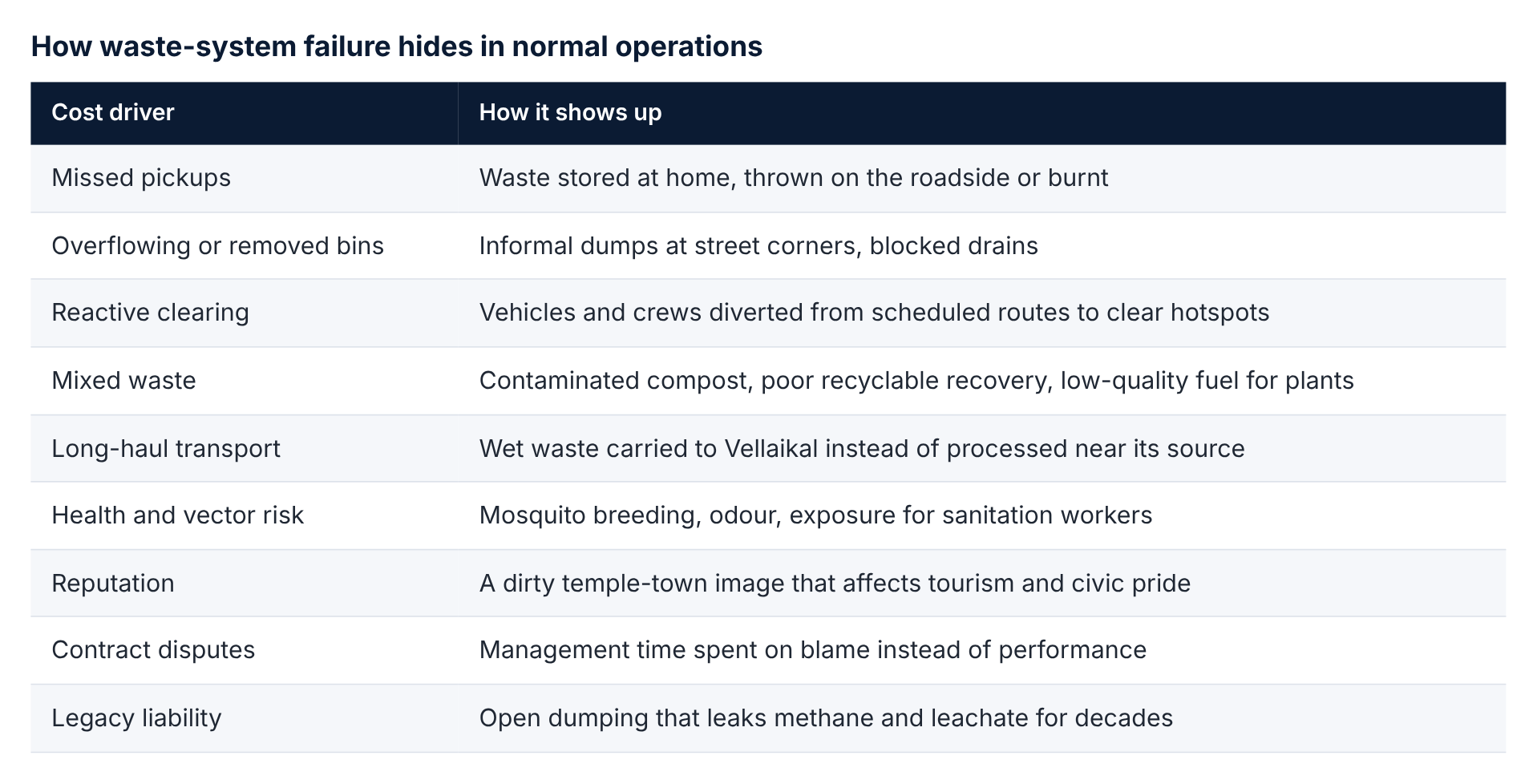
Not every ward bears all of these costs equally. That is the first lesson: the city needs ward-level data, not a single average.
2. Madurai at a Glance
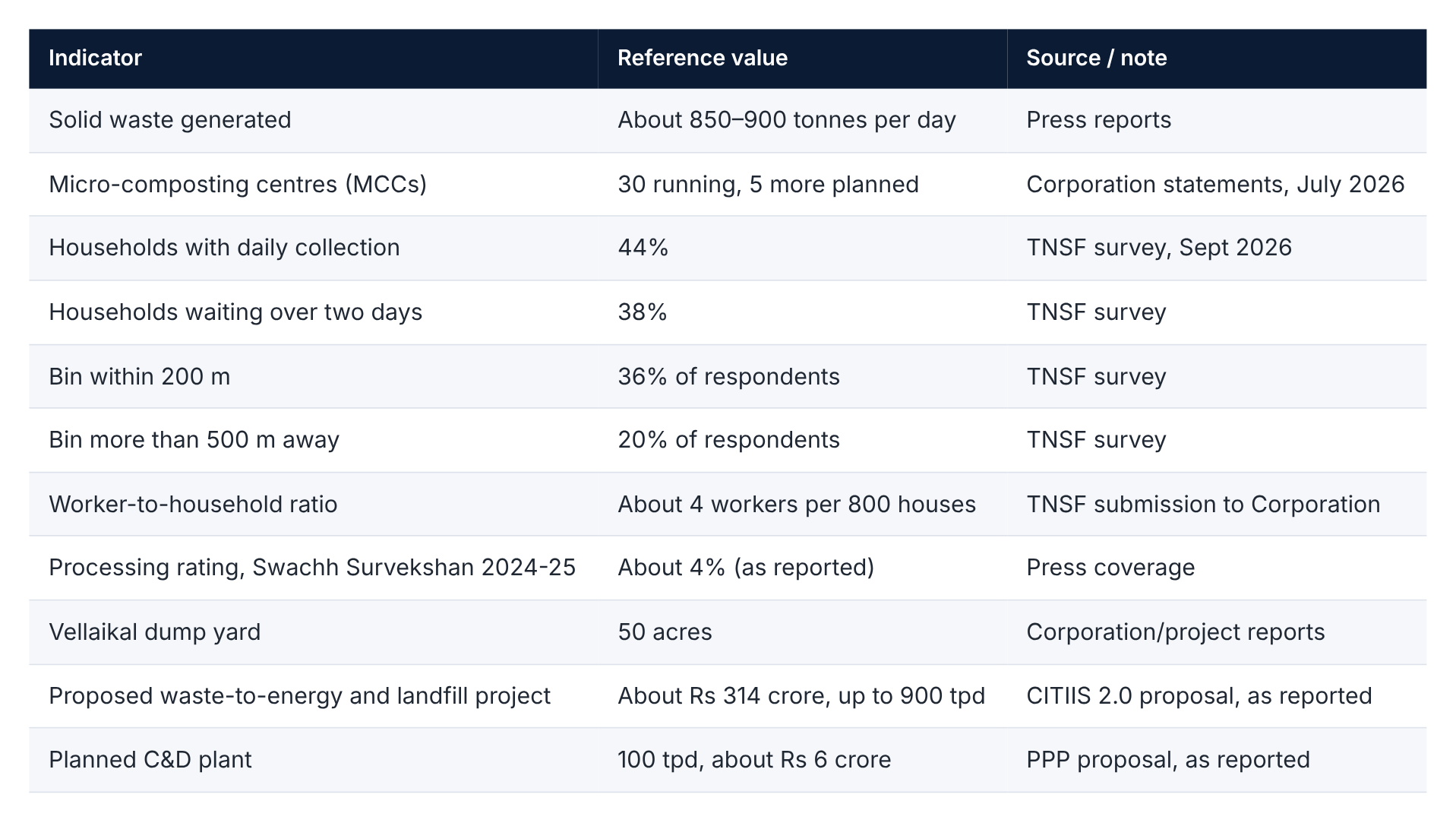
The Corporation administers the city through five zones. The 2011 census recorded a population of about one million, and today's service population is larger once commuters, students, pilgrims and tourists are counted. Older published descriptions of the system mention around 2,700 sanitary workers, hand carts and tricycles for primary collection, and a fleet of lorries, dumper placers and rented vehicles for secondary transport. Those system details should be verified against current records.
3. What the Household Data Says
The TNSF survey is the most concrete recent evidence. It is a civil-society survey, not an official audit, but its findings line up with what press coverage describes on the ground.
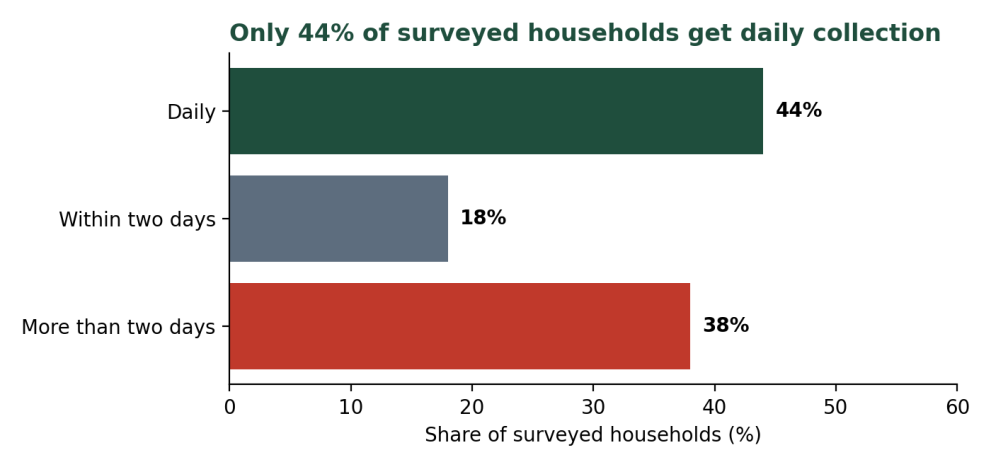
Exhibit 1. Collection frequency as reported by surveyed households (TNSF survey, September 2026).
Three things stand out.
Reliability is the headline gap. More than half of respondents do not get daily pickup. In a hot, humid climate, wet waste kept for two days becomes a smell, a pest problem and a strong reason to take it somewhere else.
Bin access is uneven. About a third of respondents live within 200 metres of a bin, while a fifth live more than 500 metres away. That is a long walk with a bag of rubbish, and many people will not make it.
Capacity is stretched. The survey team reports roughly four conservancy workers for 800 houses, or about 200 houses per worker. For segregated doorstep collection, with separate wet and dry streams, in narrow lanes and apartment blocks, that is a heavy load.
Business implication: A citywide average hides the real picture. Collection reliability, bin access and workload need to be measured ward by ward, because that is where contracts, routes and vehicles can actually be fixed.
4. From Missed Pickup to Open Dump: The Failure Chain
It helps to see the problem as a chain in which each link makes the next one worse.
Capacity gap. Crews, vehicles and routes are not matched to households and waste volumes.
Missed or late pickup. Households are left holding their waste.
Bin withdrawal. Public bins are removed in the name of a "bin-free" model that assumes reliable doorstep collection.
Informal dumping. With no pickup and no bin, the pavement or vacant plot becomes the bin.
Reactive clearing. Crews and compactors are pulled off scheduled routes to clear the mess.
More missed pickups. The routes that were skipped to clear hotspots generate the next round of complaints.
Blame and distrust. Residents blame the Corporation, the contractor blames a shortage of vehicles, and the system loses credibility.
The bin question deserves particular attention. Removing street bins is a sound idea in cities where every household gets dependable daily collection, because bins otherwise turn into mini-dumps. But in Madurai the two reforms appear to have been decoupled. Bins have been withdrawn in places where doorstep service is not yet dependable, and residents in affected areas have asked for them to be put back. A bin removed before the pickup is fixed does not end dumping. It just relocates it to a spot with no fixed point for a vehicle to service.
The same logic applies to the contractor dispute. Residents and officials say the contractor is falling short, while contract workers say the Corporation has not supplied enough compactors. Whoever is closer to the truth, a contract that cannot settle the question has no measurable baseline of vehicles, crews and routes against which to judge performance.
5. What the Corporation Is Already Doing
The Corporation deserves credit for tackling a problem many cities leave alone. Its July 2026 plan has three strands, alongside the Vellaikal projects.
AI-based surveillance. AI applied to CCTV footage will flag garbage-prone locations, and ten hotspots have been identified for closer monitoring. Dumping tends to recur at the same places, so detection plus quick clearance can break the pattern.
GPS tracking. Vehicles and sanitation staff will be tracked, which turns "did the truck come?" into a data point.
Decentralised composting. Five more MCCs will join the 30 already operating, on the logic that processing wet waste near where it is generated reduces haulage to the dump yard.
Vellaikal. A scientific landfill, waste-to-gas units and a waste-to-energy plant sized for up to 900 tonnes a day, plus a 100-tonne C&D plant that will convert debris into sand and paver blocks. Penalties of up to Rs 10,000 are already being imposed on illegal C&D dumping.
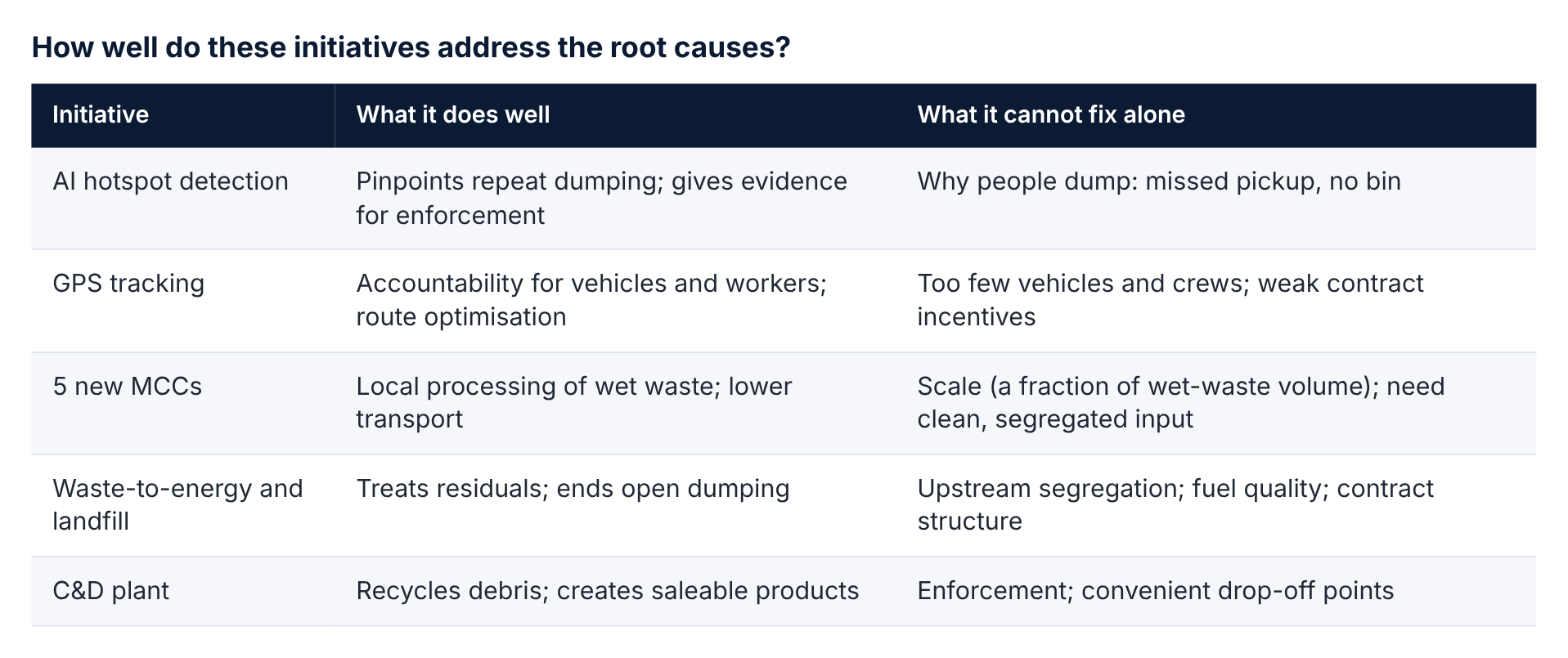
The pattern is clear. Each initiative is useful, and each depends on a working front end. A camera that catches dumping where no collection service exists produces fines that residents will see as unfair. A waste-to-energy plant fed with wet, mixed waste performs poorly and can become a financial burden.
6. Four Cities, Four Lessons
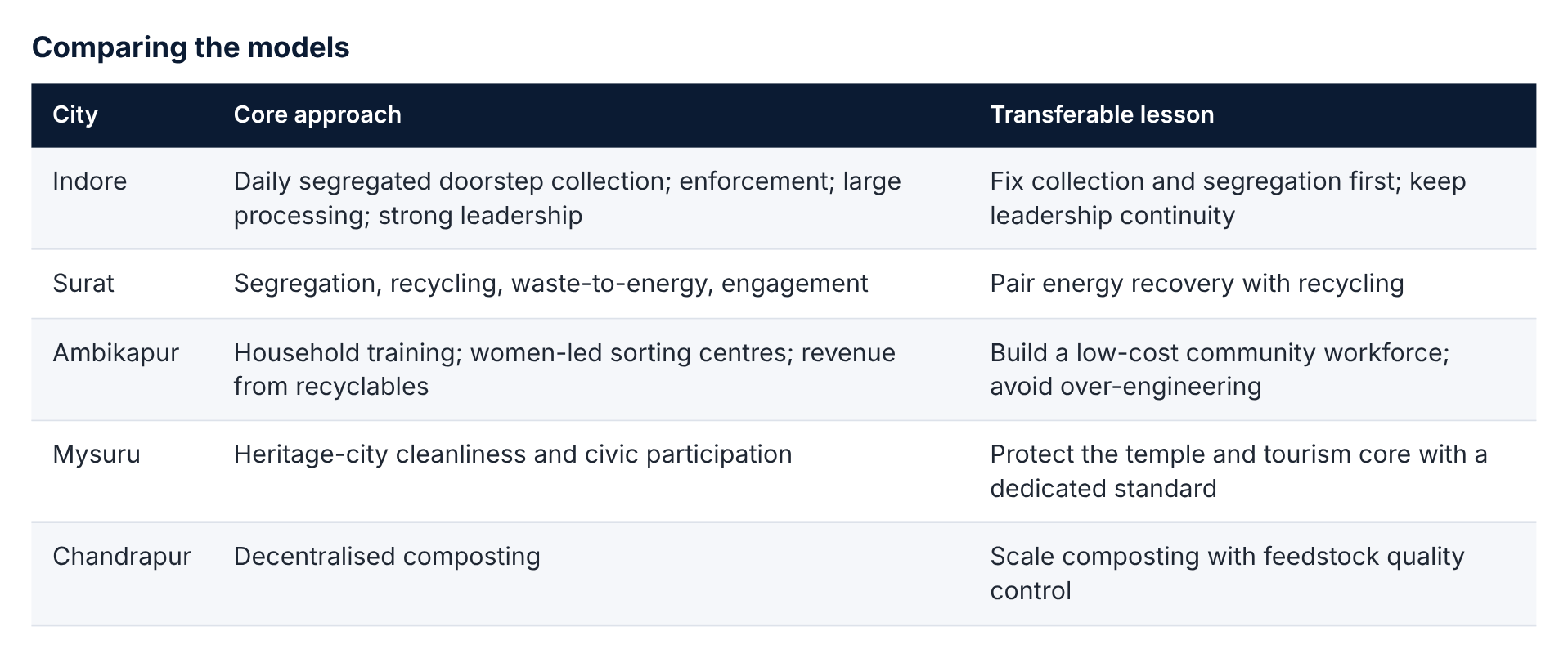
India has several cities that went from crisis to benchmark in a few years. None did it with technology alone.
6.1 Indore: discipline at the front end
Indore has topped the Swachh Survekshan rankings for several consecutive years. Before 2016 it faced the same problems as many cities: unhygienic conditions and processing that could not keep pace with waste generation. The turnaround combined daily doorstep collection with source segregation, vehicles with separate compartments, strict enforcement, sustained citizen engagement and a modern processing facility that cut landfill use. The city is also associated with a large bio-CNG plant that turns wet waste into fuel.
Application to Madurai. Indore's lesson is order of operations and continuity. Reliable segregated pickup and enforcement came first, and large processing capacity then had clean feedstock to work with. Madurai's waste-to-energy and composting plans will perform better if they follow the same sequence.
6.2 Ambikapur: the low-cost, women-led model
Ambikapur in Chhattisgarh is perhaps the most relevant benchmark for a mid-sized city on a limited budget. Every household is trained to separate organic and inorganic waste, a women-led Self Help Group sorts recyclables at decentralised centres, and recovered materials create income. Over nine years, the city reported collecting about 147,000 tonnes of waste, roughly 51,000 tonnes of it dry and 96,000 tonnes wet. The officer who led the programme has said the team studied Surat, Mysuru, Pune, Vellore and Bengaluru and deliberately avoided high-cost, high-tech solutions mid-sized cities cannot sustain. Its "garbage cafe", which trades plastic waste for meals, shows how a good incentive builds participation.
Application to Madurai. Madurai already has self-help groups in parts of its collection system. Building them into a proper sorting and material recovery network, with fair pay and clear contracts, is a practical way to add capacity without waiting for large capital projects.
6.3 Surat: recycling first, energy second
Surat is recognised for source-level segregation, strong recycling and waste-to-energy projects, backed by public engagement programmes.
Application to Madurai. Energy recovery works best at the end of a system in which recyclables and organics have already been separated. That is the right frame for the 900-tonne Vellaikal plant.
6.4 Mysuru and Chandrapur: heritage and decentralisation
Mysuru, a heritage and tourism city, is regularly cited for sustained cleanliness and civic participation. Chandrapur in Maharashtra has been recognised for processing biodegradable waste through decentralised composting points.
Application to Madurai. The temple core and tourist areas need a dedicated, visibly higher service standard, and composting points need quality control on what goes into them.
7. Where Is the Risk Highest?
The highest risks sit at the points where service failure is most visible or where poor sequencing can lock the city into costly choices: unreliable collection, weak workforce and contract capacity, and large infrastructure committed before the waste stream is ready.
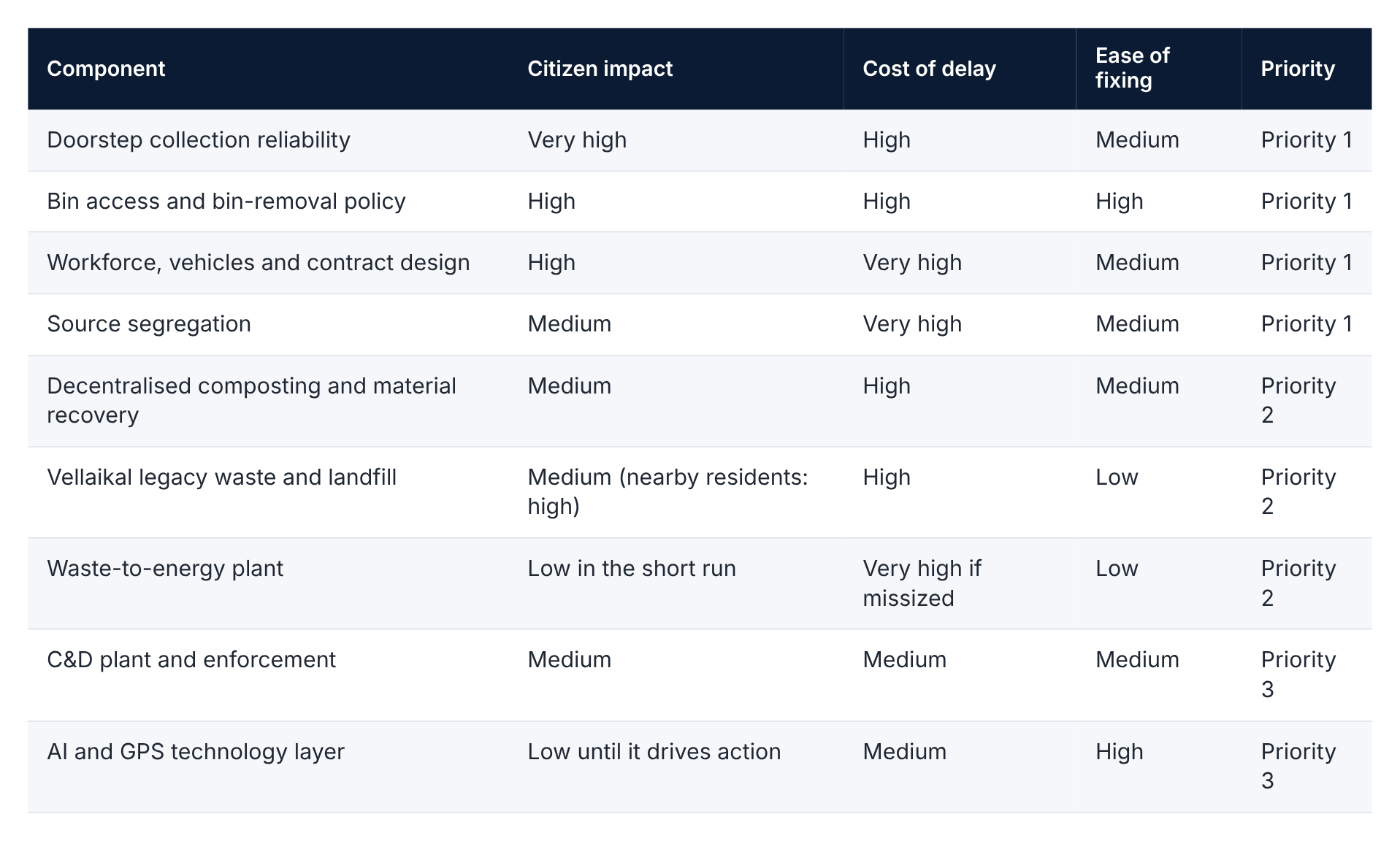
Three risks deserve particular attention: technology deployed without enough field capacity; contractor and Corporation responsibilities remaining unclear; and waste-to-energy infrastructure receiving poor-quality or insufficient feedstock. The mitigation is the same sequencing principle that runs through this article: strengthen the front end first, measure performance, and phase major capital commitments against verified waste flows.
8. A Six-Part Action Framework
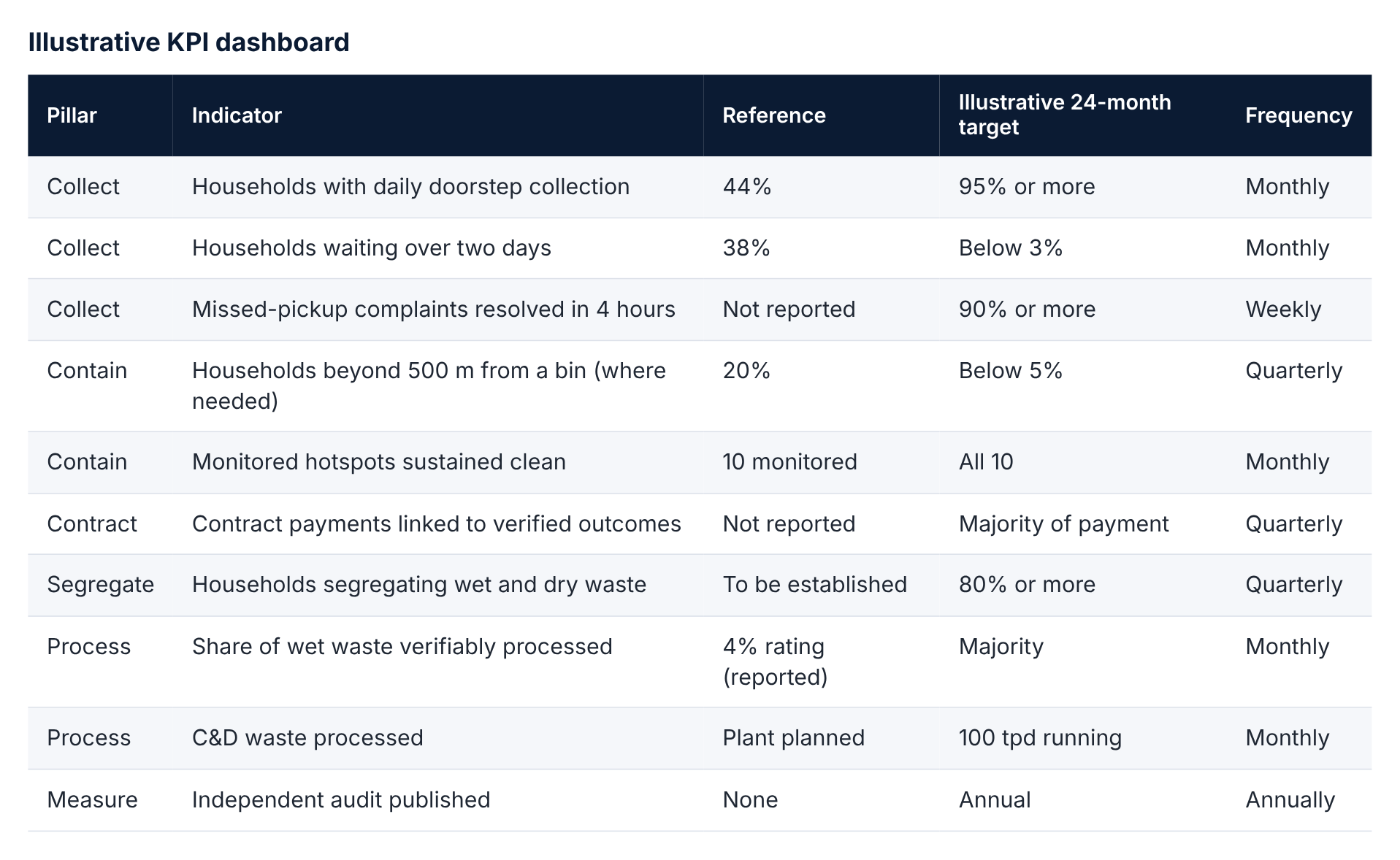
COLLECT. Make doorstep collection reliable, scheduled and verifiable. Audit every ward's households, routes, crews and vehicles. Publish a fixed collection time for every street, on ward boards and in a simple app or SMS service. Use GPS data to rebalance routes and detect skipped streets. Set a missed-pickup standard, for example re-collection within four hours of a complaint. Start with the old city, temple surroundings, markets and the most complaint-prone wards.
CONTAIN. Manage bins and collection points as a system. Adopt a rule that no bin is removed until a ward has shown a minimum period of reliable daily collection. Reinstate or replace bins where dumping has surged, with fixed lifting times. Set a maximum walking distance to a bin or collection point where one is needed, since a fifth of surveyed households are more than 500 metres away. Redesign the ten monitored hotspots physically (fencing, planting, community adoption) as well as watching them.
CONTRACT. Fix the workforce, vehicles and contract design. Move from roughly 200 households per worker to a workload standard that works for segregated collection, calibrated through the ward audit. Specify the number and type of compactors, light vehicles and e-tricycles per zone, and say clearly whether the Corporation or the contractor supplies them. Pay a significant share of the contract against verified results: households served on time, segregation compliance, bin clearance time and complaint resolution. Protect workers with fair wages, safety gear, health checks and social security, and bring informal waste pickers and self-help groups into the system. A joint operations desk where Corporation and contractor look at the same GPS and complaint data each morning replaces blame with problem-solving.
SEGREGATE. Make source segregation the norm. Distribute two-bin kits and scale the TNSF "Kuppai Nadai" garbage-walk campaign, which has run monthly for several months, to every ward. Train sanitation workers as segregation champions. Start with recognition and property-tax rebates for compliant resident associations and bulk generators, and introduce fines only once service is dependable. Require large generators such as hotels, marriage halls, hostels, markets and apartment complexes to compost or biomethanise on site. Involve schools and colleges.
PROCESS. Scale processing from the ward to Vellaikal. Commission the five new MCCs quickly and plan many more: if wet waste is roughly half to three-fifths of the total (an assumption pending a waste characterisation study), the city must handle 450 to 540 tonnes a day, far more than 35 small centres can absorb. Record inflows, compost output and sales at every MCC so processing is documented and the gap with the 4 per cent Swachh Survekshan rating can be explained. Build material recovery facilities for dry waste. At Vellaikal, remediate legacy waste, build an engineered landfill for residuals only, and phase the waste-to-energy plant with upstream segregation. Avoid rigid put-or-pay volume guarantees that penalise the city for diverting waste to composting and recycling. Pair the C&D plant with designated drop-off points and continued penalties.
MEASURE. Use technology to verify and publish, not to replace field capacity. Build a control room that combines GPS, CCTV hotspot alerts and complaints on one dashboard, with a defined response to each alert: clear the site, find the cause (missed pickup, no bin or deliberate dumping), then respond proportionately. Publish ward-wise performance monthly, hold monthly ward feedback meetings, and publish rules on CCTV data use and an appeals route for penalties. Commission an annual independent audit.
9. The Business Case: Illustrative Logic
There is no validated figure for what Madurai's current waste system costs the city in lost time, health impact, reputation and disposal expense. The right approach is to help each stakeholder (the Corporation, an operator, a lender, a corporate sponsor) calculate its own exposure. The worked example below is hypothetical, built only to show the calculation logic that a diagnostic would replace with real data.
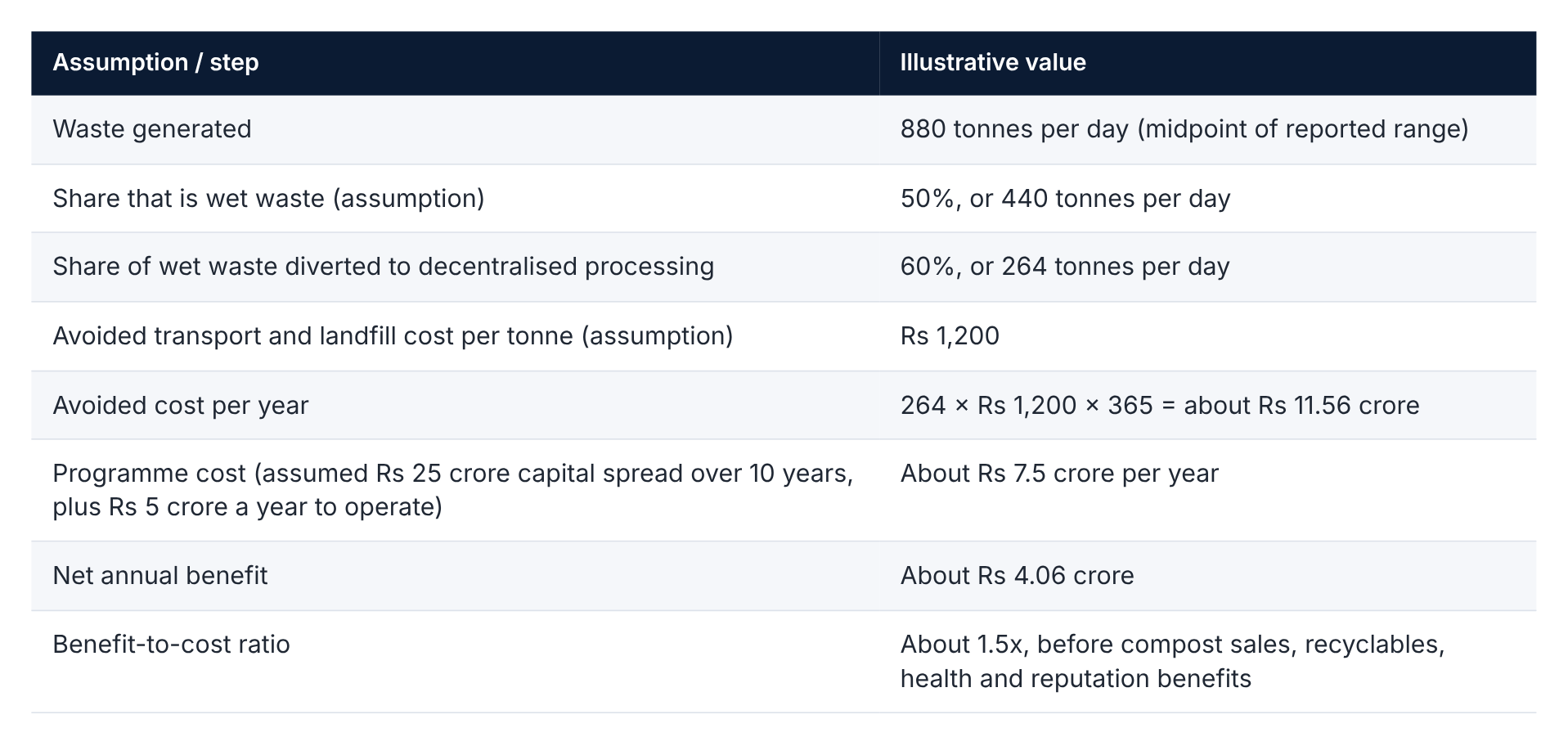
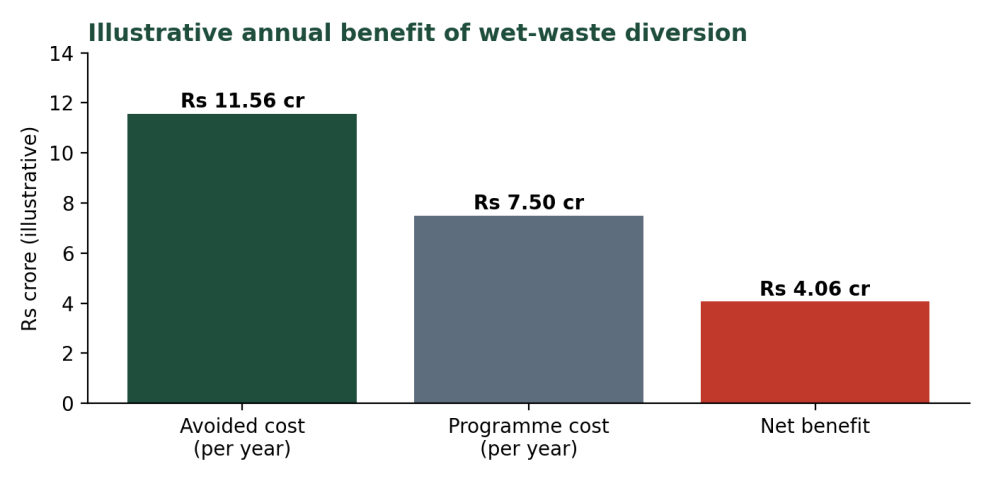
Exhibit 2. Illustrative annual benefit of diverting wet waste (hypothetical figures for illustration only).
The logic runs from volume to diversion to avoided cost to programme cost to net benefit. That chain is the deliverable, not the specific numbers. A real engagement would use measured waste composition, actual haulage and disposal costs, and verified operating costs. The case does not yet include the larger value at stake: avoiding a stranded waste-to-energy asset, protecting temple-town tourism, and reducing the health burden of open dumping.
10. Roadmap: From Quick Wins to a Benchmark City
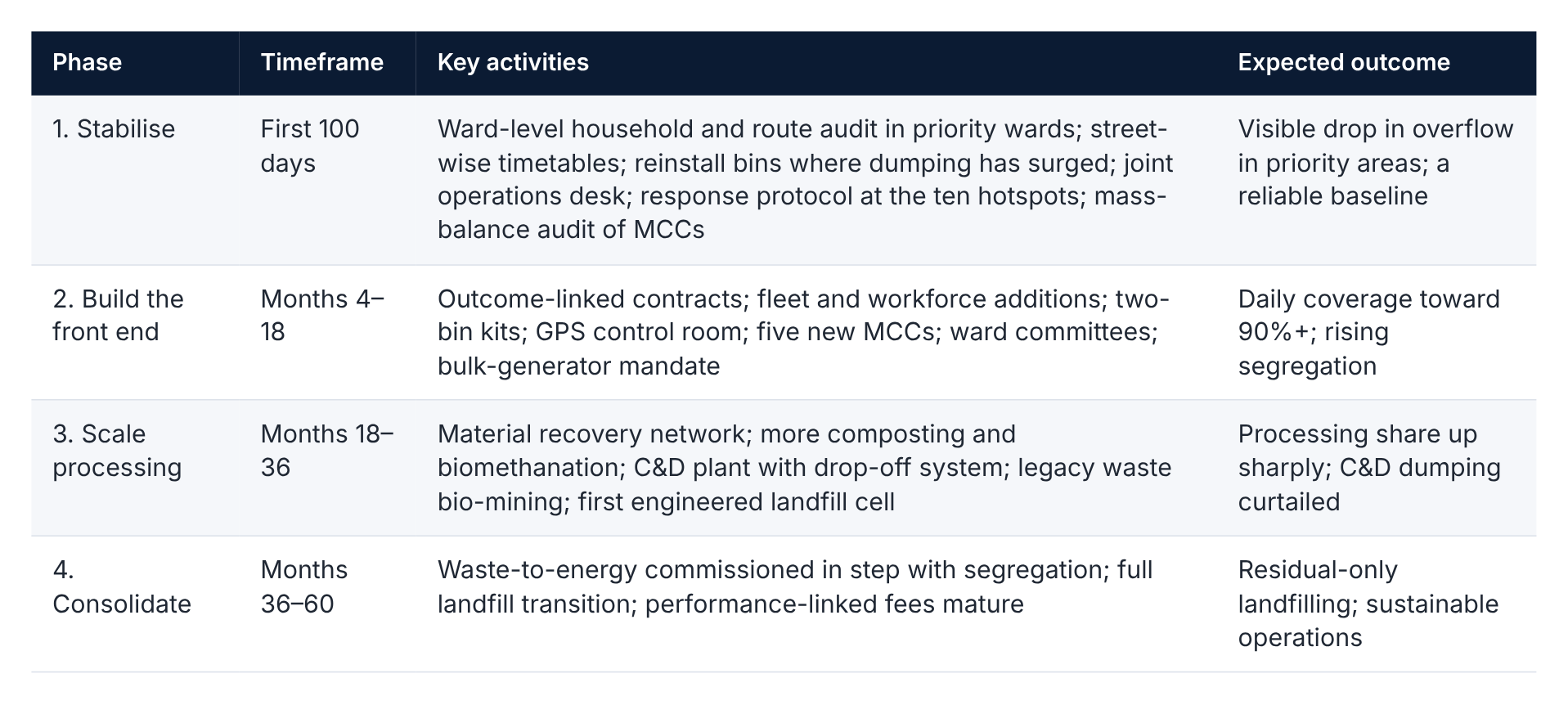
Each phase produces something concrete, from a baseline report to a verified pilot, so a Corporation, operator or funder can commission the work in stages.
The 100-day checklist
Name a senior officer accountable for each zone.
Start the household and route audit in the ten most complaint-prone wards.
Publish street-wise collection timetables.
Reinstall or replace bins where dumping surged after removal, with fixed lifting times.
Stand up a joint desk with the contractor and review GPS and complaints daily.
Issue a costed fleet-and-workforce gap note and decide who supplies what.
Audit all 30 MCCs and publish the results.
Activate monitoring at the ten hotspots with a documented response and a physical redesign of each site.
Hold the first ward feedback meetings and publish the minutes.
Launch a segregation drive in pilot wards with self-help groups, schools and civil society.
11. Key Takeaways
Collection reliability is the front line. With only 44 per cent of surveyed households getting daily pickup, it is the single most valuable metric to improve.
Sequence matters. Bin removal, surveillance and large plants have moved ahead of dependable doorstep service.
Bins and pickup are one system. Removing bins without reliable collection relocates dumping instead of ending it.
Contracts must pay for results. A dispute over vehicles and crews signals a contract with no measurable baseline.
Segregation is the foundation for processing. Composting, recycling and waste-to-energy all depend on clean input.
Waste-to-energy is the last link, not the first. Size and phase it to the waste stream the city will actually deliver, and avoid rigid volume guarantees.
Technology is an enforcement and transparency layer. It works when each alert has a defined response.
Publish the data. Ward-level reporting and an independent annual audit build the trust that any fee or penalty will need.
The Advisory Ask
For a city leader, an operator or a lender, Madurai's waste system is not a problem to have an opinion on. It is a system to help fix in the right order. The question is not whether the Corporation's plans are good. They largely are. The question is: where exactly is value being lost today, in missed pickups, dumping, mixed waste and long hauls, and which sequence of reforms closes that gap fastest, most credibly and most durably?
Selected Sources
Press reporting on broken bins, erratic doorstep collection and open dumping in Madurai, including the contractor and Corporation dispute over compactor vehicles (June 2026).
Press and trade coverage of the Madurai Corporation's strategic overhaul: AI hotspot detection, GPS tracking, ten monitored locations and five new micro-composting centres (July 2026).
Lotus Times (Madurai), "Daily garbage collection is only 44% in Madurai city: Science Forum submits full survey report to Corporation (Part-1)", 26 September 2026.
Earth5R, "10 Cities Leading India's Waste Management Revolution", with supplementary case material on Indore and Ambikapur.
Madurai Corporation published description of its solid waste management system.
Trade press on the Vellaikal waste-to-energy project, the Rs 314 crore CITIIS 2.0 proposal, the Rs 375 crore package and the planned C&D plant.
Waste composition, cost and programme figures in the business case are assumptions to be replaced with measured data. Financial illustrations are hypothetical.