Urban Development Planning
India's E-Rickshaw Charging Problem: Where Should DISCOMs Invest to Legalise the Grid's Fastest-Growing Informal Economy
September 16, 2026

Client: Government of NCT of Delhi, Power Department and Transport Department, in coordination with Delhi's DISCOMs (BSES Rajdhani, BSES Yamuna, Tata Power Delhi Distribution)
Engagement: Advise the Government of Delhi on a policy and pilot pathway to legalise informal two- and three-wheeler charging in dense urban neighbourhoods
Key Decision: Should the Government of Delhi direct its DISCOMs to pilot a transformer-aware micro-charging network, and if so, what government action is needed to launch it within one budget cycle
~1.2 lakh e-rickshaws are registered in Delhi, with total fleet estimates including unregistered vehicles running closer to 1.6 lakh
Rs 120 to 200 crore estimated annual DISCOM revenue loss in Delhi attributed to e-rickshaw power theft, depending on the year and source
Rs 0 grants released so far under PM E-DRIVE's Rs 2,000 crore public charging infrastructure allocation, as of November 2025
Executive Summary
This case study is written for the Government of Delhi's Power and Transport Departments, to inform a decision that currently sits with government, not with any single DISCOM: whether to direct a pilot that would let e-rickshaws charge legally in the neighbourhoods where nearly all of today's illegal charging is concentrated.
Delhi's e-rickshaw fleet has grown to an estimated 1.2 to 1.6 lakh vehicles, and a large share of them charge outside the formal electricity system. Drivers commonly pay local operators a daily fee, reported at anywhere from Rs 70 to Rs 300 depending on the year and neighbourhood, to plug into unmetered setups, at times up to 50 vehicles from a single illegal connection. DISCOM officials have estimated the resulting citywide loss at Rs 120 to 200 crore a year across different assessments. The risk is not only financial. Exposed wiring at these informal charging points has caused fatal electrocutions and fires, including of bystanders, particularly during the monsoon.
This case study argues that the barrier to fixing this is not political will or an absence of regulation. The Central Electricity Authority already requires dynamic load balancing for charging installations above a threshold load. PM E-DRIVE has already allocated Rs 2,000 crore nationally for public charging infrastructure. What is missing is not government intent but a government-directed mechanism: the one input that would let a DISCOM approve legal neighbourhood charging with confidence is real-time visibility into how much spare capacity a local transformer actually has, and no DISCOM will build that on its own initiative without a government mandate and a funding pathway to do so.
Our recommendation to government is direct. The Power Department should direct one DISCOM to run a defined pilot: a Transformer-Aware Neighbourhood Charging Network, combining low-cost transformer capacity monitoring with software-managed, shop-hosted micro-charging points for e-rickshaws. Modelled on real Delhi grid data and current hardware pricing, a single-neighbourhood pilot covering roughly 200 e-rickshaws is projected to pay back its Rs 5.42 lakh hardware cost in four to eighteen months depending on how quickly drivers migrate from informal operators, using funding already allocated under PM E-DRIVE and RDSS rather than requiring a new budget line.
1. The Challenge
The informal e-rickshaw charging economy has not emerged from neglect. It has emerged because no legal option exists at the scale most drivers operate at.
Illegal charging is organised rather than incidental. DISCOM assessments describe charging yards where up to 50 e-rickshaws plug in at once, run as an organised local operation, with drivers paying a daily fee for access. Discoms and police have identified the highest-theft clusters as Sangam Vihar, Kalkaji, Tughlakabad, Sarai Kale Khan, Seelampur, Yamuna Vihar, Shastri Park and Karawal Nagar. This is not a handful of opportunistic connections. It is a parallel, unbilled distribution network operating alongside the formal grid.
DISCOMs bear the cost directly. A BSES official has put the loss at Rs 14 to 18 crore a month in one assessment, or roughly Rs 170 to 200 crore annually, while more recent 2025 estimates from discoms and police cite a citywide figure closer to Rs 120 crore a year. These figures come from internal DISCOM assessments reported in the press and have not been independently audited; at least one outlet has explicitly noted the claim could not be verified. They should be treated as directional estimates rather than confirmed data.
No fixed address means no legal pathway. A driver without a registered shop or private parking has no straightforward way to apply for a sanctioned electricity connection in their own name. An apartment complex or a restaurant can apply for a load increase, pay for a proper meter, and be billed correctly. E-rickshaw drivers are structurally excluded from this process, not through policy hostility, but because the process was designed for fixed, formal premises.
The safety cost is documented and severe. In August 2024, a seven-year-old child died in northwest Delhi after coming into contact with a live wire at an unauthorised charging station near a public toilet. Weeks later, an e-rickshaw driver died from electrocution while charging his own vehicle. In May 2025, two teenagers were killed in a fire at an e-rickshaw charging and parking shed in Shahdara.
Weak local grids compound the problem in smaller towns. Even where a legal connection is attempted, semi-urban and rural grids are often too weak to support standard fast chargers, leading DISCOMs to default to refusal rather than risk overloading a transformer whose real-time headroom is not being measured.
Funding exists but is not reaching the ground. As of 23 November 2025, PM E-DRIVE had set aside Rs 2,000 crore for public charging infrastructure nationally, but no grants had yet been released for installing these facilities, with only two oil marketing companies having submitted proposals. Separately, under the national RDSS smart-metering programme, 52.53 lakh distribution transformers have been sanctioned for smart metering, yet only about 3 percent were reported as actually communicating as of early 2025. This points to an execution and design gap rather than a lack of funding.
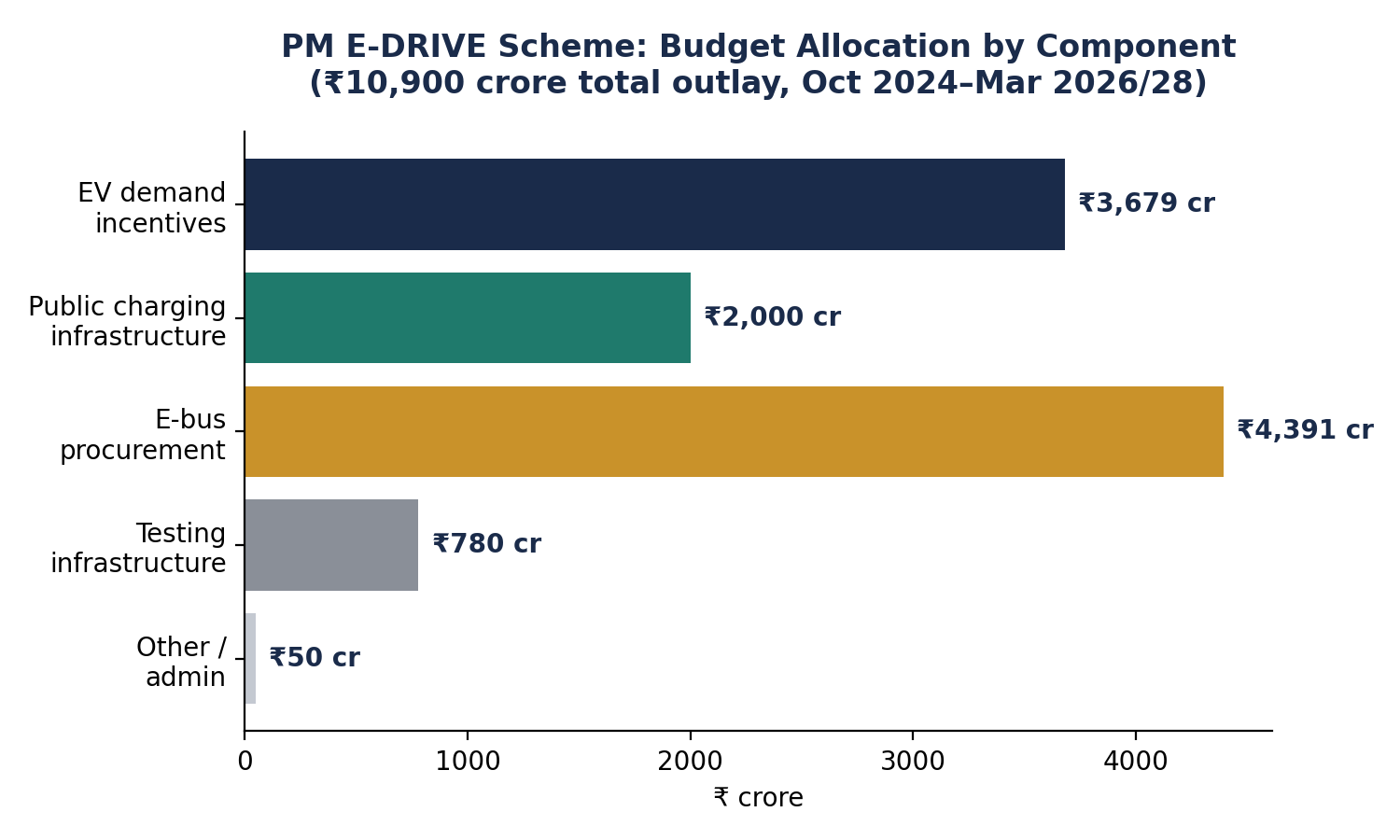
Of PM E-DRIVE's Rs 10,900 crore total outlay: Rs 3,679 crore funds vehicle demand incentives, Rs 2,000 crore funds public charging infrastructure, Rs 4,391 crore funds e-bus procurement, and the remainder covers testing infrastructure and administration.
Taken together, this is a systems gap rather than a problem of individual behaviour. A fast-growing, low-income mobility segment sits outside a legal and infrastructure pathway that was never built to accommodate it, on top of a grid whose local capacity is invisible to the body that would need to approve a fix.
2. The Core Problem and Strategic Questions
The task is not to intensify enforcement. Past crackdowns have not stopped the practice, and removing an informal option without a legal alternative tends to push drivers toward less visible, more dangerous setups. The questions that matter are:
Where are the neighbourhoods with the highest concentration of informal charging combined with local transformers that could plausibly support a legal alternative.
Why does legalisation appear easier in some areas than others, based on grid capacity, driver density and available host sites.
What technical and commercial model allows small, distributed charging points to operate without overloading local infrastructure.
How much would a pilot cost relative to the revenue currently being lost.
When is a realistic sequence from pilot to citywide rollout.
3. Diagnosing the Opportunity: A Neighbourhood Readiness Score
Rather than a citywide rollout, we propose a Neighbourhood Charging Readiness Index built from data DISCOMs already hold in part:
Readiness = 0.30 (E-Rickshaw Density) + 0.25 (Transformer Headroom) + 0.20 (Theft Intensity) + 0.15 (Host-Site Availability) + 0.10 (Safety Incident History)
E-Rickshaw Density reflects population and vehicle concentration. Sangam Vihar has a population density of roughly 24,600 people per square kilometre, while the North East Delhi district that contains Seelampur runs even higher, at roughly 36,000 people per square kilometre.
Transformer Headroom reflects spare load capacity on the nearest distribution transformer, measured through low-cost monitoring hardware.
Theft Intensity reflects the concentration of known or suspected illegal charging points.
Host-Site Availability reflects the density of shops, tea stalls and auto stands willing to host a micro-charging unit.
Safety Incident History reflects recorded electrocutions, fires and near-misses at known charging clusters.
On this construct, neighbourhoods like Sangam Vihar and Seelampur score high on density, theft intensity and incident history. The one input that cannot currently be scored at all is transformer headroom, since no DISCOM is measuring it in real time at this scale. Closing that measurement gap is what turns this from a scoring exercise on paper into a system that can actually be acted on.
The weights above are illustrative starting values, not derived from calibrated data, and the pilot's first job is to test how sensitive the resulting priority ranking is to them.
4. The Solution: A Transformer-Aware Neighbourhood Charging Network
The system has two technical components. The first senses the constraint. The second manages demand against it. Neither is new science. The innovation is applying both together, at small scale, to a segment of the grid that has never had this kind of instrumentation before.
4.1 Transformer capacity monitoring
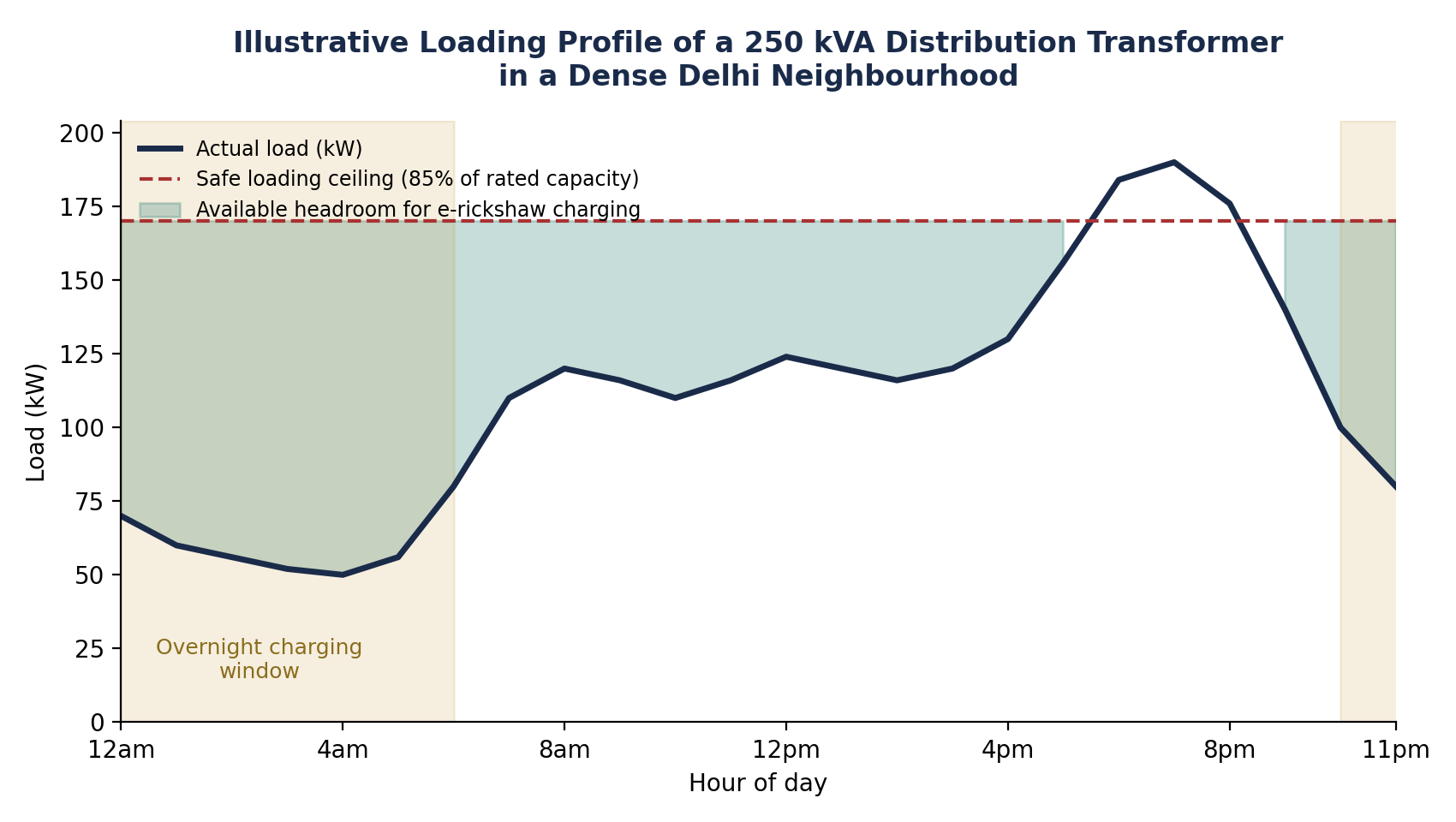
Dense Delhi neighbourhoods are typically served by 250 kVA, 400 kVA or 630 kVA distribution transformers. Engineering guidance recommends keeping a transformer below roughly 85 percent of its rated capacity. A 2024 study conducted with BSES on 50 overloaded Delhi transformers found that most of them exceed 90 percent of capacity for less than 5 percent of the year, concentrated in late-evening summer hours.
This matters because e-rickshaws charge overnight, typically for six to seven hours, which is exactly when residential and commercial demand on the same transformer falls furthest from its peak. The chart below illustrates this pattern for a typical 250 kVA transformer: a wide band of spare capacity opens up overnight, precisely during the hours e-rickshaws need to charge, while the transformer runs close to its safe ceiling only in the early evening
The proposed device is a current and voltage sensor, clamped onto the transformer's low-tension output lines. It measures load in real time and calculates spare headroom against the transformer's rated capacity. Devices of this kind are commercially available in India today at roughly Rs 10,000 to Rs 23,000 per unit.
The output of this component is a single, continuously updating number for each monitored transformer: how many additional kilowatts it can safely carry right now.
4.2 Software-managed charging points
Each e-rickshaw charging point draws a modest, well-defined load. A standard e-rickshaw charger in India is rated at roughly 750 to 900 watts of output, drawing approximately 1 kilowatt from the AC mains after accounting for charger losses. A shop hosting six to eight e-rickshaws overnight therefore presents a combined load of only 6 to 8 kilowatts.
Each charging point is fitted with a smart controller that can remotely switch the connection on, off, or into a slower trickle mode. Smart controllers of this kind, rated for roughly 3.3 kilowatts and OCPP-compatible, are already sold in India in the range of Rs 12,000 to Rs 18,000 per unit.
A central software system continuously compares the live headroom reported by the monitoring device against the combined draw requested by every connected charging point, and staggers or slows charging automatically to stay within safe limits.
4.3 Why this is a new operating model, not a new technology
Neither component here is new science. Transformer monitoring, smart EV charging controllers, and load-balancing software all exist and are commercially deployed in India today. BSES Yamuna's 2022 pilot with Fortum in Mayur Vihar managed a combined 112 kilowatts of demand across five charging points. A separate pilot by eDRV, BSES Yamuna and CEEW measured a roughly 13 percent cost saving from shifting e-rickshaw charging to off-peak hours.
What our research did not find is a documented deployment that connects transformer-level sensing with shop-hosted, software-managed charging specifically to legalise scattered, informal e-rickshaw charging. The more defensible way to describe the contribution here is not a new sensor or algorithm, but a new operating model: a DISCOM-anchored neighbourhood charging network combining existing technologies with a legal metering and revenue-sharing structure designed specifically for drivers who have no fixed premises to hold a connection under their own name.
5. Strategic Options
Transformer-aware pilot performs best across every criterion that matters:
Addresses root cause: enforcement-only is low, grid upgrades everywhere is high, a transformer-aware pilot is very high, no intervention is very low
Cost to implement: enforcement is medium, blanket grid upgrades are very high, a transformer-aware pilot is medium
Speed to first result: grid upgrades are slow, a transformer-aware pilot is fast
Revenue recovery for DISCOM: highest under a transformer-aware pilot
Scalability: highest under a transformer-aware pilot, lowest under enforcement or blanket upgrades
Enforcement-only approaches address the symptom rather than the missing legal pathway. Blanket grid upgrades work everywhere but are capital-intensive and slow. A targeted, transformer-aware pilot offers the strongest combination of cost, speed and revenue recovery, with grid upgrades reserved for neighbourhoods that genuinely need them once transformer data confirms it.
6. The Investment Case
PM E-DRIVE has allocated Rs 2,000 crore nationally for public charging infrastructure. As of November 2025, Rs 1,634.62 crore in subsidies had been disbursed under PM E-DRIVE overall, but none of the charging-infrastructure grants had been released. Delhi's own EV policy has separately offered grants of up to Rs 6,000 per charging point.
Delhi's DISCOMs already bill EV and e-rickshaw charging at a dedicated tariff of Rs 4.50 per kilowatt-hour, one of the lowest EV charging rates in India. A legal full charge costs a driver roughly Rs 50, compared with the Rs 70 to Rs 300 a day currently paid to informal operators.
A worked single-cluster example: Consider a modelled neighbourhood cluster of 200 e-rickshaws currently charging illegally, each consuming roughly 8 units of electricity a day across 300 charging days a year, for a combined 480,000 unbilled units annually. Billed at Rs 4.50 per unit, that represents roughly Rs 21.6 lakh a year in gross electricity value that could move from stolen to billed. Instrumenting four transformers and installing 25 shop-hosted smart charging points comes to approximately Rs 5.42 lakh in one-time hardware cost, with a further Rs 84,000 a year in connectivity and software costs.
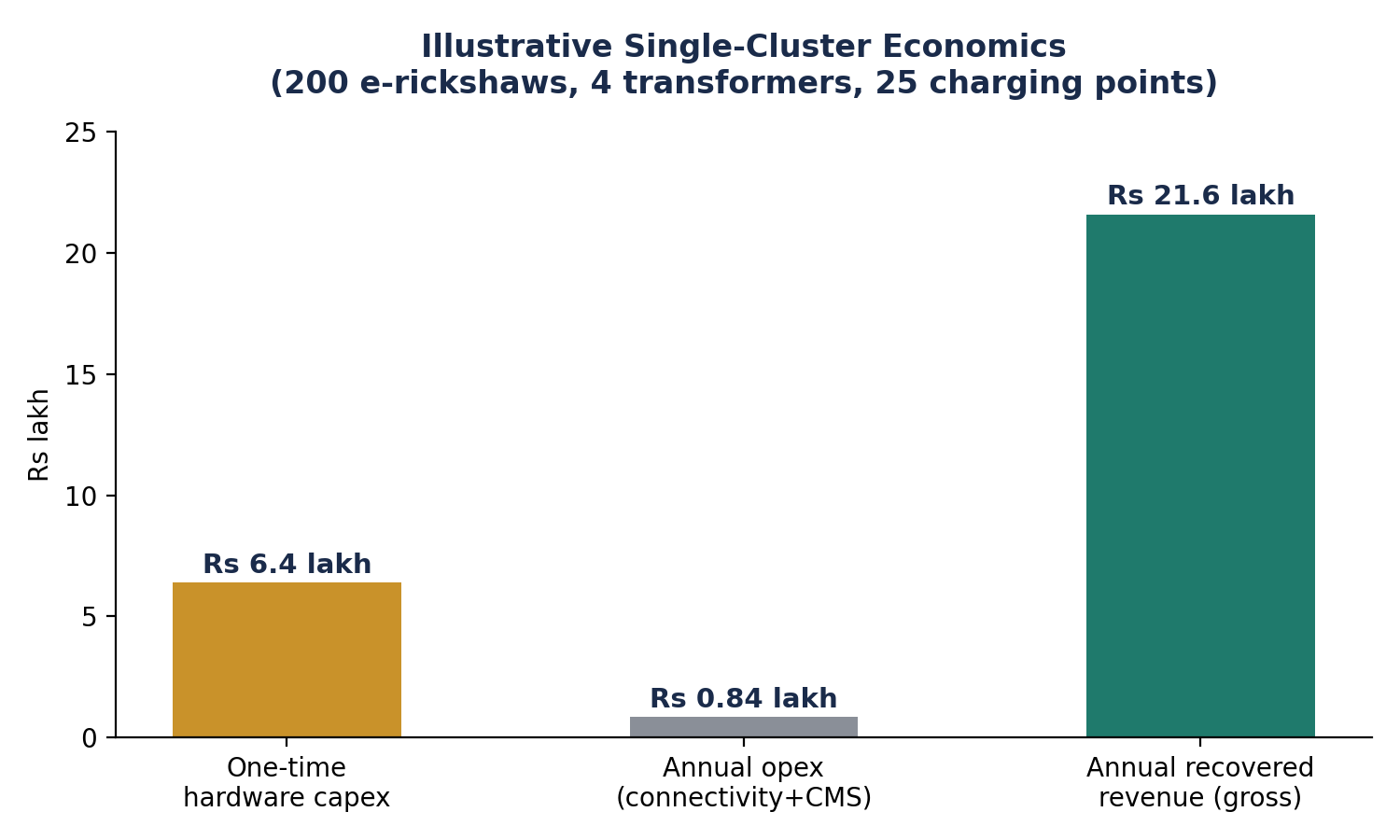
It is important to be precise about what this Rs 21.6 lakh figure represents: it is gross electricity value, not the DISCOM's net incremental benefit. The table below models this at four migration rates, using two illustrative assumptions the pilot must validate: a 15 percent revenue share paid to hosts, and a 3 percent billing and collection overhead.
At 25% driver migration: Rs 5.4 lakh gross value, Rs 3.59 lakh net after opex, payback in about 18 months
At 50% driver migration: Rs 10.8 lakh gross value, Rs 8.02 lakh net after opex, payback in about 8 months
At 75% driver migration: Rs 16.2 lakh gross value, Rs 12.44 lakh net after opex, payback in about 5 months
At 100% driver migration: Rs 21.6 lakh gross value, Rs 16.87 lakh net after opex, payback in about 4 months
The pilot remains attractive across a wide range of migration outcomes, even at a conservative 25 percent migration, payback stays under two years. The model is genuinely sensitive to the host revenue share and billing overhead assumptions, and should be rerun once real host negotiations happen.
Proposed ownership and commercial structure (a starting proposal, not a settled design):
DISCOM: owns the electricity connection and billing relationship; bills the driver at Rs 4.50/kWh
Technology operator: deploys and maintains the charging-point controllers and software; paid a fixed fee, modelled at Rs 84,000/year per cluster
Host shop or stand: provides the physical site; receives an illustrative 15% revenue share, roughly Rs 0.68 per kWh sold
E-rickshaw driver: pays roughly Rs 50 per full charge, replacing the Rs 70 to Rs 300 a day previously paid informally
This structure does not yet resolve who bears capital cost upfront, and that allocation should be one of the first commercial questions the pilot resolves.
The figures above exclude two further benefits: Tata Power Delhi Distribution's own transformer monitoring programme is associated with a fall in transformer failure rates from around 11 percent to under 1 percent, and every legalised connection removes a documented source of electrocution and fire risk.
Open commercial and regulatory questions the pilot must resolve: who signs the electricity connection for a shop-hosted charging point, who owns the sensor and charger hardware, exactly how the revenue share is structured, and what happens to the informal operators currently earning Rs 70 to Rs 300 a day, an existing, if illegal, micro-business a legal alternative would displace rather than simply replace.
7. Implementation Roadmap
Months 0 to 3, Map and Diagnose: Identify eight to ten candidate neighbourhoods using the Readiness Index, and install transformer monitoring hardware at the top-scoring sites to measure actual overnight headroom for 60 to 90 days.
Months 3 to 9, Pilot: Onboard 15 to 25 shop-hosted charging points in the highest-readiness neighbourhood, run the load-orchestration software live, and track uptime, revenue recovered and driver migration.
Months 9 to 18, Refine and Expand: Adjust the scoring and software based on pilot data, then expand to remaining named clusters in descending order of readiness.
Months 18 onward, Scale and Standardise: Package the model as a template other DISCOMs and states can adopt using their own PM E-DRIVE and RDSS allocations.
8. What Government Needs to Do, and Who Needs to Do It
Everything in this case study is actionable within powers government already has, and funding government has already allocated. It requires four specific actions:
The Power Department should issue a directive naming one DISCOM circle to run the pilot, and authorise a fast-tracked connection category for drivers without fixed premises.
DERC should confirm in writing that the existing Rs 4.50/kWh tariff applies to this pilot's shop-hosted connections.
The State EV Nodal Agency should coordinate the release of PM E-DRIVE's currently undisbursed Rs 2,000 crore allocation toward this pilot specifically.
The Transport Department should convene informal charging operators in the named theft clusters and offer a subset the opportunity to become the pilot's first authorised hosts.
Suggested timeline: A directive naming the pilot DISCOM and neighbourhood could be issued within one quarter, with fund release coordinated in parallel, so hardware procurement and the transformer monitoring window could begin within two quarters of a government decision to proceed. This pilot can begin within one budget cycle, using authority and funding that already exist.
9. Final Recommendation
The recommendation to government is not to build more charging infrastructure everywhere, and not to intensify enforcement against drivers who currently have no legal alternative. It is to direct one DISCOM to close the one input it presently lacks: real-time visibility into its own grid's spare capacity.
The constraint is not simply charger deployment. It is the absence of a scalable mechanism for DISCOMs to verify local transformer headroom, allocate it dynamically, and convert informal e-rickshaw charging into a metered service, and only government can direct that mechanism into existence. Acting on this could convert a meaningful share of an estimated Rs 120 to 200 crore annual loss into recovered public revenue, turn a dangerous informal economy into a metered and legal one, and give every other Indian state facing the same problem a government-tested template to follow.
Sources
DISCOM loss figures and illegal-charging estimates are drawn from press reporting citing DISCOM internal assessments, including BSES sources, spanning 2016 to 2025, and have not been independently audited. Registration figures, neighbourhood-level informal charging clusters, and electrocution and fire incident details are drawn from investigative reporting by Newslaundry, Rest of World, Scroll.in, Millennium Post and Deccan Herald. Transformer specifications and Delhi grid loading data are drawn from RMI's 2024 study conducted with BSES. Pilot data on the BSES Yamuna and Fortum load-balancing project, and the eDRV, BSES Yamuna and CEEW demand-side management pilot, are drawn from published project documentation. Hardware costs are drawn from current Indian retail listings and the REC Limited RDSS guidance note. PM E-DRIVE and RDSS figures are drawn from Lok Sabha replies and Prayas Energy Group's analysis, as of late 2025. The DERC tariff is drawn from published BSES and Tata Power Delhi Distribution tariff schedules.